

- Sku: SW4-SW0212
- Vendor: Squeaky's Aquatics
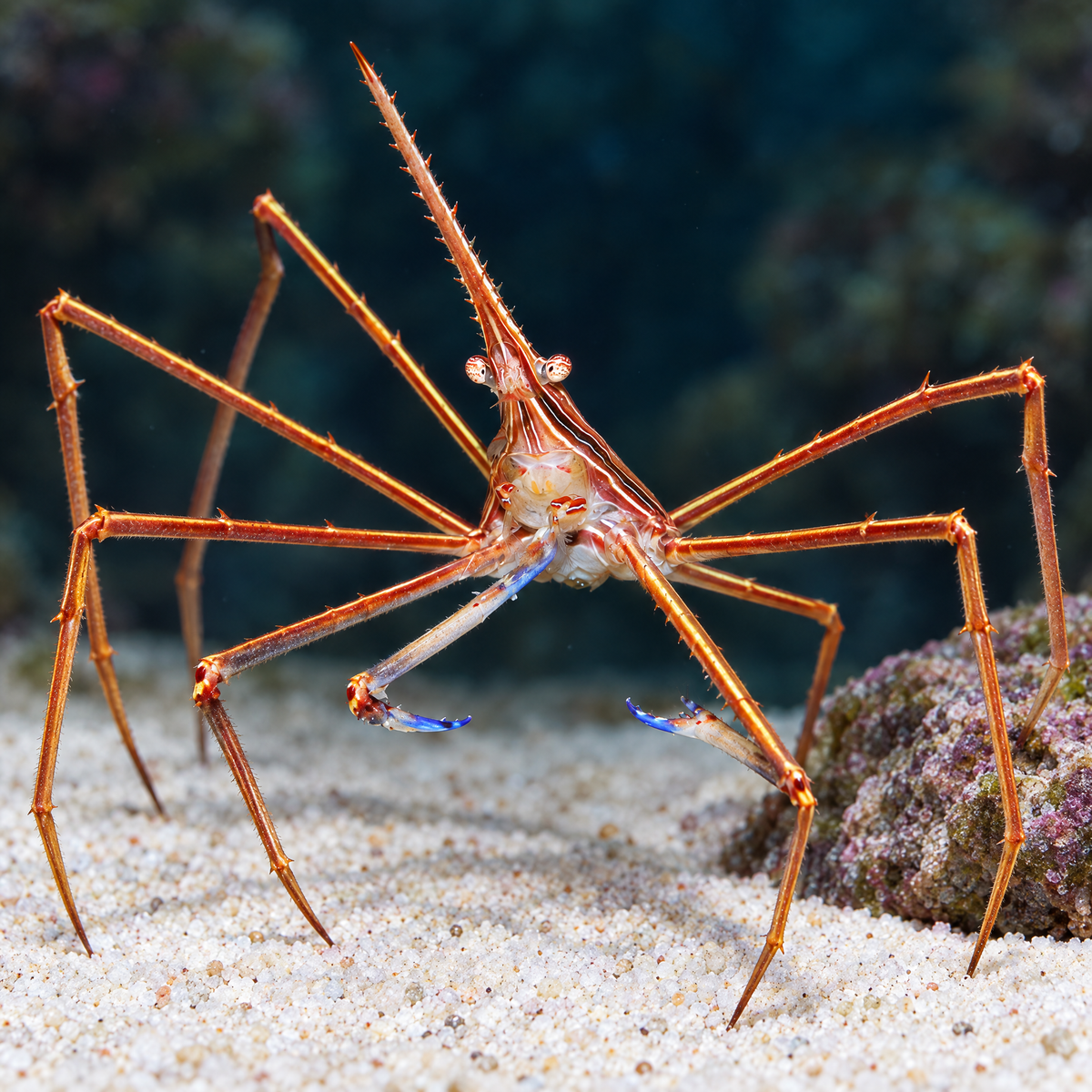
Arrow Crab (Stenorhynchus seticornis)
The Arrow Crab (Stenorhynchus seticornis) brings a striking silhouette to the aquarium, with a pointed body, fine stripes and exceptionally long legs. It searches rockwork for meaty leftovers and small worms, but its appetite makes it an intermediate-care, semi-aggressive choice that needs thoughtfully selected tankmates.
Explore our invertebrate collection and saltwater selection to compare animals that suit your aquarium.
Care Guide
- Give it room: We recommend an established aquarium of at least 30 gallons, with stable rockwork, crevices and space for its long legs. Keep one Arrow Crab per aquarium.
- Feed deliberately: Offer small portions of mysis, chopped marine seafood or suitable sinking foods. Make sure food reaches the crab; leftovers alone are not a feeding plan. Remove uneaten portions.
- Keep conditions steady: Check salinity and temperature regularly. Drip acclimate carefully to match your aquarium, maintaining temperature throughout the process.
- Avoid copper: Never expose the crab to copper medication. Check treatment labels for invertebrate safety before use.
- Respect molting: A shed shell can look like a dead crab. Check its hiding places before assuming a loss, and leave a healthy crab undisturbed while its new shell hardens.
Specifications
| Scientific name | Stenorhynchus seticornis |
| Common names | Arrow Crab, Yellowline Arrow Crab, Spider Crab |
| Origin | Western Atlantic and Caribbean |
| Care level | Intermediate: stable water and careful tankmate selection |
| Temperament | Semi-aggressive; opportunistic predator |
| Adult size | About 6 inches across the legs; allow room for larger specimens |
| Recommended aquarium | 30 gallons or larger with established rockwork |
| Reef compatibility | With caution; ornamental worms, crustaceans and coral polyps may be at risk |
| Diet | Meaty marine foods, sinking foods and small worms |
| Temperature | 72 to 78°F |
| Specific gravity | 1.023 to 1.025 |
| pH / alkalinity | 8.1 to 8.4 / 8 to 12 dKH |
| Sale unit | One crab; representative image, appearance varies |
Compatibility
Choose tankmates carefully. Small ornamental shrimp, feather dusters, other crabs and small or slow-moving fish can become prey. Coral polyps may also be picked at, particularly when food is scarce. Feeding well reduces hunger but does not guarantee compatibility.
Avoid crab-eating fish such as puffers, triggers, hawkfish and large predatory wrasses. Do not add an Arrow Crab to a tank simply to eliminate bristleworms; it can eat desirable worms too, and still needs feeding once easy prey is gone.
If algae grazing is your main goal, compare the Emerald Crab as a different option. This is an alternative to consider, not a recommendation to house both crabs together.
Recommended Foods & Supplies
- Ocean Nutrition Prime Reef Flake: a supplemental prepared food; make sure a portion reaches the crab and vary with meaty foods.
- Instant Ocean Aquarium Hydrometer: monitor specific gravity and avoid sudden salinity changes.
- Browse foods and nutrition for marine feeding options and water testing supplies for routine checks.
FAQ
Will it eat bristleworms?
It may eat small bristleworms, but results vary. Buy it because it fits your tank and you want to care for it, rather than as a guaranteed pest treatment.
Is it safe with corals and shrimp?
Use caution around corals and avoid vulnerable ornamental shrimp. This is a predator and scavenger, not a universally safe cleanup animal.
Can I keep more than one?
We recommend one per aquarium because Arrow Crabs can become territorial toward their own kind.
Does one purchase include one crab?
Yes. Each purchase is for one Arrow Crab. The image represents the species; size, markings and sex can vary.
Have a question?
Arrow Crab (Stenorhynchus seticornis)
