


- Sku: 1570759
- Vendor: Squeaky's Aquatics
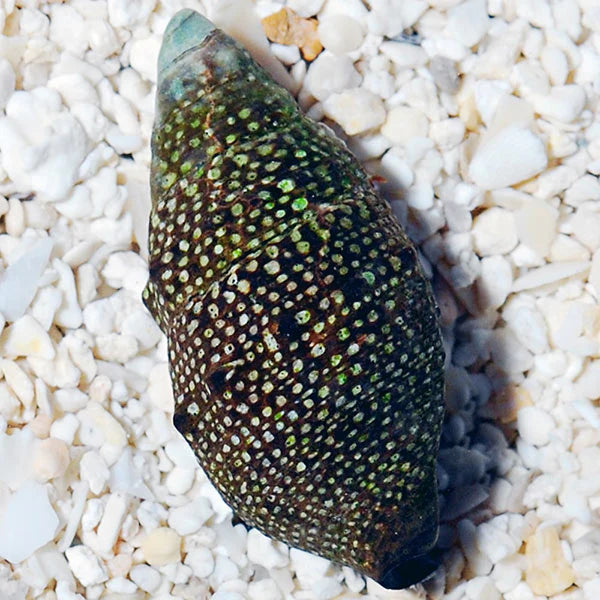
Cerith Snails (Cerithium spp.)
Cerith Snails (Cerithium spp.) are one of the most efficient cleanup crew species for marine and reef aquariums. They climb glass and rockwork during the day to graze film algae and diatoms, and burrow into the sand at night to turn substrate and consume detritus. Drop a few of these in any new reef and watch nuisance algae and uneaten food vanish. Pair with our other saltwater livestock for a complete cleanup crew.
Reef safe, peaceful, and inexpensive to dose in groups. They are a top pick for nano reefs and a must-have in any sand-bed system.
Care Guide
- Tank size: 10 gallons minimum. Larger systems benefit from groups.
- Stocking density: Roughly one Cerith per 1 to 2 gallons of display volume. A 30-gallon reef does well with 15 to 20 snails.
- Diet: Detritivore and grazer. They eat film algae, diatoms, cyanobacteria, and uneaten food. No supplemental feeding needed in established tanks; add a small piece of dried algae sheet if film growth is low.
- Sand bed: Best with a sand substrate of 1 to 2 inches. They will work bare-bottom tanks for algae but won't show their sand-sifting behavior.
- Reef safe: Yes. Will not bother corals, fish, or other inverts. They eat algae off coral plates without damaging tissue.
- Acclimation: Slow drip 30 to 45 minutes. Snails are sensitive to abrupt salinity and pH shifts.
Specifications
| Scientific name | Cerithium spp. |
| Common names | Cerith Snail, Caribbean Cerith |
| Family | Cerithiidae |
| Care level | Easy |
| Temperament | Peaceful |
| Max size | 1 to 1.5 in (2.5 to 4 cm) |
| Diet | Detritivore / algae grazer |
| Reef safe | Yes |
| Min tank size | 10 gallons |
| Stocking | 1 per 1 to 2 gallons |
| Temperature | 72 to 78°F |
| Salinity | 1.023 to 1.026 SG |
| pH | 8.1 to 8.4 |
| Origin | Caribbean / Indo-Pacific |
| Pickup | In-store pickup only |
Tank Mates & Compatibility
Compatible with virtually all reef-safe fish and invertebrates. Pair with Nassarius snails (carnivore detritivores), Trochus or Astrea snails (algae specialists), and a few hermit crabs to round out a balanced cleanup crew. Avoid keeping with predatory hermits, large wrasses (some species pick at snails), pufferfish, and triggers.
One caution: Cerith snails are slow and small. If your tank has a large or aggressive crab population, watch that they aren't being pulled out of their shells. Add empty shells if hermits are present so the hermits have alternatives.
Recommended Pairings
- More saltwater livestock, build the rest of the cleanup crew.
- Salt mixes, keep parameters stable; sudden salinity swings are the most common snail killer.
- Saltwater refractometer, verify SG before each acclimation.
- Brightwell Calibration Standard, keep your refractometer accurate.
FAQ
How many should I get?
About one per gallon for a nuisance algae problem, or one per two gallons for steady-state maintenance. Easier to add more later than to overshoot.
Will they reproduce in my tank?
Cerith snails often spawn in reef tanks (you'll see strings of eggs on the glass), but the larvae rarely survive the filtration. Treat any new snails you spot as a bonus.
One is upside-down, help?
Cerith snails can right themselves but it takes time. If you find one on its back for more than a few hours, gently flip it. A dead snail emits a foul smell and should be removed.
Do they eat hair algae or bubble algae?
Some film algae yes, but they do not meaningfully control hair algae or bubble algae. For those use Trochus snails, emerald crabs, or sea hares respectively.
Have a question?
Cerith Snails (Cerithium spp.)
