


- Sku: FTACO450AA-4
- Vendor: Squeaky's Aquatics
Convict Tang (Acanthurus triostegus)
The Convict Tang (Acanthurus triostegus), known in Hawaii as the Manini, is the surgeonfish you buy to solve an algae problem. Six crisp black bars on a pale silver-white body, a small black smudge at the tail base, and a mouth that works over rock all day long. It is one of the most effective hair algae grazers in the hobby and one of the very few tangs that naturally shoals, so a group of them moving across the rockwork together is a genuinely different look from the usual single showpiece tang. Browse the rest of our saltwater fish.
It is also the widest-ranging surgeonfish in the world, found across the entire Indo-Pacific and into the eastern Pacific, which is part of why it adapts to aquarium life as readily as it does.
Care Guide
- Tank size: 100 gallons and up, with a long footprint. This is an active, constantly moving grazer, and horizontal swimming distance matters more than volume. Do not try it in a standard 55.
- Established tank required: it wants a mature system with live rock that actually grows algae. A brand new tank cannot feed it.
- Diet: herbivore, and a hungry one. Dried seaweed on a clip daily or near daily, plus a quality marine pellet and frozen mysis for protein. Grazing supplements the diet, it does not replace it. An underfed tang loses condition fast.
- Temperament: peaceful toward non-tangs and safe in a community reef. The friction is with other surgeonfish. It will harass, and be harassed by, other tang species in anything short of a very large system.
- Keeping a group: unusually for a tang, you can. Add three or more at the same time so no individual gets singled out. Adding a second Convict later to an established one usually goes badly.
- Water: 72 to 78°F, salinity 1.020 to 1.025, pH 8.1 to 8.4. Strong flow and good oxygenation, and stay on top of nitrate.
- Ich awareness: surgeonfish are more prone to marine ich than most reef fish. Stable temperature, low stress, and heavy feeding are the defence. Everything we sell goes through our in-store quarantine first.
- Lid recommended: a startled tang can and will jump.
Specifications
| Common names | Convict Tang, Convict Surgeonfish, Manini |
| Scientific name | Acanthurus triostegus |
| Family | Acanthuridae (surgeonfish) |
| Origin | Indo-Pacific and eastern Pacific, the widest-ranging surgeonfish |
| Care level | Intermediate |
| Temperament | Peaceful with non-tangs, territorial with other surgeonfish |
| Adult size | 5 to 8 inches in the aquarium |
| Minimum tank | 100 gallons |
| Reef safe | Yes |
| Diet | Herbivore, strong hair algae grazer |
| Shoaling | Yes, in groups added together |
| Temperature | 72 to 78°F |
| Salinity | 1.020 to 1.025 |
| pH | 8.1 to 8.4 |
| Water type | Saltwater |
Compatibility
Excellent with clownfish, wrasses, gobies, blennies, cardinalfish, dottybacks, and angelfish, and completely safe with corals and inverts. It will ignore your cleanup crew and your ornamental shrimp.
The thing to plan around is other tangs. If you already keep a Scopas Tang, a Flame Fin Tomini Tang, or any other surgeonfish, expect some sorting out, and give them a big enough tank to do it in. Introducing all your tangs at once, or rearranging rockwork when you add one, takes most of the heat out of it.
Recommended Foods & Supplies
- Dried seaweed sheets on a feeding clip, the daily staple for any tang
- SFBB Frozen Mysis Shrimp for protein a few times a week
- Piscine Energetics Saltwater Pellets as a dry daily food
- Browse the full saltwater selection for tankmates and reef supplies
FAQ
Will it really clear hair algae?
It is one of the best grazers you can buy for the job. Give it an established tank with algae to work on and it will graze constantly. Keep feeding it seaweed anyway, because once the algae is gone there is nothing left to live on.
Can I keep more than one?
Yes, which is unusual for a tang. Add three or more at the same time. Convicts shoal naturally in the wild. What does not work is adding a second one months later to an established fish.
Is it reef safe?
Yes. It grazes rock and leaves corals, clams, and inverts alone.
Will it get along with my Yellow Tang?
Probably, in a large tank, with some early chasing. Tang-on-tang aggression is about body shape and territory, so the more room and the more rockwork you have, the smoother it goes. In a 75 gallon with an established tang already in residence, we would not.
How big does it actually get?
Usually 5 to 8 inches in an aquarium. Wild fish reach closer to 10, but home tanks rarely push them that far.
Have a question?
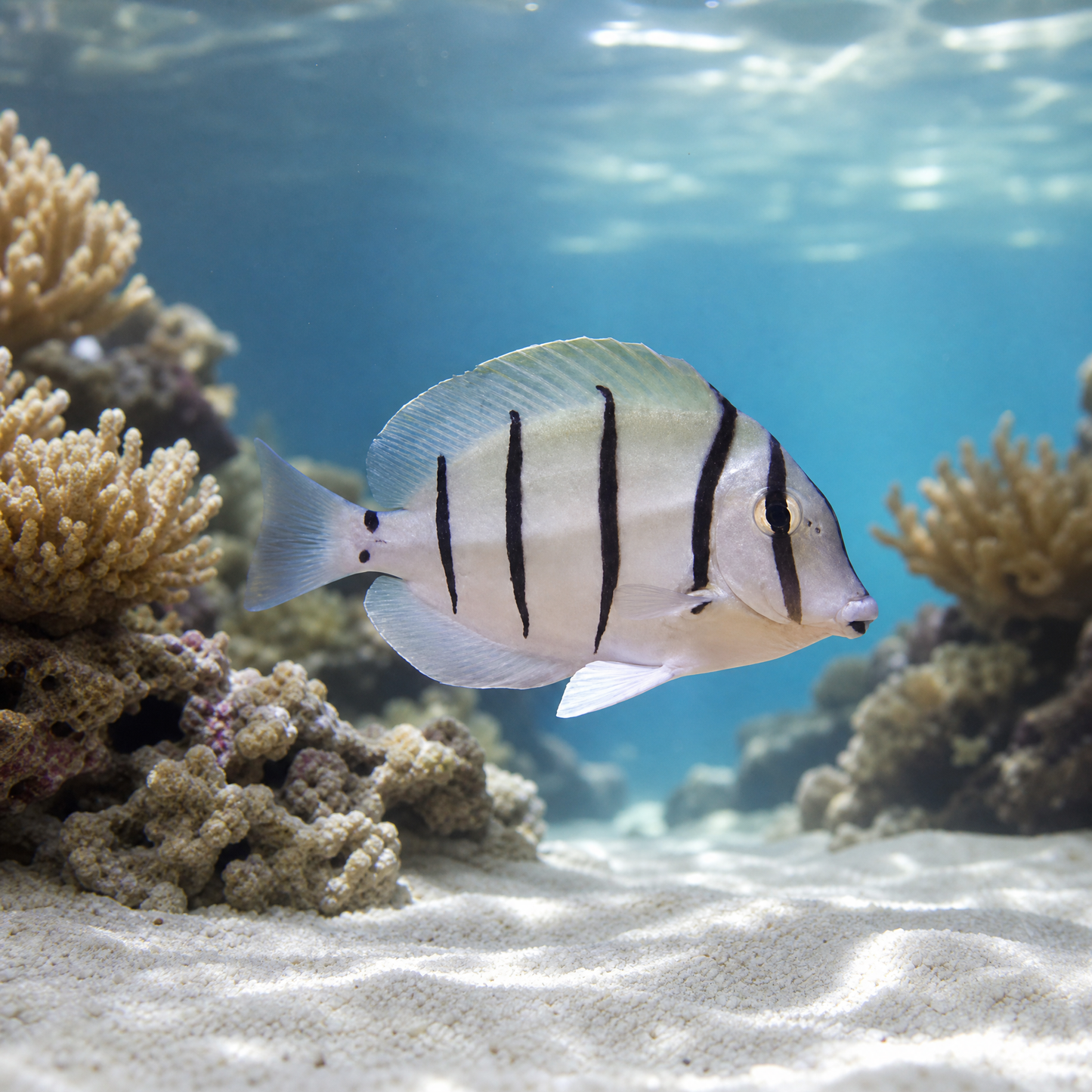
Convict Tang (Acanthurus triostegus)
