


- Sku: 3337392
- Vendor: Squeaky's Aquatics
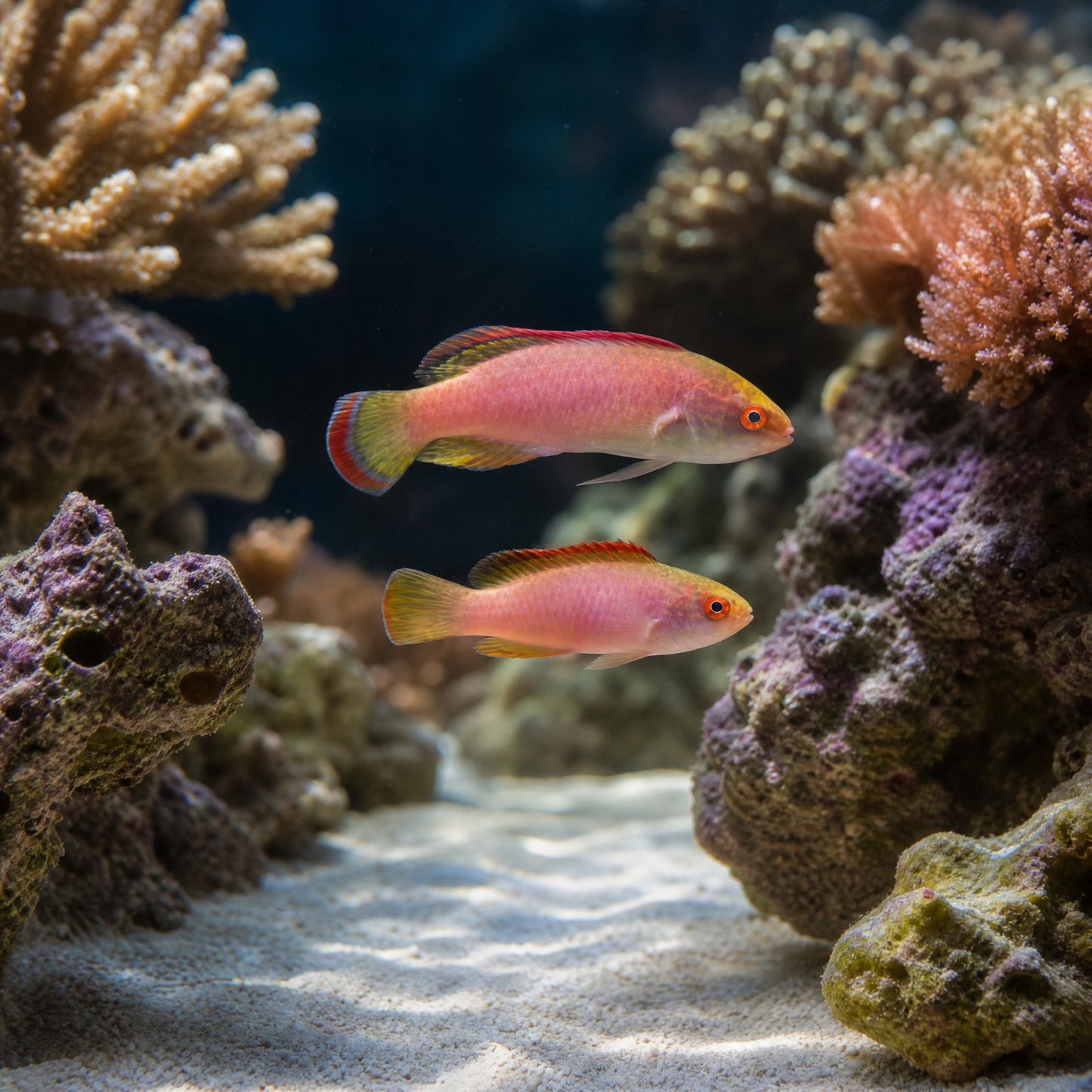
Pink Margin Fairy Wrasse Pair (Cirrhilabrus rubrimarginatus)
The Pink Margin Fairy Wrasse (Cirrhilabrus rubrimarginatus) is one of the cleanest looking fish in a genus full of show-offs: a rose and salmon body that warms to gold along the back, finished with the thin red fin margins the species is named for. This listing is a male and female pair, which is how you actually get the full display, since a male only lights up when he has a female to flare at. Like every fairy wrasse it is completely reef safe, active in open water all day, and peaceful with anything it cannot swallow. Browse the rest of our saltwater livestock and supplies to round out the reef.
Care Guide
- A tight lid is rule one. Fairy wrasses are the hobby's most notorious carpet surfers, and the risk is highest in the first few weeks. A fitted screen lid like the Innovative Marine SafeScreen is required equipment here, not an upgrade. Close the gaps around returns, cords and overflows too, a wrasse only needs one.
- Tank size: 90 gallons or larger with genuine swimming length. A pair needs more open water than a single fish, and this species cruises the tank all day rather than perching.
- Water: 72 to 78°F, pH 8.1 to 8.4, salinity 1.020 to 1.025, dKH 8 to 12. Stability matters more than hitting any one number exactly.
- Feeding: a zooplankton feeder in the wild, so think small and often. Two or three modest meals a day of PE Mysis, enriched brine, live copepods and a quality marine pellet will keep both fish full-bodied and colored up. Frequent small portions beat one big feeding.
- Lighting and aquascape: this is a deeper-water species collected well below the reef crest, so expect a shy first week under bright reef lighting. Give it rockwork to duck into and open water in front of it. Both fish settle quickly once they learn where food comes from.
- At night fairy wrasses wrap themselves in a mucus cocoon and wedge into the rocks. Not being able to find them after lights out is normal, not a problem.
Specifications
| Scientific name | Cirrhilabrus rubrimarginatus |
| Common names | Pink Margin Fairy Wrasse, Red-Margined Fairy Wrasse, Pintail Fairy Wrasse |
| What you get | One male and one female |
| Care level | Moderate |
| Temperament | Peaceful |
| Reef safe | Yes, fully |
| Max adult size | About 5 in (13 cm) for the male, female slightly smaller |
| Min tank size | 90 gallons |
| Diet | Carnivore, zooplankton feeder |
| Water temperature | 72 to 78°F |
| Salinity | 1.020 to 1.025 |
| pH | 8.1 to 8.4 |
| Origin | Western Pacific: Indonesia, Philippines, southern Japan, Palau |
| Pickup | In-store pickup only |
Compatibility
Good tank mates: tangs, dwarf and swallowtail angels, clownfish, anthias, cardinalfish, gobies, blennies and other peaceful reef fish. It is safe with every coral, and safe with shrimp, snails, clams and other invertebrates, which is what makes fairy wrasses such easy reef additions.
Keep the pair intact. Do not add a second male Cirrhilabrus rubrimarginatus, males will fight. If you want to build a harem later, add more females rather than another male, and add them all at once.
Add other fairy and flasher wrasses carefully. Different species usually coexist in a large tank, but similar-looking or similarly-colored males can trigger disputes. Introduce new wrasses at the same time or with rockwork rearranged, and give them space. Our Clown Fairy Wrasse is different enough in color to usually pair up fine in a large system.
Avoid: aggressive dottybacks, large aggressive triggers and puffers, lionfish, groupers, or anything with a mouth big enough to fit a five-inch wrasse.
Recommended Foods & Supplies
- Piscine Energetics PE Mysis: the staple meaty frozen food, high in fat and readily taken.
- Reef Nutrition Tigger-Pods: live copepods that trigger natural picking behavior, great for settling a shy new wrasse.
- Ocean Nutrition Frozen Mysis Shrimp: a second frozen option to keep the diet varied.
- Ocean Nutrition Formula 1 Pellets: a quality dry food for the meals between frozen feedings.
- Boyd Vitachem Marine: vitamin soak for frozen food, worth doing during the first weeks.
- Innovative Marine SafeScreen Mesh Screen Lid: the jump insurance this fish genuinely needs.
FAQ
Do I really need a lid?
Yes. This is the single most common way people lose a fairy wrasse, and it usually happens in the first two weeks while the fish is still spooky. A screen lid costs a fraction of the pair and removes the risk entirely.
What does buying a pair get me?
Color and behavior. A lone male in a tank with nothing to display to tends to sit in his everyday coloration. With a female present he flashes, spreads his fins and drives the intense pink and red that people buy this species for. You also skip the guesswork of sexing and introducing a second fish later.
Are they safe with my corals and cleanup crew?
Completely. Cirrhilabrus wrasses feed on zooplankton in the water column and have no interest in coral tissue, clam mantles, ornamental shrimp or snails. They are among the safest fish you can put in a full reef.
Why does the male look washed out some days?
That is normal. Fairy wrasse males cycle between a muted resting color and full display color many times a day, and they also fade at night. Shipping and a new tank will mute him for a while too. Good food and a settled tank bring the color back.
Have a question?
Pink Margin Fairy Wrasse Pair (Cirrhilabrus rubrimarginatus)
