


- Sku: FW1-F4247
- Vendor: Squeaky's Aquatics
Sailfin Molly (Poecilia latipinna)
The Sailfin Molly (Poecilia latipinna) is a hardy, peaceful livebearer best known for the males' towering "sailfin" dorsal. Color phases we carry rotate through the classic palette of silver, dalmatian, marbled green, and gold, so each shipment is a colorful, beginner-friendly addition to a community tank. Note that mollies thrive in hard, alkaline water and can even adapt to brackish setups. Browse our other freshwater livestock to round out a compatible community.
Care Guide
- Minimum tank size: 30 gallons. Sailfin Mollies are bigger than common short-finned mollies and need swimming room, and long tanks beat tall ones.
- Temperature: 72 to 82°F (22 to 28°C).
- pH: 7.5 to 8.5. They thrive in hard, alkaline water. Avoid acidic blackwater setups.
- Hardness: Moderately hard to hard (10 to 25 dGH). A pinch of aquarium salt or marine salt is welcomed but not required.
- Diet: Omnivore leaning herbivore. Offer a high-quality tropical flake daily, plus blanched zucchini, spirulina, or algae wafers 2 to 3 times a week. Bloodworms and brine shrimp work as treats.
- Stocking ratio: Keep more females than males (2 to 3 females per male) to spread out the male's attention and prevent harassment.
- Livebearer: Mollies are prolific live-bearers. If you don't want fry, plan to rehome them or expect natural attrition in a community tank.
- Brackish capable: Sailfins are one of the most salt-tolerant livebearers and can be slowly acclimated up to low-end brackish (SG 1.005 to 1.012) if desired.
Specifications
| Common Name | Sailfin Molly (assorted colors) |
| Scientific Name | Poecilia latipinna |
| Family | Poeciliidae (livebearers) |
| Origin | SE United States & Mexico, coastal & brackish wetlands |
| Care Level | Beginner-friendly |
| Diet | Omnivore: flake + veggie supplements + occasional protein |
| Lifespan | 3 to 5 years |
| Adult Size | 4 to 6 in (10 to 15 cm), males show a tall sail dorsal |
| Water Type | Freshwater (hard/alkaline) or brackish |
Compatibility & Tank Mates
Sailfin Mollies are peaceful in community setups with calm tank mates that share their water preferences. Avoid aggressive fin-nippers and very soft-water species.
- Other livebearers: Bumble Bee Platy, Red Wag Platy, Peppermint Platy
- Calm schoolers: Zebra Danio, Black Emperor Tetra, Bleeding Heart Tetra
- Bottom dwellers: Panda Corydoras, Orange Laser Corydoras, Kuhli Loach
- Peaceful cichlids: Bolivian Ram (if pH overlap allows)
- Nerite snails, ramshorn snails (legal in GA; avoid mystery/apple snails)
Avoid: Male bettas, aggressive cichlids, tiger barbs and other nippers, and very acidic-water specialists like discus or wild Apistos.
Recommended Foods & Supplies
- Ocean Nutrition Brine Shrimp Plus Flake: high-protein staple flake
- Seachem Prime Water Conditioner: dechlorinator for every water change
- Live freshwater plants: broadleaf and grass plants for cover; mollies graze biofilm off leaves
- All freshwater foods: rotate spirulina flake, algae wafers, frozen brine for color and gut health
FAQ
Will I get fry?
Almost certainly. Mollies are livebearers and breed readily in good conditions. Hidden fry survive better in heavily planted tanks; otherwise most are eaten by tank mates and adults.
Do I need salt in the water?
No. Sailfin Mollies do fine in straight fresh water as long as it's hard and alkaline. A pinch of aquarium salt won't hurt and can help with stress, but it's optional.
Why do my mollies look pale or have clamped fins?
Usually a water quality or hardness issue. Mollies struggle in soft, acidic water. Test pH and GH and adjust toward pH 7.5 to 8.5 and 10 to 25 dGH. Stable parameters fix most "molly diseases" before they start.
Can I pick the colors?
We rotate stock by what arrives from our suppliers. Silver, dalmatian, marbled green, and gold are common. Come in and we'll show you what's swimming in the display.
Have a question?
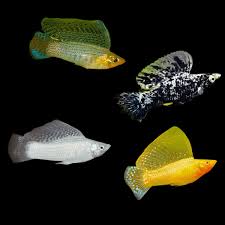
Sailfin Molly (Poecilia latipinna)
