


- Sku: FANFL600AF-4
- Vendor: Squeaky's Aquatics
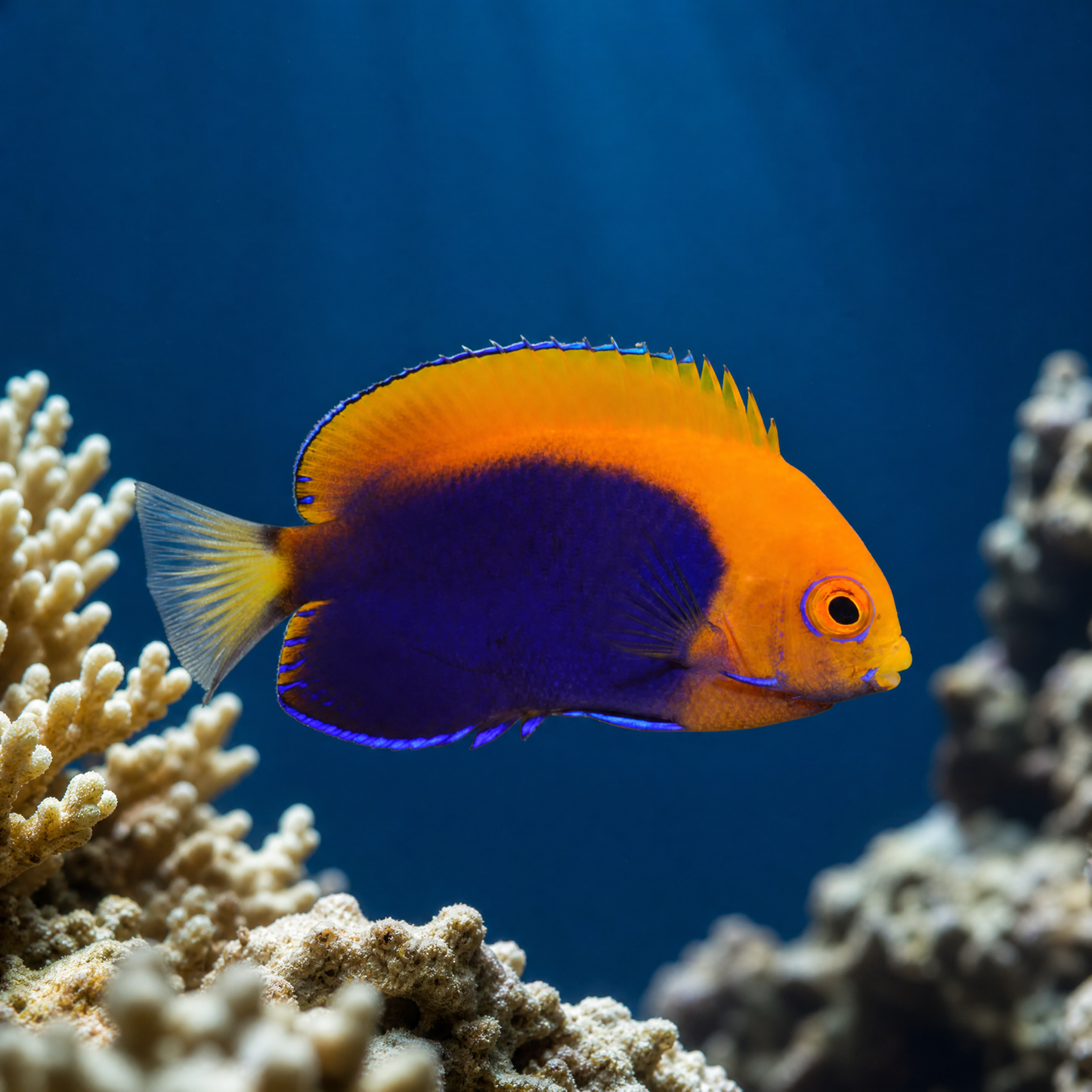
African Flameback Angelfish (Centropyge acanthops)
The African Flameback Angelfish (Centropyge acanthops) packs the color of a full-size angel into a fish barely three inches long. A blazing orange saddle runs from the face back over the dorsal, a deep sapphire blue covers the flanks, and the tail is a clean pale yellow. It is one of the smallest and most affordable dwarf angels in the hobby, and one of the boldest: expect it out in the open picking at rockwork all day rather than sulking in a cave. Care level is intermediate and temperament is semi-aggressive. Browse the rest of our live fish and saltwater supplies to round out the tank.
Care Guide
- Tank size: 30 gallons is the honest minimum, 55 gallons or more is better. The fish is tiny, but it grazes constantly and wants territory to patrol.
- Live rock is not optional: this is a grazing fish. Mature rock covered in film algae and microfauna is what keeps it fed between meals and what keeps it from getting bored and picking at corals. A brand new sterile tank is the wrong home for one.
- Water parameters: 72 to 78°F, pH 8.1 to 8.4, salinity 1.020 to 1.025, alkalinity 8 to 12 dKH. Dwarf angels dislike swinging parameters and poor water quality more than most reef fish.
- Feeding: omnivore with a strong vegetarian streak. Feed three times a day in a young tank. Rotate dried seaweed on a clip, Formula Two, angel and butterfly frozen blends, and meaty items like PE Mysis. A well fed angel is a far lower coral risk than a hungry one.
- Aquascape: plenty of caves, overhangs, and swim-through rockwork. They bolt for cover when startled and settle in much faster in a tank with good hiding options.
- Lid: recommended. Startled dwarf angels can carpet surf.
- Acclimation: introduce to a mature, stable system and give the fish a quiet first week. Wild-collected angels can be shy for a few days before they start grazing openly.
Specifications
| Scientific name | Centropyge acanthops |
| Common names | African Flameback Angelfish, Orangeback Angelfish, African Pygmy Angel |
| Origin | Western Indian Ocean, East Africa to Madagascar and the Seychelles, 20 to 130 feet deep |
| Max size | About 3 inches (7 to 8 cm) |
| Care level | Intermediate |
| Temperament | Semi-aggressive |
| Minimum tank | 30 gallons, 55 gallons preferred |
| Reef safe | With caution, see Compatibility below |
| Temperature | 72 to 78°F |
| Salinity | 1.020 to 1.025 |
| Diet | Omnivore, algae grazer |
| Pickup | In-store only |
Compatibility
Reef safe with caution, and we mean the caution part. Some Flamebacks live in mixed reefs for years and never touch a coral. Others develop a taste for LPS flesh, clam mantles, or zoanthids and never unlearn it. There is no way to know in advance which fish you have. If your tank is built around expensive corals, understand that you are accepting a real risk. Keeping the fish well fed with plenty of algae, and adding it to a tank with established grazing surfaces, tilts the odds heavily in your favor.
With fish it is easygoing. It ignores most unrelated tankmates and gets along with clownfish, gobies, blennies, wrasses, and chromis. The exception is its own kind: keep only one dwarf angel per tank unless the system is very large, and avoid pairing it with our Coral Beauty, Flame Angel, or Eibli Angel. Two Centropyge in one tank usually ends with one of them dead. Add it after peaceful fish are settled but before anything else territorial.
Recommended Foods & Supplies
- SFBB Angel & Butterfly Frozen Cube, formulated for exactly this fish
- Two Little Fishies SeaVeggies Purple Seaweed plus a feeding clip for daily grazing
- Ocean Nutrition Formula Two, the herbivore-weighted staple
- Brightwell AngeLixir, an amino acid soak made for marine angels and butterflies
- CaribSea Moani Live Rock to build the grazing surfaces this fish depends on
FAQ
Is this the same as a Brazilian Flameback?
No. They look similar, but the Brazilian Flameback (Centropyge aurantonotus) has a dark blue tail, while this African species has a pale yellow one. The African Flameback is also the smaller and more affordable of the two.
Will it eat my corals?
It might. Individual temperament varies and there is no reliable way to predict it. Keep it well fed with algae and greens, add it to a mature tank with grazing surfaces, and most Flamebacks leave corals alone. If you are not willing to accept any risk, a blenny or goby is the safer pick.
Can I keep two together?
Not in a normal home tank. Dwarf angels are territorial with each other and one will almost always kill the other. One per system unless you are running a very large aquarium.
Do I need a big tank for a three inch fish?
Yes, more than you would expect. The size requirement is about grazing area and territory, not swimming room. A 30 gallon with plenty of mature live rock beats a bare 55 every time.
Have a question?
African Flameback Angelfish (Centropyge acanthops)
