


- Sku: 4006
- Vendor: Fritz
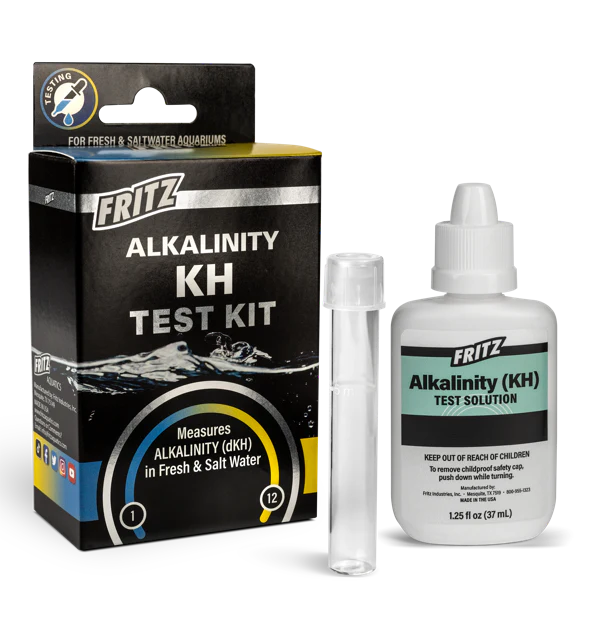
Fritz Alkalinity (KH) Test Kit
The Fritz Alkalinity (KH) Test Kit is a liquid reagent test that measures alkalinity, also called carbonate hardness, in both freshwater and saltwater aquariums. It is a drop-count test that reads from 1 to 12 dKH, and each drop equals 1 dKH (17.9 ppm). See all of our water testing supplies.
What's in the Box
- 1 reagent bottle, 1.25 fl oz (37 mL)
- A test tube
- An instruction card with chart
Why Test Alkalinity
Fritz explains that alkalinity measures the buffering capacity of aquarium water, its ability to resist pH changes. Higher KH means better resistance to pH swings, and lower KH leaves the water more prone to them. KH naturally drops over time through nitrification and the introduction of CO2 and other acids, so regular testing matters.
In freshwater tanks, especially planted tanks, low KH is one of the most common causes of sudden pH crashes. In reef tanks, corals depend on stable alkalinity to build their skeletons.
How to Test
- Fill the test tube to the 5 mL line with aquarium water.
- Holding the bottle upside down and completely vertical, add one drop at a time. Cap and gently shake the tube between drops, and count each drop.
- The test is complete when the water turns from blue to yellow.
- The number of drops equals your KH in dKH. Each drop is 17.9 ppm, so 4 drops is 71.6 ppm.
If the color is hard to judge, remove the cap and look down through the tube over a white background. Keep test solution out of the aquarium and follow the full instructions in the box.
Reading Your Results
Fritz recommends keeping at least 4 dKH to support a healthy nitrifying bacteria population, especially when setting up a new tank. Typical ranges from Fritz:
- 0 to 4 dKH: soft water fish such as discus and other South American cichlids
- 4 to 8 dKH: tropical community fish such as tetras and bettas
- 8 to 12 dKH: African Rift Lake cichlids and marine species
To raise KH, Fritz recommends Fritz pH Higher, or Fritz Rift Lake Cichlid Buffer for a bigger increase in African cichlid systems. To lower KH, use Fritz pH Lower or do partial water changes with lower-KH water such as RO/DI.
Specifications
| Brand | Fritz Aquatics |
| Measures | Alkalinity (carbonate hardness, KH) |
| Range | 1 to 12 dKH |
| Resolution | Each drop = 1 dKH (17.9 ppm) |
| Method | Drop-count titration, blue to yellow |
| Water type | Freshwater and saltwater |
| Reagent | 1 bottle, 1.25 fl oz (37 mL) |
| Made in | USA |
| UPC | 080531040065 |
Related Fritz Tests
- Fritz Wide Range pH Test Kit, since KH affects how stable your pH stays.
- Fritz General Hardness (GH) Test Kit for freshwater hardness.
- Fritz Calcium Test Kit for reef tanks, where calcium and alkalinity need to stay in balance.
FAQ
How do I read the result?
Count the drops it takes to turn the sample from blue to yellow. Each drop equals 1 dKH, or 17.9 ppm.
Does it work in saltwater?
Yes. Fritz states it measures KH in both freshwater and saltwater aquariums.
Have a question?
Fritz Alkalinity (KH) Test Kit
