


- Sku: 1100627
- Vendor: Squeaky's Aquatics
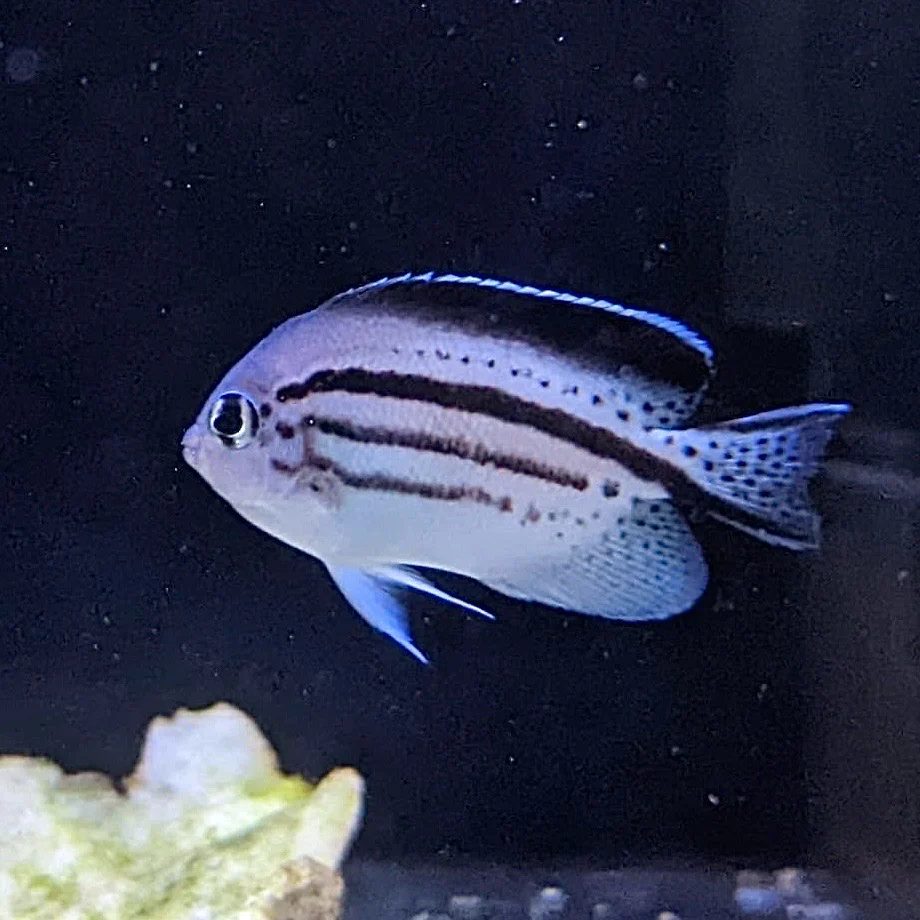
Lamarck Angel (Genicanthus lamarck)
The Lamarck Angelfish (Genicanthus lamarck) is the rare angel you can actually keep in a reef tank. Unlike the dwarf and large angels that pick at corals and clams, swallowtail angels in the genus Genicanthus are mid-water plankton feeders. They cruise the open swim space, leave coral flesh and zoanthids alone, and bring movement to the upper third of the display. Pair it with our other saltwater fish in a 125-gallon or larger reef.
Females have a clean white body with two horizontal black stripes from gill to tail. Mature males add a yellow tail blush, additional black markings on the dorsal, and develop long pelvic-fin streamers. Genicanthus lamarck is protogynous, so all juveniles start as females and the dominant individual in a group becomes the male.
Care Guide
- Tank size: 125 gallons minimum, 180+ gallons preferred. Swallowtails need horizontal swim length, not just rockwork.
- Diet: Planktivore. Frozen mysis, brine, finely chopped seafood, marine pellets, and quality nori. Multiple small feedings a day mirror their natural mid-water grazing.
- Reef safe: Yes. Rated reef safe with caution: ignores most corals, but individual fish occasionally pick at clam mantles or large polyp stony corals. Watch new additions for the first week.
- Temperament: Peaceful. Does well with most reef tank mates including tangs, wrasses, anthias, and clownfish.
- Compatibility with other angels: Best as the only true angel in the tank unless the system is very large. A female + male pair of Lamarcks works in 180+ gallons.
- Acclimation: Slow drip 60 to 90 minutes. Newly imported swallowtails can be shy for the first few days; dim lights and a quiet room help.
Specifications
| Scientific name | Genicanthus lamarck |
| Common names | Lamarck Angelfish, Lamarck's Angel, Freckletail Lyretail Angelfish |
| Family | Pomacanthidae (Swallowtail / Genicanthus) |
| Care level | Moderate |
| Temperament | Peaceful |
| Max adult size | Up to 10 in (25 cm) |
| Diet | Planktivore / omnivore |
| Reef safe | Yes with caution |
| Min tank size | 125 gallons (180+ preferred) |
| Temperature | 72 to 78°F |
| Salinity | 1.020 to 1.025 SG |
| pH | 8.1 to 8.4 |
| Origin | Western Pacific (Indonesia, Philippines, Great Barrier Reef) |
| Pickup | In-store pickup only |
Tank Mates & Compatibility
Excellent peaceful reef companion. Works with most tangs (yellow, kole, hippo), wrasses, anthias, clownfish, gobies, blennies, dottybacks, and larger cardinals. Avoid keeping with notably aggressive fish such as triggers, large groupers, or competitive damsels that may bully a planktivore at feeding time.
Reef-safe with most stony and soft corals, anemones, snails, hermits, and adult cleaner shrimp. Watch for occasional clam-mantle nipping; if it occurs, target-feed the angel more often.
Recommended Foods & Supplies
- SFBB Freeze-Dried Mysis: meaty staple for planktivores. Soak in vitamin enhancer.
- Piscine Energetics PE Pellets 2 mm: high-quality dry food that swallowtails take readily.
- Brightwell AngeLixir: amino-acid food soak formulated for marine angels.
- Reef Nutrition Tigger Feast: live copepods for natural picking through the water column.
- Rod's Three Weed Blend: varied seaweed clip to round out the diet.
FAQ
Is it really reef safe?
Yes, more so than any other true angel genus. Genicanthus evolved to feed on plankton in open water rather than to pick at coral, so they ignore corals in captivity. The occasional individual will sample a clam mantle; well-fed Lamarcks rarely cause problems.
Can I keep a pair?
In a 180-gallon or larger reef, yes. Start with two small females, the larger will transition to male within a few months. Adding a confirmed male and a small female works too.
How big does it actually get?
Around 7 to 8 inches is typical in home aquaria; the published 10 inch maximum is mostly wild-fish reaching that size.
Will it eat my pods?
Yes, it will graze copepods and small mysis from the rockwork and water column. Keep a refugium to replenish them if you also have a mandarin or pipefish.
Have a question?
Lamarck Angel (Genicanthus lamarck)
