


- Sku: SQ-CLOWNLONGFINOC
- Vendor: Squeaky's Aquatics
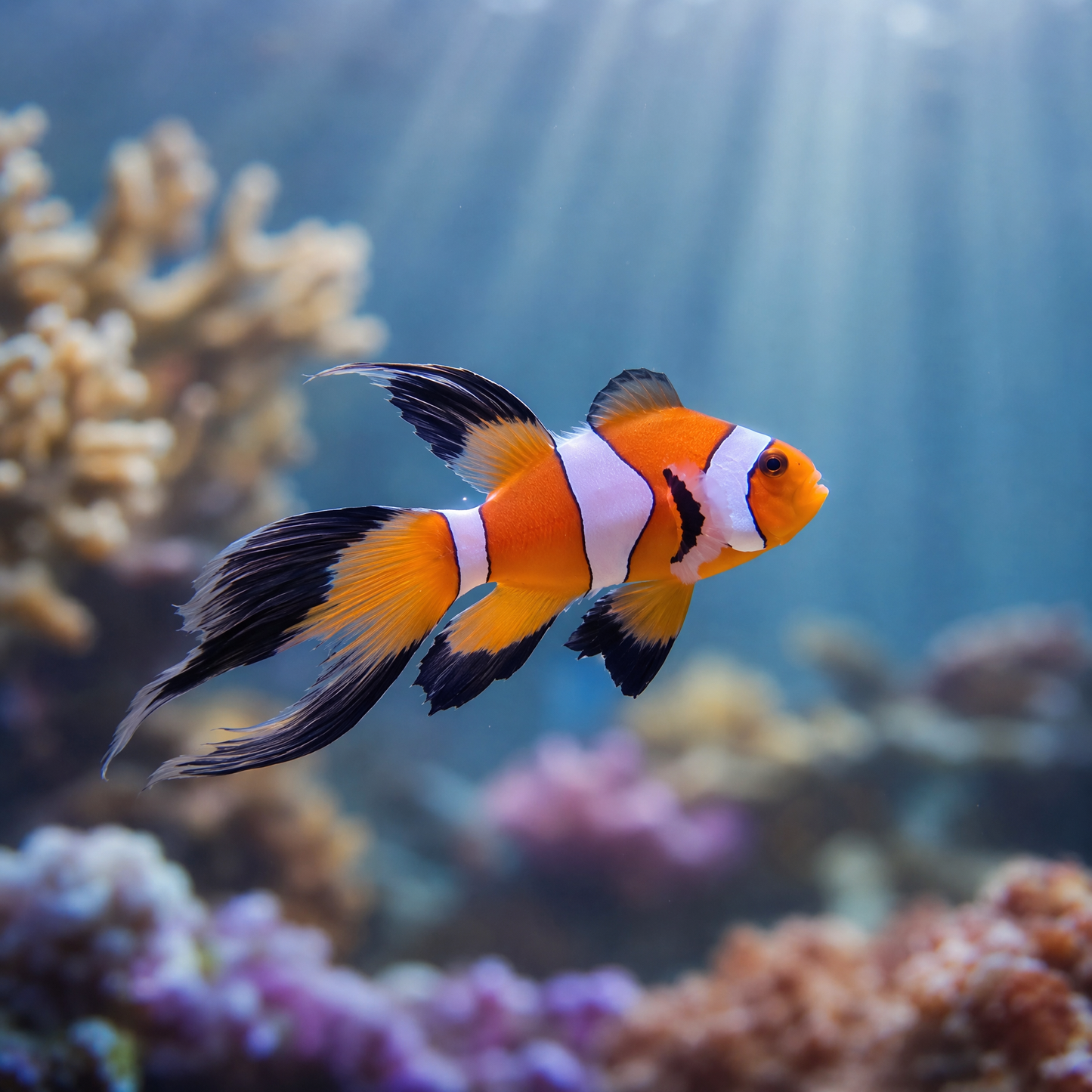
Longfin Ocellaris Clownfish (Amphiprion ocellaris)
The Longfin Ocellaris Clownfish (Amphiprion ocellaris) is the fish everybody already recognizes, given a completely different silhouette. It is the classic orange and white clown, three crisp bars and black fin edging, but the longfin gene stretches every fin into flowing, trailing finnage that drifts behind it. The result is a familiar fish that moves like something else entirely, slower and more deliberate, closer to a marine betta in profile. It is captive bred, eats prepared food from day one, and is exactly as hardy and beginner friendly as a standard Ocellaris. Browse the rest of our saltwater livestock and supplies to build the tank around it.
Care Guide
- Tank size: 20 gallons or larger for one or a pair. Clownfish claim a small patch and defend it, so rockwork and a hosting spot matter more than open swimming length.
- Water parameters: 74 to 80°F, pH 8.1 to 8.4, salinity 1.020 to 1.026. Captive bred Ocellaris are about as forgiving as marine fish get, which is why they are the standard first clownfish.
- Flow: keep it moderate. Long fins look wonderful and swim poorly. A longfin parked in front of a strong powerhead burns its day fighting current, so aim flow across the rockwork rather than through the clown's territory.
- Feeding: omnivore and an enthusiastic eater. A marine pellet like PE Saltwater Pellets daily, plus frozen PE Mysis a couple of times a week, covers everything. Watch that faster tank mates are not stealing every bite before the longfin gets there.
- Anemone: completely optional. If you want the classic picture, a bubble tip (Entacmaea quadricolor) like our Snowflake Bulb Anemone or Green Bulb Anemone is the host they take to most readily, and only once the tank is mature.
- Lid: recommended. Clowns are not famous jumpers, but an open rim and a startled fish is a bad pairing.
Specifications
| Scientific name | Amphiprion ocellaris, longfin strain |
| Common names | Longfin Ocellaris Clownfish, Longfin Clownfish, Fancy Longfin |
| Origin | Captive bred, never wild collected |
| Care level | Beginner |
| Temperament | Peaceful, territorial only toward other clownfish |
| Reef safe | Yes, fully |
| Max size | About 3 inches, plus finnage |
| Minimum tank | 20 gallons |
| Temperature | 74 to 80°F |
| pH | 8.1 to 8.4 |
| Salinity | 1.020 to 1.026 |
| Diet | Omnivore |
| Host anemone | Not required. Bubble tip (Entacmaea quadricolor) if you want one |
| Pickup | In-store pickup at Squeaky's Aquatics |
Compatibility
Peaceful with everything except other clownfish, and fully reef safe with corals, clams, and inverts including the Scarlet Skunk Cleaner Shrimp. Dependable tank mates include the Royal Gramma, Banggai Cardinal, Blue Green Chromis, Bicolor Blenny, Tailspot Blenny, and the Engineer Goby.
The longfin caveat. Trailing fins are a target and a handicap. Avoid known fin nippers, and be thoughtful about fast, food motivated fish that will out-compete a slower swimmer at feeding time. A Flame Hawkfish or a blenny is no problem; an aggressive dottyback or a large pushy damsel is.
Other clownfish. One clown or one bonded pair per tank. Two different clownfish species in the same tank almost always ends in a fight. If you are comparing looks, we also stock the Black Ice Longfin, the standard Ocellaris, the Black Ocellaris, the Wyoming White, and the larger Spotcinctus.
Recommended Foods & Supplies
- PE Saltwater Pellets 2mm daily staple
- Piscine Energetics PE Mysis
- SFBB Mysis Shrimp Cube
- Xtreme Marine Krill Flakes
- Hikari Marine-S
FAQ
Is the longfin gene bad for the fish?
It is a cosmetic trait, not a deformity, and these fish live normal lifespans. The practical difference is swimming efficiency. Keep flow moderate, make sure it gets its share at feeding time, and skip fin nipping tank mates, and a longfin does everything a standard Ocellaris does.
Will the fins keep growing?
They lengthen as the fish matures, so a young longfin looks more dramatic every few months. Fins also regrow well if they get torn, as long as water quality is good.
Do I need an anemone?
No. Captive bred clowns have never encountered one and will happily host a rock, a coral, a powerhead, or nothing at all. Anemones want a mature tank and strong light, so treat one as a later addition.
Can I buy a pair?
Yes, while both are here. Clownfish are protandrous, so every fish starts male and the dominant one of a pair becomes female. Two young fish added together sort it out themselves, which is much easier than introducing a second clown to an established adult later.
Have a question?
Longfin Ocellaris Clownfish (Amphiprion ocellaris)
