


- Sku: 48070958350555
- Vendor: Squeaky's Aquatics
Longspine Porcupine Puffer (Diodon holocanthus)
The Longspine Porcupine Puffer (Diodon holocanthus) is an expressive saltwater showpiece with watchful eyes, a powerful beak, and a curious personality. This intelligent fish quickly learns its feeding routine and becomes a memorable centerpiece in a properly sized fish-only aquarium. Explore more marine livestock and supplies in our Salt Water collection.
Care Guide
- Aquarium: Use an established 180 gallon or larger fish-only system with secure rockwork, caves, and open swimming room.
- Filtration: Provide strong biological and mechanical filtration with a protein skimmer. Puffers are enthusiastic, messy eaters and water quality can decline quickly.
- Water: Maintain 70 to 78°F, specific gravity 1.020 to 1.025, pH 8.1 to 8.4, and alkalinity around 8 to 12 dKH.
- Diet: Offer varied meaty foods such as clam, mussel, shrimp, krill, squid, and marine fish flesh. Hard-shelled foods are essential for wearing down the continuously growing beak.
- Temperament: Semi-aggressive. Choose sturdy tankmates too large to swallow and watch for fin nipping, especially after lights out.
- Handling: Never intentionally make a puffer inflate. Transfer it underwater in a rigid container instead of lifting it into the air or catching its spines in a net.
Specifications
| Common names | Longspine Porcupine Puffer, Balloonfish, Porcupinefish |
| Scientific name | Diodon holocanthus |
| Family | Diodontidae |
| Distribution | Tropical Atlantic, Indian, and Pacific Oceans |
| Care level | Intermediate |
| Temperament | Semi-aggressive |
| Adult size | Commonly 8 to 14 inches, potentially near 20 inches |
| Minimum aquarium | 180 gallons |
| Reef safe | No |
| Diet | Meaty marine foods and hard-shelled invertebrate foods |
| Water type | Saltwater |
| Pickup | In-store only |
Compatibility
Best kept in a large fish-only aquarium with sturdy, similarly sized fish that will not harass it or compete excessively at feeding time. Every individual is different, so closely monitor introductions and provide multiple shelters.
Avoid ornamental shrimp, crabs, snails, clams, urchins, sea stars, and delicate corals. Very small fish may be eaten, while slow or long-finned fish may be nipped. If you want another personable marine puffer, consider the Striped Dogface Puffer as an alternative rather than an automatic tankmate.
Recommended Foods and Supplies
- SFBB Silversides Flat Pack for varied meaty feeding.
- Marine foods for frozen and prepared options.
- Water testing supplies for monitoring a heavily fed system.
Frequently Asked Questions
Is this puffer reef safe?
No. It naturally eats shelled invertebrates and may damage corals.
Why are hard-shelled foods important?
The fused beak grows continuously. Regular shell-on foods help provide natural tooth wear and reduce the risk of overgrowth.
Can I make it puff up?
No. Inflation is a stress response. Never provoke it, and keep the fish submerged during transfers so it does not swallow air.
Can two puffers live together?
Do not assume they will. Territorial behavior and feeding competition can become serious, so mixing puffers requires an exceptionally large system, backup housing, and close observation.
Why does this fish need such strong filtration?
Large meaty meals create substantial waste. A mature biofilter, protein skimmer, mechanical filtration, and consistent maintenance are essential.
Have a question?
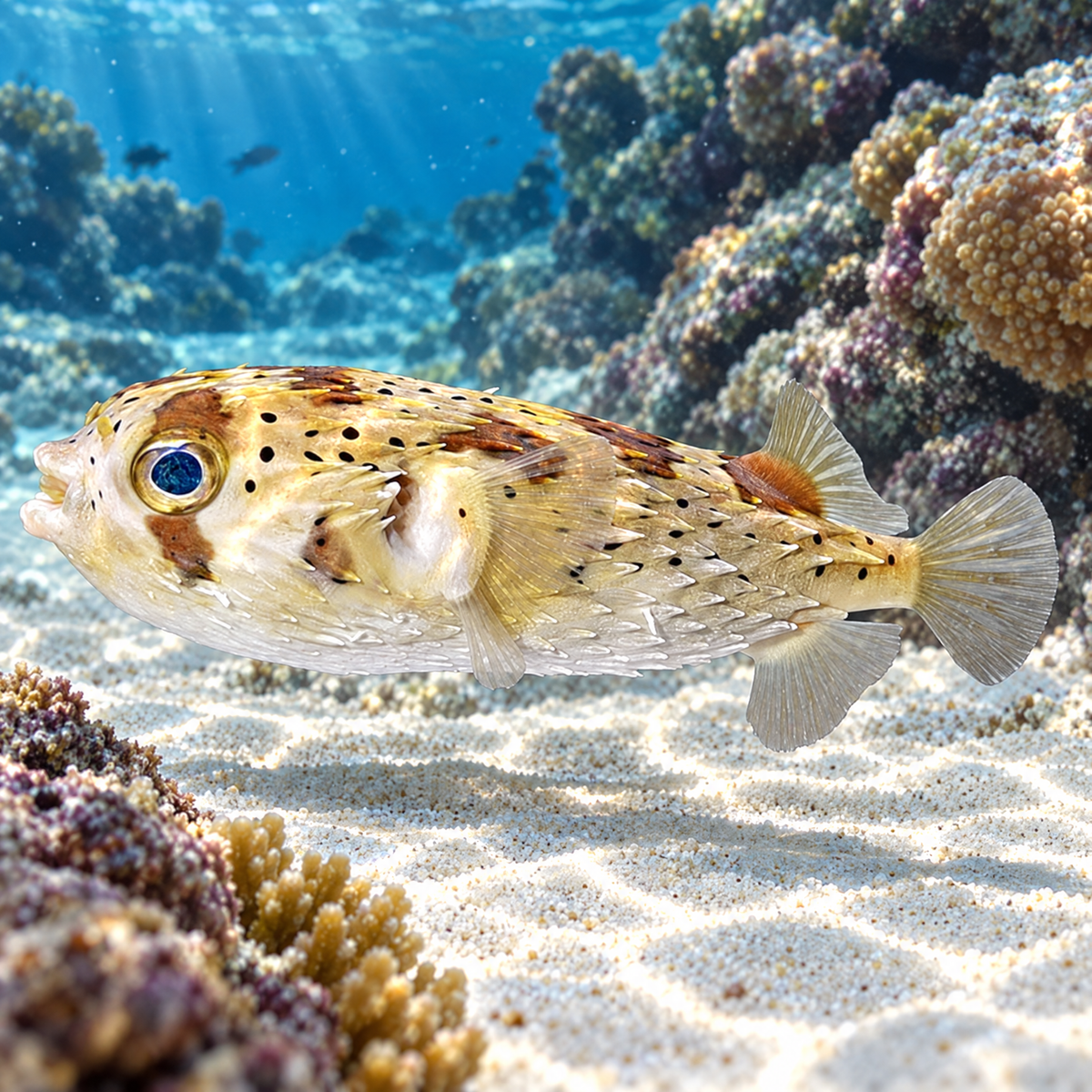
Longspine Porcupine Puffer (Diodon holocanthus)
