



- Sku: 8805950
- Vendor: Squeaky's Aquatics
Bucephalandra "Green" (Bucephalandra sp.) - Tissue Culture Cup
Bucephalandra "Green" (Bucephalandra sp.) is the plain-name entry point into the most collectable genus in the planted-tank hobby, and it is a genuinely good plant rather than a consolation prize. Compact deep-green leaves on a creeping rhizome, a faint iridescent shimmer that catches the light at the right angle, and the same set-and-forget toughness as Anubias. It grows on rock and driftwood rather than in substrate, needs no CO2, and asks for very little beyond being left alone. Browse the rest of our live freshwater plants.
Bucephalandra is endemic to Borneo, where it grows clinging to rocks in fast streams that flood and recede. That is exactly how to treat it in an aquarium: attached to hardscape, not planted.
Why Tissue Culture
This arrives as a sealed tissue culture cup: grown in sterile lab conditions in nutrient gel, so it comes with no snails, no pest eggs, no algae, and no hitchhiking parasites. For a shrimp tank or a carefully managed aquascape that is worth a lot. You also get many small individual plantlets from one cup rather than a single clump, so a single cup seeds several spots.
Care Guide
- Rinse the gel off first. Take the portion out of the cup and rinse the agar away completely under cool water. Leftover gel fouls the tank and feeds bacterial bloom.
- Never bury the rhizome. The thick creeping stem the leaves grow from must stay exposed or it rots. Glue it to rock or driftwood with super glue gel, tie it with thread, or wedge it into a crevice. Roots into the substrate are fine.
- Split it up. Separate the cup into several small portions and glue each to its own spot. They spread and knit together over time, which looks far better than one lump.
- Light: low to moderate. Bright light does not speed it up much and mostly grows algae on the slow leaves. Moderate light does bring out the blue and purple sheen.
- Water: 71 to 82°F, pH 6.0 to 8.0. Undemanding and adaptable, but it prizes stability over any particular number.
- CO2 and fertilizer: neither required. A water-column dose of Seachem Flourish keeps new leaves coming. CO2 speeds growth and deepens colour if you already run it.
- Patience: this is a slow plant. A few new leaves a month is normal and healthy. In exchange it never needs trimming and never melts once established.
- Propagation: cut the rhizome into sections with a few leaves each. Every piece grows on.
Specifications
| Scientific name | Bucephalandra sp. "Green" |
| Common names | Bucephalandra, Buce, Buce Green |
| Sold as | Sealed tissue culture cup, splits into several plantlets |
| Care level | Beginner |
| Plant type | Rhizome, attaches to hardscape |
| Placement | Foreground to midground, on rock or driftwood |
| Height | 2 to 5 inches |
| Light | Low to moderate |
| CO2 | Not needed |
| Temperature | 71 to 82°F |
| pH | 6.0 to 8.0 |
| Growth | Slow, propagate by rhizome division |
| Origin | Borneo, endemic to stream rocks |
| Pickup | In-store pickup at Squeaky's Aquatics |
Placement & Companions
Glue it along a piece of driftwood, into rock crevices, or across the face of a stone where it can creep. It sits naturally alongside other rhizome plants that want the same treatment: Anubias Nana for larger leaves above it and Java Fern for height behind.
It is a shrimp tank staple. The slow leaves grow a fine biofilm that Amano Shrimp and Neocaridina graze constantly, and being tissue culture there is nothing riding along to contaminate a clean shrimp setup. Completely safe with all fish, snails, and inverts.
Collecting them is half the fun. We also stock Brownie Purple, Kedagang, and Kapuas Brownie Ghost.
Recommended Supplies
- Super glue gel (cyanoacrylate) to attach the rhizome to hardscape
- Malaysian Driftwood to mount it on
- Seachem Flourish water-column fertilizer
- More live plants to build the scape around it
Frequently Asked Questions
My new Buce is melting. Did I kill it?
Almost certainly not. Tissue culture plants are grown out of water, so the emersed leaves commonly die back when submerged. Leave the rhizome attached and undisturbed and new submersed leaves push out within a few weeks.
Can I plant it in the substrate?
No. Bury the rhizome and it rots. Only the fine roots may go into substrate, and even then attaching it to rock or wood is easier and looks better.
Do I have to rinse the gel off?
Yes, thoroughly. The agar is a nutrient medium and will cloud your water and fuel a bacterial bloom if it goes in with the plant.
Why is it so expensive for such a small plant?
Slow growth. Bucephalandra takes a long time to produce, which is what keeps the price up across the whole genus. The upside is a plant that lasts years with almost no maintenance.
How do I get the blue shimmer?
It is an iridescence in the leaf surface rather than a pigment, so it shows best under moderate direct light at a viewing angle. It is subtler on "Green" than on some of the darker cultivars.
Is it safe for shrimp?
Ideal for them. Tissue culture means no pesticide residue and no pest hitchhikers, which is exactly what a shrimp keeper wants.
How do I get my plants?
These are in-store pickup only. We hold your order and pull it fresh when you arrive.
Have a question?


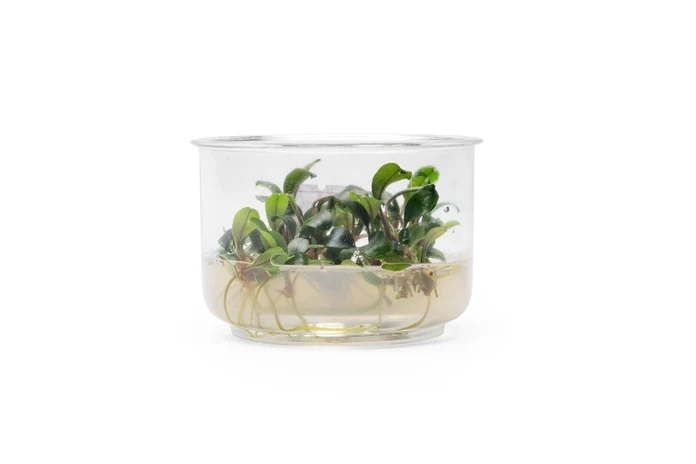
Bucephalandra "Green" (Bucephalandra sp.) - Tissue Culture Cup
