


- Sku: 9402188660955
- Vendor: Squeaky's Aquatics
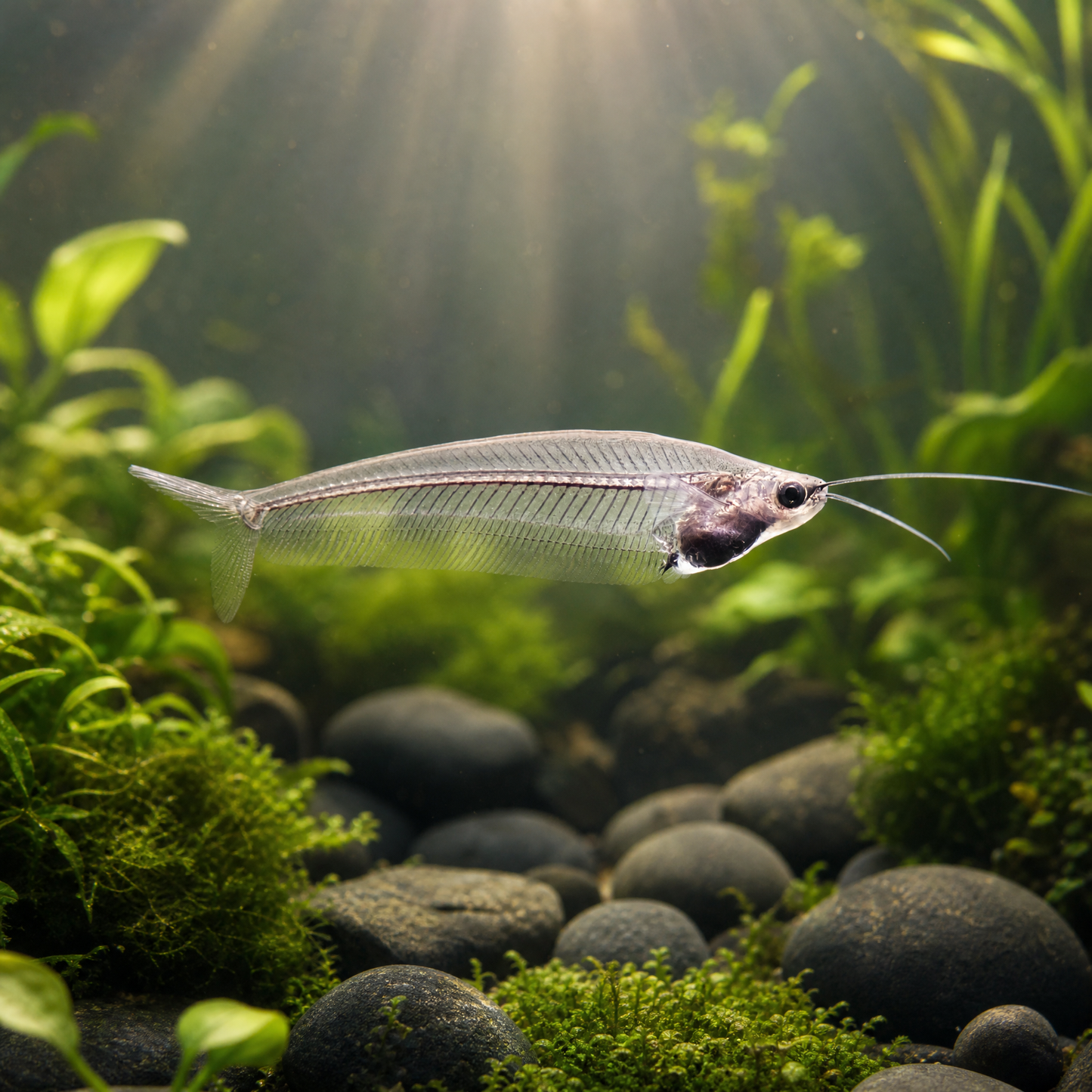
Glass Catfish (Kryptopterus vitreolus)
Glass Catfish (Kryptopterus vitreolus) is one of the true oddities of the hobby: a nearly transparent fish whose skeleton and organs are visible right through its body. Unusually for a catfish, it hovers in open mid-water in loose shoals rather than hugging the bottom. It is peaceful and mesmerizing, but it is also sensitive and highly social, so it must be kept in a group in stable, established water. Browse the rest of our freshwater fish.
Care Guide
- Always in groups: Glass Catfish are shoaling fish that stress and waste away when kept alone or in pairs. Keep six or more so they feel secure and stay out in the open.
- Established, stable water: They are sensitive to swings in water quality. Add them only to a mature, well-cycled tank at 75 to 80F with a pH of 6.0 to 7.5.
- Gentle tankmates: Pair them only with small, calm fish. Boisterous or nippy tankmates keep them hidden and off their food.
- Feeding: They are micro-predators. Offer frozen and live foods like bloodworms and brine shrimp along with small sinking or slow-drifting prepared foods.
Specifications
| Common Name | Glass Catfish, Ghost Catfish |
| Scientific Name | Kryptopterus vitreolus |
| Origin | Thailand |
| Care Level | Intermediate |
| Temperament | Peaceful |
| Adult Size | 2.5 to 3 in |
| Minimum Tank Size | 30 gallons, group of 6+ |
| Temperature | 75 to 80F |
| pH | 6.0 to 7.5 |
| Diet | Micro-predator (carnivore) |
| Sold As | Juvenile to sub-adult |
Compatibility
Glass Catfish are peaceful and a little timid, so they do best with other small, gentle community fish. Great companions include Neon Tetras, Ember Tetras, small rasboras, and peaceful corydoras. Keep them away from large or aggressive fish and known fin-nippers.
Recommended Foods & Supplies
- Frozen bloodworms and brine shrimp for conditioning
- Fine-particle sinking and slow-drifting prepared foods
- Live plants to provide cover and mid-water structure
- More freshwater fish
FAQ
Why do I have to buy several?
Glass Catfish are shoaling fish. In groups of six or more they are active and hardy; kept alone they stress, stop eating, and decline.
Are they really see-through?
Yes. Their bodies are transparent, so you can see the spine and internal organs. Cloudiness or a milky look is a sign of stress or illness.
Do they stay on the bottom like other catfish?
No. Unusually for catfish, they hover in mid-water in a loose group, often angled slightly nose-up.
Are they hard to keep?
They are more sensitive than average, so they need an established tank and calm tankmates, but in the right setup they are long-lived and rewarding.
Have a question?
Glass Catfish (Kryptopterus vitreolus)
