


- Sku: PLANT-LCRUSH
- Vendor: Squeaky's Aquatics
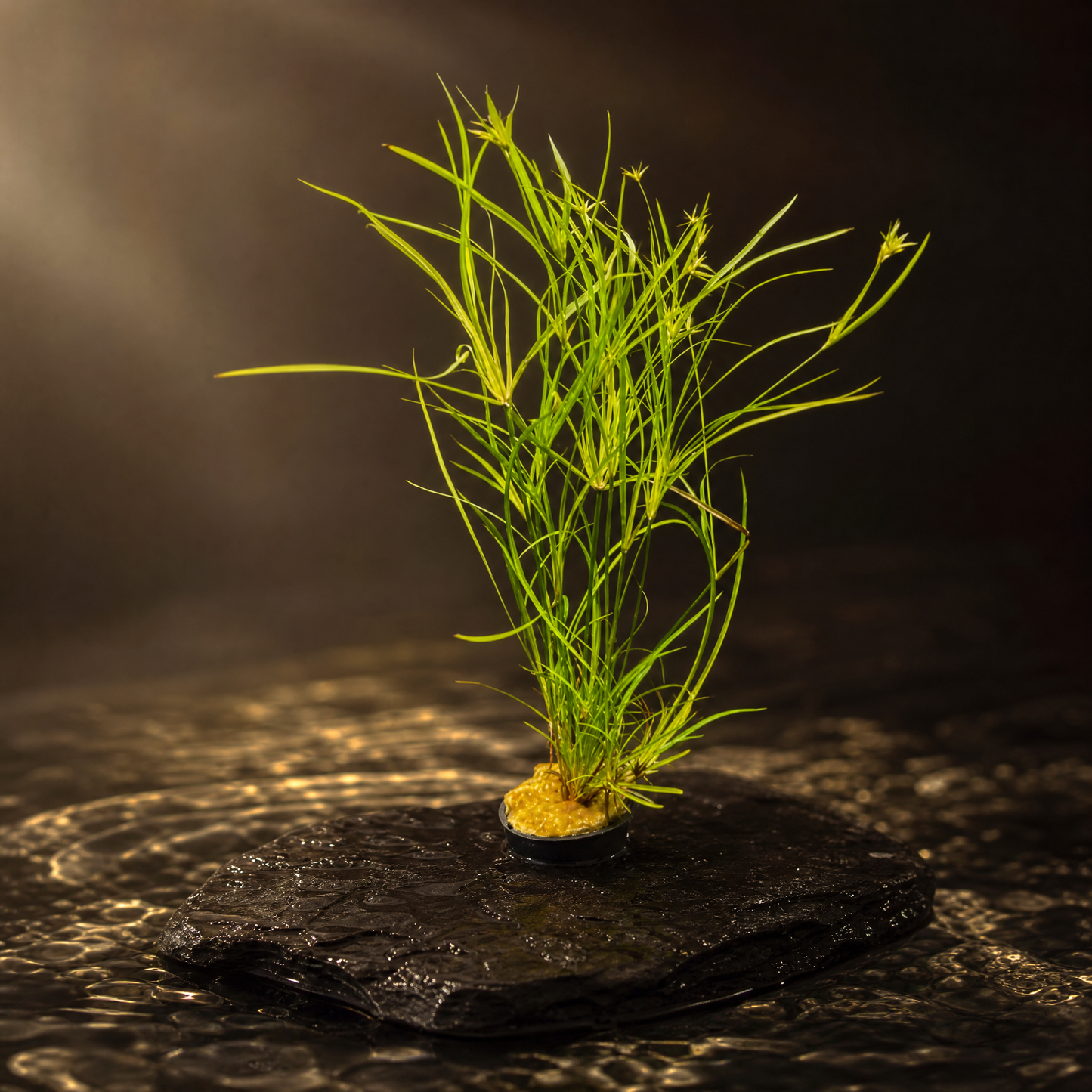
Lesser Creeping Rush (Juncus repens) - Potted
Lesser Creeping Rush (Juncus repens), usually sold under its scientific name, is a fine grassy plant with an unusual habit: flattened stems interrupted at regular intervals by tufts of needle-thin leaves, so it reads as somewhere between a grass and a stem plant. Under moderate light it is a soft, bright green. Push the light and the nutrients and the tips flush copper and rust red, which is the reason most people buy it. It is undemanding, needs no CO2, and it is one of the few aquarium plants native to our own corner of the world. Browse the rest of our live freshwater plants to round out the tank.
Care Guide
- Light drives the color: low to moderate light gives you a healthy green plant. Strong light plus good nutrients is what turns the tips orange and red. A planted-spectrum fixture like the Fluval Plant 4.0 LED makes the difference.
- Feed it from both ends: it roots well and appreciates Seachem Flourish Tabs in the substrate, plus a water-column dose of Seachem Flourish. Iron and trace elements are what bring out the red.
- Water parameters: 68 to 80°F, pH 6.0 to 7.5, soft to moderately hard. It is genuinely tolerant and even handles cooler tanks that most tropical plants sulk in.
- CO2: not required. It grows fine without it, just faster and denser with it.
- Planting: peel off the net pot, tease out the rock wool, and separate the clump into a few smaller portions. Plant them a couple inches apart and they will knit together as the runners spread.
- Watch for green spot algae: the steady, unhurried growth rate makes the older leaves a target. Keep phosphate from bottoming out, trim the worst leaves, and let a cleanup crew work the rest.
Specifications
| Scientific name | Juncus repens |
| Common names | Lesser Creeping Rush, Creeping Rush |
| Sold as | Potted plant, net pot with rock wool |
| Care level | Beginner |
| Placement | Foreground to midground, grouped |
| Height | 4 to 8 inches, creeping sideways |
| Light | Low to high (high light for red tips) |
| CO2 | Not required, beneficial |
| Temperature | 68 to 80°F |
| pH | 6.0 to 7.5 |
| Growth | Moderate, spreads by runners and side shoots |
| Origin | Southeastern United States, Mexico, Cuba |
| Pickup | In-store pickup at Squeaky's Aquatics |
A Local Native
Juncus repens grows wild across the southeastern United States, Georgia included, in ditches, pond margins, and slow blackwater. That heritage is why it shrugs off temperature swings and water chemistry that fussier imports will not tolerate. It is a natural fit for a biotope tank built around native or blackwater species, and it pairs beautifully with botanicals and driftwood.
Placement & Companions
Plant it in loose groups in the foreground or midground where the fine texture contrasts against broad-leaved plants. It sits well next to Dwarf Sagittaria and Dwarf Hairgrass for a layered grassy foreground, and the arching stems give shrimp and fry somewhere to hide. Completely safe with Amano Shrimp, nerite snails, and community fish.
Recommended Supplies
- Seachem Flourish Tabs root fertilizer
- Seachem Flourish water-column trace elements
- Fluval Plant & Shrimp Stratum nutrient substrate
- Fluval Plant 4.0 LED to bring out the red
FAQ
How do I get the red color?
Strong light first, then iron and trace elements. In a low-light tank it stays green and healthy, which is perfectly fine, but the copper and rust tones only show up when you push the lighting.
Do I need CO2?
No. It grows without it. CO2 makes it fill in faster and hold color more easily, but plenty of people run it in low-tech tanks.
Is it a stem plant or a rosette?
Both, in a sense. It has flattened stems with leaf tufts spaced along them. Propagate it like a stem plant: cut a top below a leaf cluster and replant it. Rooted or not, it takes.
Will it carpet?
Not a true carpet, but it creeps and sends out side shoots, so a group planted a couple inches apart fills in into a low grassy thicket over time.
Why are the older leaves getting spotty?
Green spot algae likes slow-growing leaves. It is common on this plant and not a sign of poor health. Keep phosphate from hitting zero and trim the worst leaves at water-change time.
How do I get my plants?
These are in-store pickup only. We hold your order and pull it fresh when you arrive.
Have a question?
Lesser Creeping Rush (Juncus repens) - Potted
