

- Sku: 480362
- Vendor: Squeaky's Aquatics
Neon Tetra (Paracheirodon innesi)
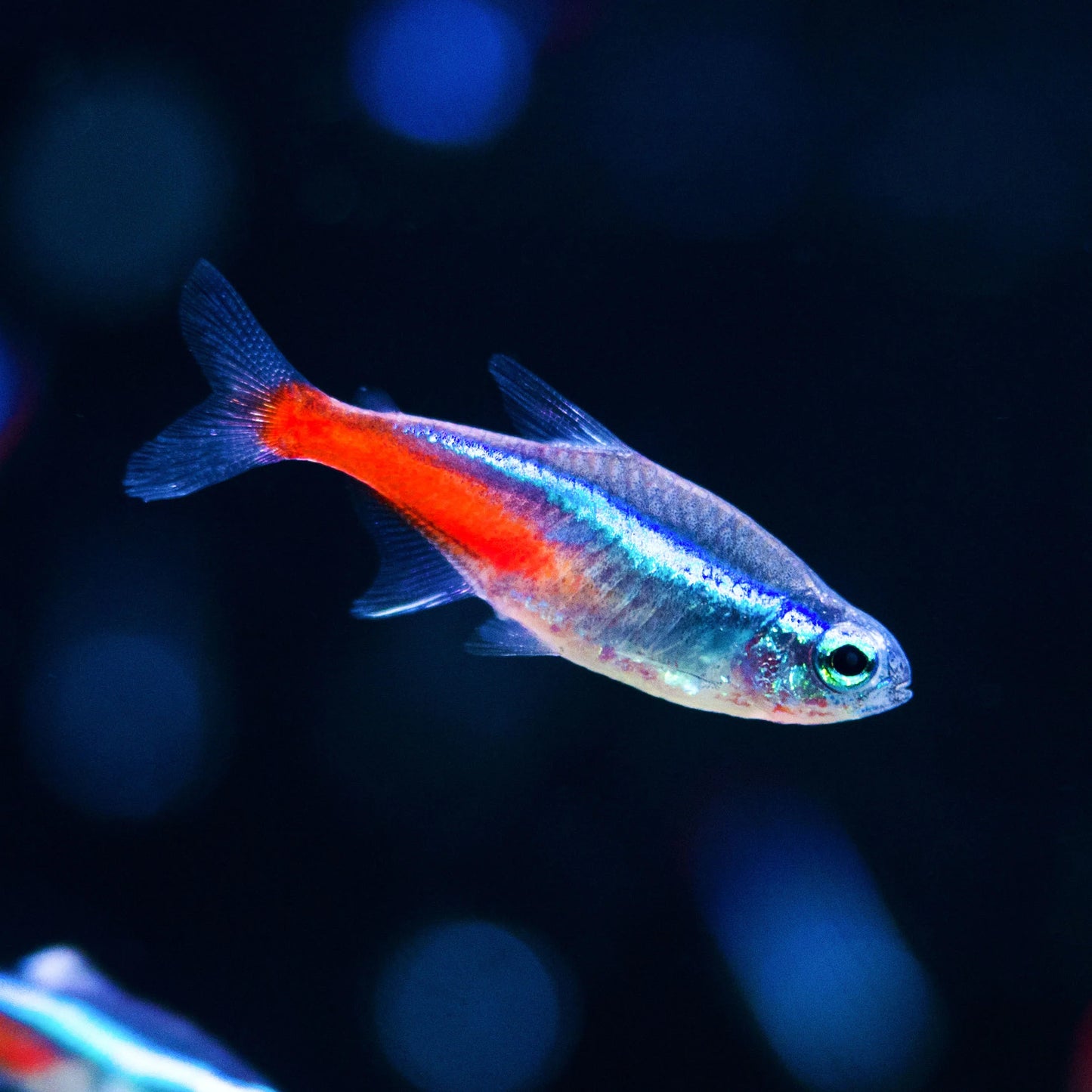
The Neon Tetra (Paracheirodon innesi) is the fish that got most of us into the hobby. An iridescent blue stripe runs the length of the body and a slash of scarlet covers the back half, and neither is pigment: the blue is structural color that flares and dims with the light and the fish's mood. In a planted tank with dark substrate, a school of them looks like a handful of neon filaments drifting through the midwater. Peaceful, tiny, cheap, and genuinely beautiful in numbers. Browse the rest of our freshwater livestock and supplies to build the tank around it.
Care Guide
- Buy a real school. Six is the bare minimum and ten or more is where they actually behave like neons: tight, confident, out in the open, colors up. A handful of three hides in a corner and looks washed out, which is not the fish's fault.
- Tank size: 10 gallons for a small school, 20 gallons for a proper one. Length matters more than height since they cruise back and forth.
- Water parameters: 70 to 78°F, pH 6.0 to 7.5, hardness 1 to 10 dGH. They come from soft, acidic Amazon blackwater and prefer the cooler end of tropical, so there is no need to run the tank at 82°F.
- Aquascape: dark substrate, planted cover, and some open swimming lane in the middle. Against sand and bare glass the colors look thin. Against Java Moss and Cryptocoryne they light up.
- Feeding: omnivore with a tiny mouth. Micro pellets and finely crushed flake are the staple, so Hikari Micro Pellets or Xtreme Nano Pellets work well, with baby brine shrimp as a treat.
- Lifespan: 5 years and beyond in a stable tank. The common "neons only live a year" belief comes from tanks that were not ready for them.
Specifications
| Scientific name | Paracheirodon innesi |
| Common names | Neon Tetra, Neon |
| Family | Characidae |
| Care level | Beginner, in an established tank |
| Temperament | Peaceful, schooling |
| Minimum school | 6, with 10 or more strongly preferred |
| Max size | About 1.5 inches |
| Current size | Medium grade |
| Minimum tank | 10 gallons, 20 for a full school |
| Temperature | 70 to 78°F |
| pH | 6.0 to 7.5 |
| Hardness | 1 to 10 dGH, soft water preferred |
| Diet | Omnivore, small foods only |
| Lifespan | 5 years or more in a stable tank |
| Origin | Blackwater streams of the upper Amazon, Peru, Colombia, and Brazil |
| Pickup | In-store pickup at Squeaky's Aquatics |
Compatibility
Peaceful with anything that will not eat them, which is the only real constraint on a 1.5 inch fish. They pair beautifully with other small community species: Ember Tetra, Brilliant Rummy Nose Tetra, Von Rio Flame Tetra, and Cherry Barb. Underneath them, a group of Skunk Corys or Panda Corys works the bottom while an Otocinclus handles algae. Amano Shrimp and nerite snails are completely safe.
What to avoid. Angelfish are the classic mistake, since an adult angel treats a neon as a snack, and the same goes for most cichlids, larger gouramis, and anything with a mouth big enough. Fin nippers like tiger barbs will also harass them.
Recommended Foods & Supplies
- Hikari Micro Pellets, sized right for a neon's mouth
- Xtreme Nano Slow-Sinking Pellets
- Xtreme Community Crave Flakes
- Ocean Nutrition Instant Baby Brine Shrimp
- Java Moss and Java Fern for cover and contrast
FAQ
Why do neons have a reputation for dying?
Because they are cheap, so they get used as cycling fish in brand new tanks, and ammonia kills them. Add them to a tank that has been running and stable for at least a month or two and they are a hardy, long lived fish. The species is not fragile, the way it usually gets bought is.
Neon or Cardinal Tetra, what is the difference?
Look at where the red stops. On a Neon Tetra the red covers only the back half of the body. On a Cardinal Tetra it runs the full length from nose to tail. Cardinals also grow slightly larger and prefer softer, warmer water.
What is Neon Tetra Disease?
A microsporidian parasite that causes patchy loss of color, a lumpy body, and a curved spine. There is no cure, so affected fish should be removed. It is uncommon in healthy stock but it is the reason quarantining new arrivals is worth the trouble, and the reason you should look closely at any fish before you buy it.
Do they need a heater?
Usually yes, but a modest one. They are comfortable from 70 to 78°F, which is cooler than many people run a tropical tank. Overheating shortens their lives, so there is no benefit to pushing 80°F and up.
Have a question?
Neon Tetra (Paracheirodon innesi)
