


- Sku: 3110202
- Vendor: Squeaky's Aquatics
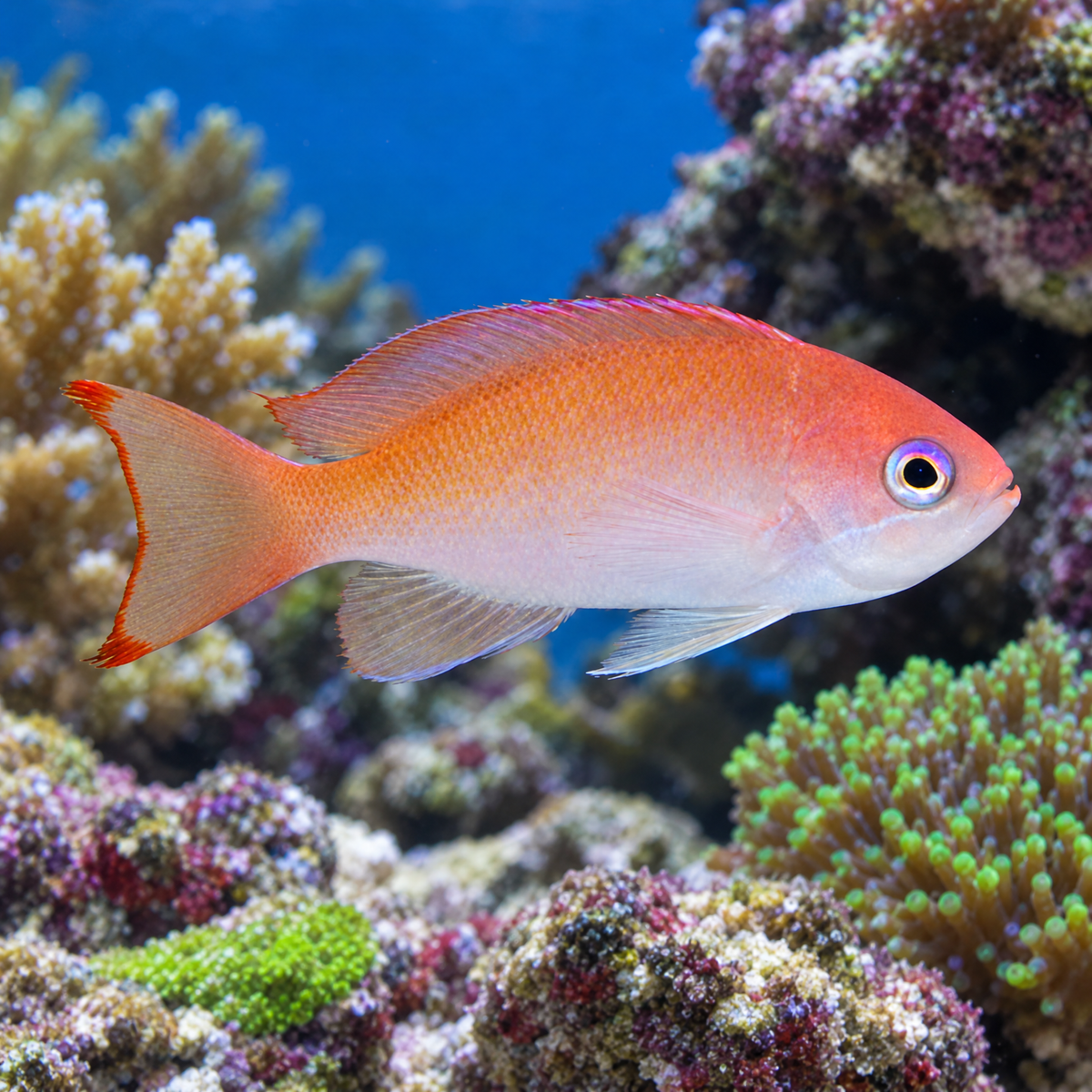
Stocky Anthias (Pseudanthias hypselosoma)
The Stocky Anthias (Pseudanthias hypselosoma), also sold as the Pink Anthias, is a deep-bodied anthias in warm pink and orange with a lavender-ringed eye and blue-edged fins. It ranges across the Indo-Pacific, from the Maldives east to Samoa, where it hovers in loose groups over lagoon patch reefs and picks plankton from the current. It is one of the hardier and easier-feeding anthias, making it a good first anthias for a larger reef. Peaceful and reef safe. Browse the rest of our saltwater livestock and supplies to build out the tank.
Sold as an Individual, Sex Not Guaranteed
Like all anthias, this species starts life as a female, and the dominant fish in a group can later turn male. Our fish are sold individually and their sex is not guaranteed. Males are a richer pink-orange with a red patch on the dorsal fin and longer fins, while females are paler and a little smaller. The photo shows a representative fish rather than the exact fish you will take home. Ask us in store and we are happy to show you the fish in the tank.
Care Guide
- Tank size: 100 gallons or larger for one fish, 125 gallons or more for a group. It reaches about 7 inches and swims the open water all day.
- Groups: keep it singly or as one male with several females. Two males in the same tank will usually fight.
- Lid recommended: anthias can jump when startled, so a lid or mesh screen is a good idea.
- Water parameters: 72 to 78°F, pH 8.1 to 8.4, salinity 1.020 to 1.025, dKH 8 to 12. Good flow and strong filtration keep it comfortable.
- Feeding: a plankton picker that does best with small meals several times a day. Offer PE Mysis, PE Calanus, enriched brine shrimp, and fine marine pellets. Two or three feedings daily keep it full-bodied and colorful.
- Cover: rockwork with caves and overhangs gives it places to retreat, which keeps it confident and out in the open.
Specifications
| Scientific name | Pseudanthias hypselosoma |
| Common names | Stocky Anthias, Pink Anthias |
| Sex | Sold as an individual, not guaranteed |
| Care level | Intermediate |
| Temperament | Peaceful, males can quarrel with other males |
| Reef safe | Yes |
| Max size | About 7 inches |
| Minimum tank | 100 gallons, 125 for a group |
| Temperature | 72 to 78°F |
| Salinity | 1.020 to 1.025 |
| Diet | Carnivore, small meaty foods fed often |
| Origin | Indo-Pacific, Maldives to Samoa |
| Pickup | In-store pickup only |
Compatibility
Stocky Anthias mix well with other peaceful reef fish: fairy wrasses like the Fine-Spotted Fairy Wrasse, clownfish like the Darwin Misbar Ocellaris Clownfish, the Blue Green Chromis, the Royal Gramma, tangs, gobies, and cleanup crew like the Scarlet Skunk Cleaner Shrimp. It ignores corals and invertebrates. Skip large predators and fast, aggressive feeders that will outcompete it at mealtime.
Different anthias species can share a large tank if they are added together. Looking at other anthias? See our Bimaculatus Anthias Female, Lyretail Anthias Female, Lyretail Anthias Male, and Ruby Anthias.
Recommended Foods & Supplies
- Piscine Energetics PE Mysis, the staple that keeps anthias fat and colorful
- Piscine Energetics PE Frozen Calanus, a rich, plankton-sized food
- Hikari Bio-Pure Frozen Mysis Shrimp, an easy everyday frozen food
- Rod's Food Frozen Original Blend, a varied meaty mix
FAQ
Is it a male or a female?
We sell it as an individual and cannot guarantee the sex. Males show a red patch on the dorsal fin and deeper color, while females are paler. A lone female, or the top fish in a group, will often turn male over time.
Is the Stocky Anthias reef safe?
Yes. It feeds on plankton-sized foods and leaves corals, clams, and shrimp alone.
How often should I feed it?
Two or three small feedings a day. Anthias graze constantly in the wild, and frequent meals keep them healthy and colorful.
Can I keep more than one?
Yes, in a large tank. Keep one male with several females, or a single fish. Two males together will usually fight.
Have a question?
Stocky Anthias (Pseudanthias hypselosoma)
