

- Sku: 1130932
- Vendor: Squeaky's Aquatics
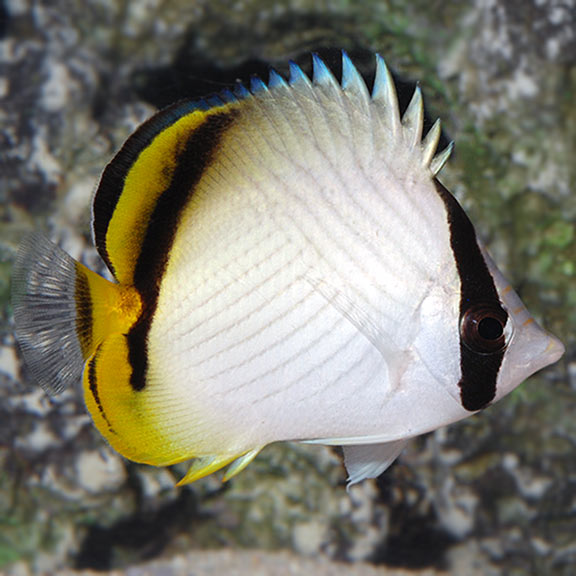
Vagabond Butterflyfish (Chaetodon vagabundus)
The Vagabond Butterflyfish (Chaetodon vagabundus) is the butterflyfish we point people to when they want the classic butterfly look without the classic butterfly heartbreak. A bright white body is crossed by fine diagonal lines that meet in a chevron, a bold black bar runs through the eye, and the back half of the fish glows yellow with a black band sweeping through the rear fins and tail. Where many butterflies are picky eaters, the Vagabond usually takes frozen and prepared foods quickly and holds up well once settled. The catch is its appetite for invertebrates: it picks at corals and anemones, so it shines in a fish-only or fish with live rock system. Browse the rest of our saltwater livestock and supplies and our full fish selection to plan the tank around it.
Care Guide
- Tank size: 125 gallons or larger for an adult. It grows to around 7 to 9 inches and spends the whole day cruising the open water and rockwork.
- Best setup: a fish-only or fish with live rock tank. Plenty of mature rock gives it something to pick at between meals and keeps it relaxed.
- Water parameters: 72 to 78°F, pH 8.1 to 8.4, salinity 1.020 to 1.025. Keep nitrate low and oxygen high with good surface agitation.
- Feeding: omnivore. Feed small portions two to three times a day, rotating meaty frozen foods like SFBB Angel & Butterfly Cube and mysis with marine algae. A frozen clam on the half shell is a great way to get a new arrival eating.
- One butterfly per tank: Vagabonds are territorial toward other butterflyfish. Mated pairs happen in the wild, but in a home tank plan on one unless the system is very large and both fish go in together.
Specifications
| Scientific name | Chaetodon vagabundus |
| Common names | Vagabond Butterflyfish, Crisscross Butterflyfish |
| Origin | Fiji, South Pacific |
| Care level | Intermediate |
| Temperament | Peaceful, territorial toward other butterflyfish |
| Reef safe | No, eats coral polyps and anemones |
| Max size | 7 to 9 inches |
| Minimum tank | 125 gallons |
| Temperature | 72 to 78°F |
| pH | 8.1 to 8.4 |
| Salinity | 1.020 to 1.025 |
| Diet | Omnivore |
| Pickup | In-store pickup at Squeaky's Aquatics |
Compatibility
Not reef safe. Like most butterflyfish, the Vagabond grazes on coral polyps, zoanthids, soft corals, anemones, feather dusters, and clam mantles. That same habit makes it a well known aiptasia eater, so it can clean up a pest anemone problem in a fish-only tank. Cleanup crew snails and hermit crabs are generally left alone, but small ornamental shrimp and tube worms are at risk. If you need aiptasia control inside a reef, a targeted treatment like Joe's Juice or Peppermint Shrimp is the safer route.
With other fish it is an easy, even-tempered neighbor. Good tank mates include the Yellow Foxface, Scopas Tang, Coral Beauty Angelfish, and Blue Green Chromis. Skip fin nippers and aggressive triggers, and avoid adding a second butterfly such as our Auriga Butterflyfish unless the tank is very large and both go in at the same time.
Recommended Foods & Supplies
- SFBB Angel & Butterfly Cube, a frozen blend made for this group of fish
- Piscine Energetics PE Mysis for the meaty part of the rotation
- Hikari Bio-Pure Frozen Clam on a Half Shell, a proven way to start a butterflyfish eating
- BRS Nori Seaweed Sheets on a VeggieMag Seaweed Clip for grazing
- Selcon Vitamin Booster to soak frozen foods
- Innovative Marine AccuDrip Acclimator for a slow, low-stress introduction
FAQ
Can I put it in my reef tank?
We do not recommend it. Some hobbyists get away with a Vagabond among hardy SPS for a while, but it will eventually sample most corals, zoanthids, and anemones. Plan on a fish-only or fish with live rock tank.
Will it eat aiptasia?
Very often, yes, and that is one reason people keep them. Just remember it does not stop at aiptasia, so it is an answer for fish-only tanks, not reefs.
Is it a good first butterflyfish?
It is one of the better ones. Vagabonds tend to accept frozen foods quickly and handle normal tank life well, where many butterflies refuse food or need pristine conditions. A mature, stable tank still matters.
How big does it get?
Around 7 to 9 inches as an adult. It starts smaller, so size the tank for where it is going, not where it is today.
Can I keep two?
Only in a large system with both fish added together. Two butterflies added at different times usually fight.
Have a question?
Vagabond Butterflyfish (Chaetodon vagabundus)
