


- Sku: FW1-F9770
- Vendor: Squeaky's Aquatics
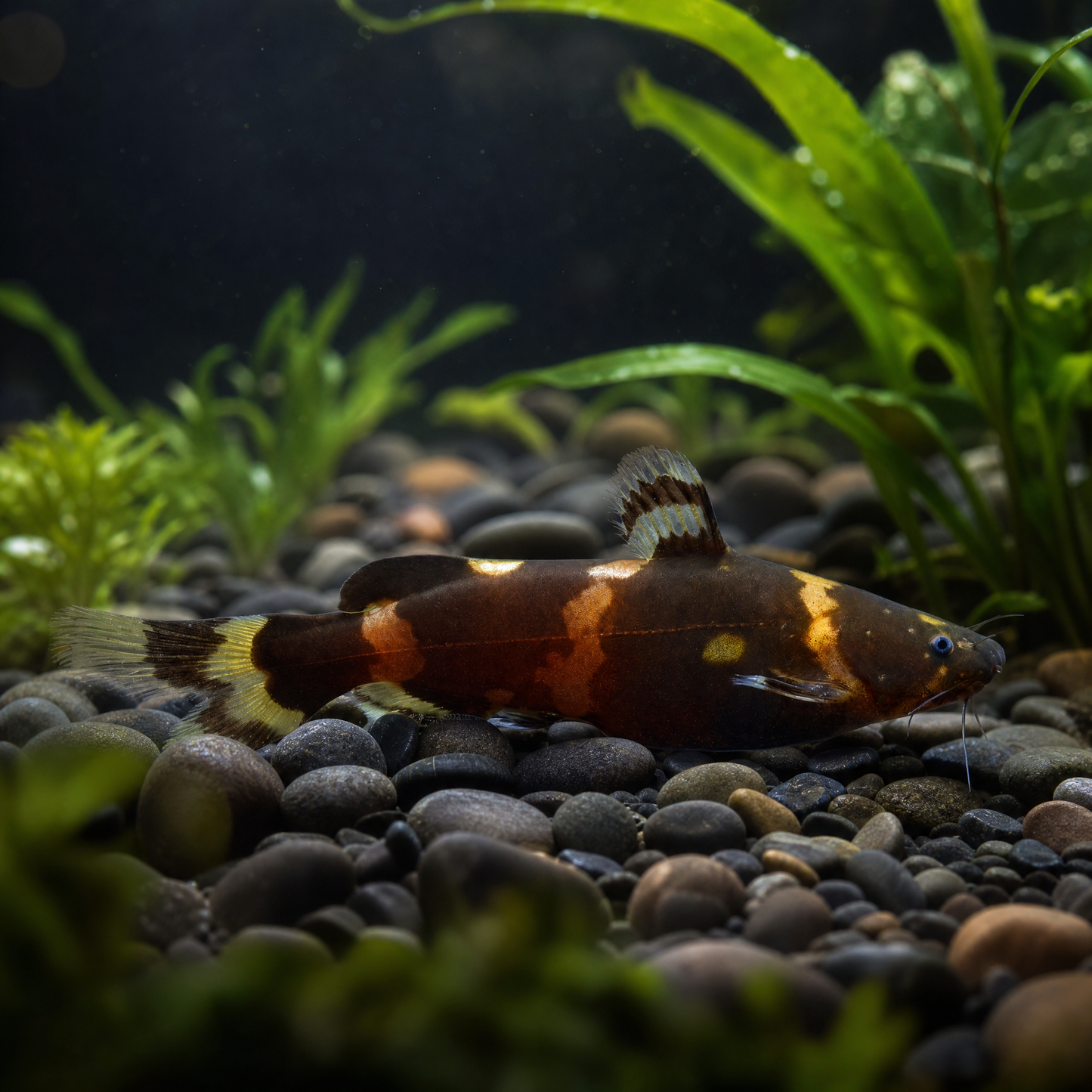
Asian Bumblebee Catfish (Pseudomystus siamensis)
The Asian Bumblebee Catfish (Pseudomystus siamensis) is a stocky, armored little bagrid in chocolate brown broken up by cream and gold banding, with a matching barred tail and a set of long, constantly working barbels. It is handsome, genuinely hardy, long lived, and full of personality once it settles. It is also nocturnal and a predator, which are the two things to understand before you buy one. Browse the rest of our freshwater livestock and supplies while you plan the tank.
Asian, Not South American
Two unrelated fish are sold as "Bumblebee Catfish" and most of the care advice online is written about the other one. The South American Bumblebee Catfish (Microglanis iheringi) tops out around 3 inches and is a mild, largely harmless community fish. This is the Asian species, Pseudomystus siamensis, from the Mekong and Chao Phraya basins, and it is a different animal: bigger at 4 to 6 inches, more thickly built, more territorial with its own kind, and considerably more predatory.
If you researched a bumblebee catfish and came away thinking it was a peaceful little community bottom dweller, you were probably reading about Microglanis. Plan for this one on its own terms and it is an excellent fish. Plan for it as a nano-safe scavenger and you will lose tetras.
Care Guide
- Tank size: 30 gallons for a single adult, 40 to 55 gallons if you want a small group. Floor space and sightline breaks matter far more than water volume.
- Caves are not optional: this fish wants somewhere dark and tight to wedge into during the day. A Hikari Dark Rock Cave, driftwood tangles, cholla wood, or a plain PVC tube all work. More hides means a bolder, less territorial fish.
- Water parameters: 72 to 80°F, pH 6.4 to 7.4, GH 4 to 15. Undemanding and forgiving once established, which is a large part of the appeal.
- Substrate: fine sand or smooth rounded gravel. Those barbels are working tools and sharp substrate wears them down.
- Feeding: carnivore. Sinking foods dropped after the lights dim: frozen bloodworms, Repashy Bottom Scratcher gel, or Hikari Sinking Wafers. Feeding at night is the difference between a fed catfish and a hungry one hunting your tetras.
- Keeping more than one: possible, but they squabble over caves. Give each fish at least one hide of its own and break up the line of sight, or keep a single specimen.
- Handling: stiff pectoral and dorsal spines lock outward and tangle in mesh nets. Guide it into a cup or bag underwater instead.
Specifications
| Scientific name | Pseudomystus siamensis |
| Common names | Asian Bumblebee Catfish, Siamese Bumblebee Catfish |
| Family | Bagridae |
| Care level | Intermediate |
| Temperament | Semi-aggressive, predatory toward small fish |
| Adult size | About 4 to 6 inches |
| Minimum tank | 30 gallons for one, 40 to 55 for a group |
| Temperature | 72 to 80°F |
| pH | 6.4 to 7.4 |
| Hardness | 4 to 15 GH |
| Diet | Carnivore, sinking and frozen foods at night |
| Activity | Nocturnal, hides during the day |
| Lifespan | Commonly 5 to 8 years |
| Origin | Mekong and Chao Phraya basins, Southeast Asia |
| Water type | Freshwater |
| Pickup | In-store pickup at Squeaky's Aquatics |
Compatibility
Judge every tankmate by whether it fits in the mouth, because that is the only rule this fish follows. Good company means medium, robust, not bite-sized: Boesemani Rainbowfish, Black Skirt Tetras, Pearl Gourami, larger barbs, and a Bristlenose Pleco or Yo Yo Loach sharing the floor. The armored Spotted Raphael Catfish is a natural companion with the same night shift habits, provided each has its own cave.
What goes wrong: anything under about two inches is on the menu, so skip Neon, Ember, and Cardinal Tetras, Chili Rasbora, Celestial Pearl Danio, and shrimp colonies. Slow, long finned fish such as fancy bettas and guppies are a poor match because a nocturnal hunter will find them asleep. Large aggressive cichlids run the risk the other way. And if you keep more than one Bumblebee, cave disputes are the thing to design around, not fights in open water.
Recommended Foods & Supplies
- Hikari Dark Rock Cave its daytime headquarters
- SFBB Frozen Bloodworms the after-dark staple
- Repashy Bottom Scratcher invertivore gel it will hunt down
- Hikari Sinking Wafers easy sinking backup
- Galapagos Cholla Wood extra hides and sightline breaks
- Estes Natural Aquatic Sand barbel safe floor
FAQ
Will it really eat my Neon Tetras?
Yes, in time. It hunts at night and grows into a mouth that easily takes a one inch fish. This is the most common regret with the species. If small tetras are staying, this catfish should not.
I never see mine. Is it alive?
Almost certainly, and probably well fed. It is nocturnal and spends daylight wedged into a cave. Feed after lights out and you will get regular appearances. Daytime confidence grows with age and plenty of hides.
Is this the same as the Bumblebee Catfish I read about?
Check which one. The South American Microglanis iheringi stays near 3 inches and is far milder. This is the Asian Pseudomystus siamensis, which grows larger and is more predatory. See the section above.
Can I keep two together?
Yes, with planning. Give each fish its own cave and break up the sightlines. They squabble over real estate rather than fighting in open water, so a scape with plenty of hiding spots settles most of it.
Is it safe with my Bristlenose or Cory catfish?
Adult armored catfish of similar size are generally fine. It is small, soft bodied fish that are at risk, not tank tough bottom dwellers that can hold their own.
Have a question?
Asian Bumblebee Catfish (Pseudomystus siamensis)
