


- Sku: FW1-F1157
- Vendor: Squeaky's Aquatics
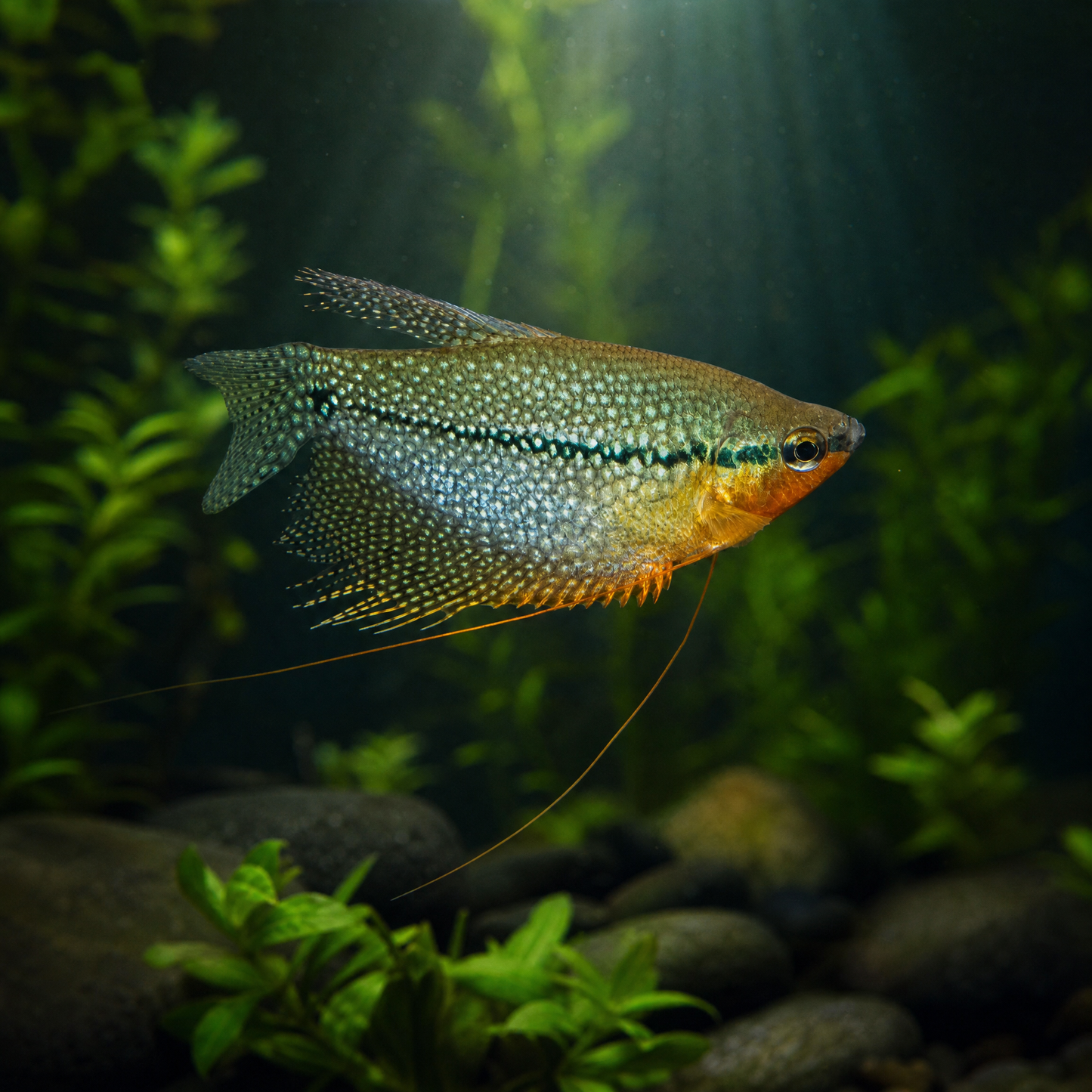
Pearl Gourami (Trichopodus leerii)
The Pearl Gourami (Trichopodus leerii) is the one people stop walking for. A lattice of pearly white spots is scattered across a warm brownish violet body, a thin dark line runs from the snout through to the tail, and a mature male carries a deep orange red throat and breast that flares when he displays. He is big enough to anchor a community tank at four to five inches, slow and deliberate in the way he moves, and gentle with everything around him. He is also genuinely easy, which is rare for a fish this showy. Browse the rest of our freshwater livestock and supplies to build the tank around him.
Care Guide
- Tank size: 30 gallons and up. These reach a real five inches, and the tank needs footprint more than height so a pair can stay out of each other's way.
- Plant it heavily and soften the light. Pearl Gouramis come from shaded, tannin stained peat swamps, and a bright bare tank leaves them washed out and skulking behind the filter. Give them Anubias, Java Fern, Java Moss, and something floating to break up the surface. The pearl pattern only really lights up on a fish that feels covered. Browse our live freshwater plants.
- Keep the flow low. This is a still water fish from swamps and flooded forest. A hard filter outflow pushes it around and keeps it away from the surface, where it needs to be.
- Surface access is required. Like bettas, Pearl Gouramis breathe atmospheric air through a labyrinth organ and must reach the top. Leave an air gap under the lid so the air they gulp is warm and humid rather than cold room air.
- Water parameters: 76 to 82°F, pH 6.0 to 7.5, hardness 5 to 15 dGH. Soft and slightly acidic is ideal, but they adapt well to ordinary tap water.
- Feeding: omnivore, and not a fussy one. A quality flake or pellet staple such as TetraMin Tropical Flakes or Hikari Micro Pellets, rotated with frozen and freeze dried foods like frozen brine shrimp or freeze dried daphnia. They are famous for picking hydra out of a tank, and they will hunt planaria too.
- Medicate carefully. Labyrinth fish tolerate aquarium salt poorly compared to most community species, so use it sparingly and at reduced strength if at all. Skip tea tree oil products such as Melafix and Bettafix entirely, since the oil film on the surface interferes with labyrinth breathing. Ask us before dosing anything copper based.
- Lid: required. Any surface breathing fish can jump, and a startled gourami will clear an open rim.
Specifications
| Scientific name | Trichopodus leerii (formerly Trichogaster leerii) |
| Common names | Pearl Gourami, Lace Gourami, Mosaic Gourami, Diamond Gourami |
| Family | Osphronemidae, the gouramis |
| Care level | Beginner |
| Temperament | Peaceful. Males may spar with each other |
| Max size | 4 to 5 inches |
| Minimum tank | 30 gallons |
| Temperature | 76 to 82°F |
| pH | 6.0 to 7.5 |
| Hardness | 5 to 15 dGH |
| Flow | Low. A labyrinth fish from still swamp water |
| Diet | Omnivore. Also eats hydra and planaria |
| Lifespan | 4 to 8 years |
| Origin | Southeast Asia. Malay Peninsula, Sumatra, and Borneo, in peat swamps and slow blackwater |
| Pickup | In-store pickup at Squeaky's Aquatics |
Compatibility
An excellent community centerpiece that does not bully anything. Pair it with peaceful schoolers such as Neon Tetras, Cardinal Tetras, Rummy Nose Tetras, Brilliant Rasboras, or Cherry Barbs. Along the bottom, Sterbai Corys, Skunk Corys, Black Kuhli Loaches, and an Otocinclus all work well.
What to avoid. Fin nippers are the real problem. Those long thread-like pelvic feelers are an obvious target and tiger barbs will shred them. Skip anything large or boisterous enough to intimidate a slow feeder, and be careful with dwarf shrimp: Amano Shrimp are usually fine at full size, but a five inch gourami will eat shrimplets and smaller cherry shrimp.
Keeping more than one. A single male with two or three females is the classic setup. Two males in the same tank will display and chase, especially in a tank under 40 gallons or when a female is present, so give them room and sight breaks if you want a group. We also carry the smaller Honey Gourami and Dwarf Gourami, plus the Blue Gourami, all different species with their own temperaments.
Recommended Foods & Supplies
- Tetra TetraMin Tropical Flakes as a staple
- Hikari Micro Pellets or Xtreme Community Crave Flakes
- Frozen Brine Shrimp Plus and Mini Bloodworms as treats
- Anubias Nana and Java Moss for cover and confidence
- A dechlorinator from our water care shelf for every water change
FAQ
How do I tell males from females?
Two easy tells once they mature. The male's dorsal fin is longer and comes to a point, while the female's is shorter and rounded, and the male develops the orange red throat and breast that the female lacks. Males are also a little slimmer. Young fish of both sexes look much the same, so give them time.
Mine is pale and hiding. Is something wrong?
Usually it is the tank, not the fish. Pearl Gouramis wash out under bright light in an open layout. Add plants, floating cover, and a dimmer light, keep the flow gentle, and the pearl spotting and red throat come up over the following weeks. A newly moved fish also needs a few days to settle before it colors up.
What are the long thread-like fins?
Modified pelvic fins that work as touch and taste organs. In murky wild water they let the fish feel out its surroundings, and in the aquarium you will see them constantly probing plants and decor. They are delicate, which is exactly why fin nippers are such a poor match.
Will it really eat hydra?
Yes, and it is one of the few reliable options. Pearl Gouramis pick hydra off the glass and plants, and they will take planaria as well. That does not replace fixing the overfeeding that caused the outbreak, but it helps a lot.
Do they build bubble nests?
Males often do, especially in a calm, well planted tank with warm water and a snug lid. It is a sign of a comfortable fish rather than a problem, and you do not need to act on it unless you want to try breeding them.
Have a question?
Pearl Gourami (Trichopodus leerii)
