


- Sku: 240282
- Vendor: Squeaky's Aquatics
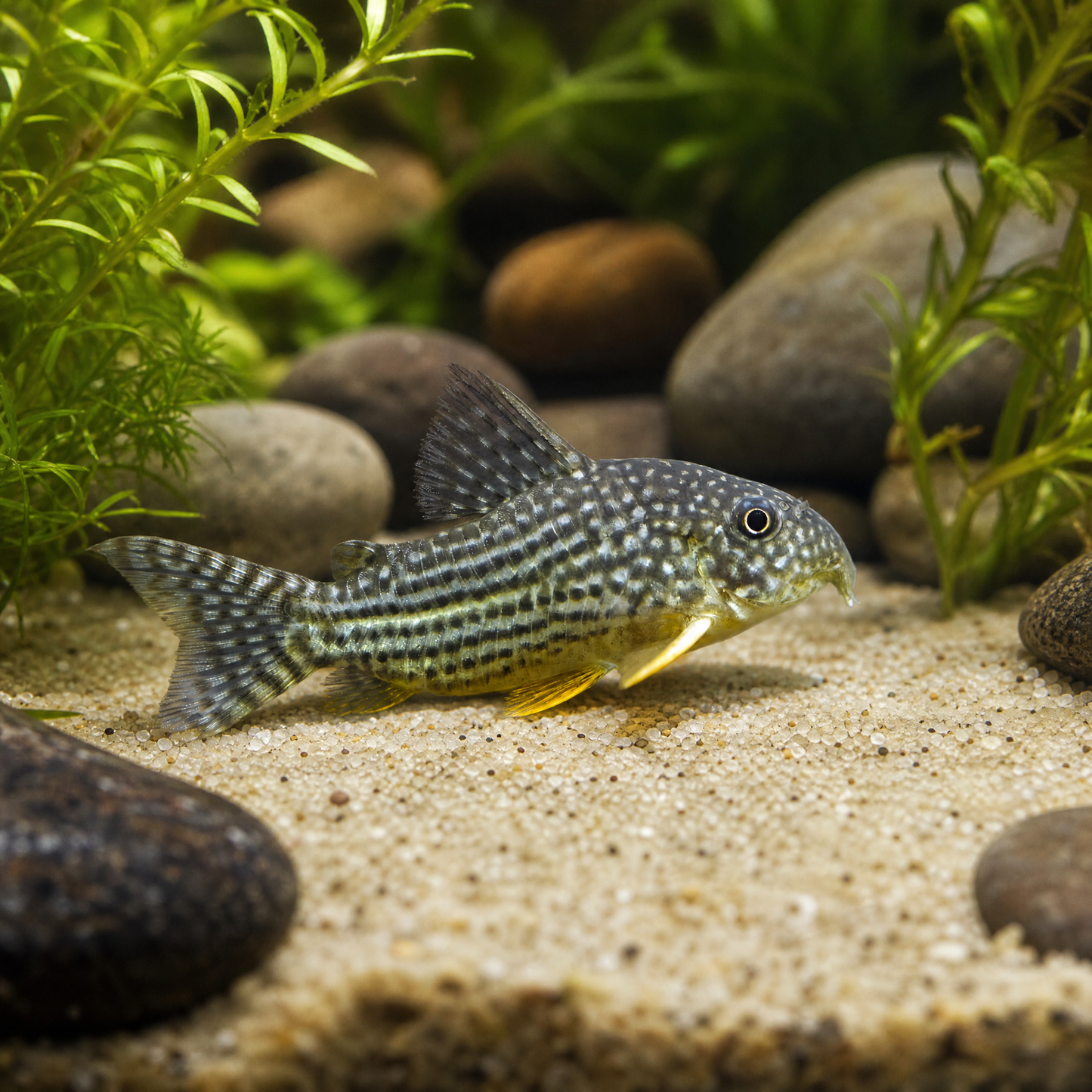
Sterbai Cory (Corydoras sterbai)
The Sterbai Cory (Corydoras sterbai) is the best looking and most useful armored catfish in the freshwater hobby: a dark chocolate body dusted with cream white spots, a finely reticulated head, and bright orange pectoral fin spines that flash every time it darts across the sand. What sets it apart from every other cory is heat tolerance. Most Corydoras start to struggle above 78°F, but the Sterbai is comfortable up to 82°F, which makes it the one cory that genuinely belongs in a discus or warm South American biotope tank. Peaceful, hardy, long lived, and endlessly busy along the bottom. Browse the rest of our freshwater livestock and supplies to build out the rest of the tank.
Care Guide
- Buy a group, not a single fish. Corys are shoaling animals. Six or more is the minimum for confident, out-in-the-open behavior, and a group of eight to ten is where they really come alive. A lone cory hides and stops eating.
- Tank size: 20 gallons or larger. Floor space matters far more than height, so a wider footprint always beats a taller tank.
- Substrate is the one thing you cannot compromise on: use soft aquarium sand or very smooth, rounded gravel. Sharp or coarse gravel wears down their barbels, and a cory that loses its barbels can no longer find food properly.
- Water parameters: 73 to 82°F, pH 6.0 to 7.6, GH 2 to 15. Genuinely adaptable, but keep nitrates low, they are sensitive to dirty water and to salt.
- Feeding: omnivore, and a scavenger by design rather than a cleanup crew. They need their own food that reaches the bottom. Hikari Sinking Wafers, Xtreme Shrimpee Sinking Sticks, and frozen bloodworms are all taken eagerly. Feed after lights out if faster mid-water fish are beating them to it.
- Do not use salt or copper based medications at full dose. Like all scaleless catfish, Sterbai are far more sensitive to them than the fish they live with.
- Netting: scoop them in a cup or container rather than a net. Their pectoral and dorsal spines lock outward, tangle in mesh, and can deliver a mild sting.
Specifications
| Scientific name | Corydoras sterbai |
| Common names | Sterbai Cory, Sterba's Corydoras, Sterba's Cory Cat |
| Care level | Beginner |
| Temperament | Peaceful, shoaling |
| Recommended group | 6 or more |
| Max size | 2.5 inches, females slightly larger |
| Minimum tank | 20 gallons |
| Temperature | 73 to 82°F, warm tank safe |
| pH | 6.0 to 7.6 |
| Hardness | GH 2 to 15 |
| Diet | Omnivore, sinking foods |
| Substrate | Sand or smooth rounded gravel |
| Lifespan | 5 to 10 years |
| Origin | Rio Guaporé basin, Brazil and Bolivia |
| Pickup | In-store pickup at Squeaky's Aquatics |
Compatibility
One of the safest community fish there is. Sterbai ignore everything above them and are far too armored to be bullied by ordinary community stock. Pair them with schooling fish like Cardinal Tetra, Neon Tetra, Ember Tetra, Rummy Nose Tetra, or Celestial Pearl Danio. They also mix perfectly with other bottom dwellers that work different shifts, including the Otocinclus Catfish and Bristlenose Pleco, and with cleanup inverts like Amano Shrimp and nerite snails. Different Corydoras species will shoal loosely together, but they school far more tightly with their own kind, so build one solid group of Sterbai before mixing in Panda or Skunk Corys. Avoid large cichlids, and avoid anything aggressive enough to harass a fish that cannot swim away quickly.
Recommended Foods & Supplies
- Hikari Sinking Wafers staple sinking food
- Xtreme Shrimpee Sinking Sticks high protein sinking stick
- Repashy Community Plus omnivore gel food
- SFBB Frozen Bloodworms for conditioning and spawning
- Estes Natural Aquatic Sand barbel safe substrate
- Hikari Ultimate Water Conditioner for water changes
FAQ
Why does everyone recommend Sterbai for discus tanks?
Because of the temperature range. Discus want water in the low 80s, which is above the comfort zone of most Corydoras. Sterbai handle it without the shortened lifespan you see when other corys are kept that warm, so they are the standard bottom dweller for warm water setups.
Mine keeps racing to the surface for a gulp of air. Is something wrong?
No, that is completely normal. Corydoras can breathe atmospheric air through a modified gut and will dash up for a gulp even in perfectly oxygenated water. Only worry if the whole group is doing it constantly and hanging at the surface, which usually points to a water quality problem.
Will they clean up leftover food for me?
Partly, but never stock them as a cleanup service. They are opportunists, not vacuums, and they will slowly starve in a tank where all the food gets eaten mid-water. Always drop a sinking food specifically for them.
How can I tell males from females?
Look from above. Females are noticeably wider and rounder through the body, especially when full of eggs, and tend to be a bit larger overall. Males are slimmer with a more pointed profile.
Is this the same fish as a Haraldschultzi Cory?
They are frequently confused. Sterbai have white spots on a dark head, while Corydoras haraldschultzi have the reverse, dark spots on a light head. The orange pectoral spines look similar on both.
Have a question?
Sterbai Cory (Corydoras sterbai)
