


- Sku: ISNBU520AA-0
- Vendor: Squeaky's Aquatics
Bumble Bee Snail (Engina mendicaria)
The Bumble Bee Snail (Engina mendicaria, often sold under the older name Pusiostoma mendicaria) is a tiny Indo-Pacific snail with bold black and yellow bands that really do look like a bumble bee. It is a busy little scavenger that spends its time hunting through rockwork and sand for leftover meaty food, dead organisms, and small worms. Browse the rest of our saltwater livestock and supplies and our invertebrates.
To be straightforward about what it does: this is not an algae eater, even though it often gets sold in cleanup crew packs as one. It is primarily a carnivorous scavenger and a micro-predator, and it may prey on very small snails and worms. Buy it for its looks and for mopping up leftover food, and pair it with true grazers for algae.
Care Guide
- Tank size: 10 gallons and up. An established tank with live rock and a sand bed gives it the most to forage.
- Diet: carnivorous scavenger. Leftover meaty foods, dead organisms, detritus, and small worms. In a clean, lightly fed tank it can go hungry, so drop a small piece of thawed mysis or a sinking pellet near it now and then.
- Not an algae grazer: it will not clean film algae, hair algae, or diatoms. Plan on separate snails for that job.
- Reef safe: yes with corals and fish. Use caution with very small snails, tiny feather dusters, and other small, slow invertebrates it may pick off.
- Water: 72 to 78°F, salinity 1.023 to 1.025, pH 8.1 to 8.4, dKH 8 to 12. No copper, ever.
- Acclimation: slow drip over 60 to 90 minutes. Snails are very sensitive to salinity swings.
- How many: about one per 5 to 10 gallons. More than that and they run out of food.
Specifications
| Common names | Bumble Bee Snail, Bumblebee Snail, Bumble Bee Whelk |
| Scientific name | Engina mendicaria (synonym Pusiostoma mendicaria) |
| Family | Pisaniidae (whelks) |
| Origin | Indo-Pacific reefs |
| Care level | Beginner |
| Temperament | Peaceful toward fish and corals, predatory toward tiny invertebrates |
| Adult size | About 0.5 to 0.75 inch |
| Minimum tank | 10 gallons |
| Reef safe | Yes, with caution around very small snails and worms |
| Diet | Carnivorous scavenger, not an algae eater |
| Stocking | About 1 per 5 to 10 gallons |
| Temperature | 72 to 78°F |
| Salinity | 1.023 to 1.025 |
| Water type | Saltwater |
Compatibility
Fine with corals, anemones, and peaceful reef fish, and with larger invertebrates like cleaner shrimp and hermit crabs. For algae, pair it with real grazers such as Red Banded Trochus Snails, Astrea Snails, and Cerith Snails, which are all big enough to be left alone.
Cautions: very small snails (including baby snails born in the tank), tiny feather dusters, and small worms can be eaten. Pufferfish, triggers, hogfish, and larger wrasses will eat Bumble Bee Snails, so skip them in those tanks.
Recommended Foods & Supplies
- SFBB Frozen Mysis Shrimp, a small thawed piece keeps it fed in a clean tank
- Nassarius Snail, another scavenger that works the sand bed
- Zebra Turbo Snail for the algae work this snail will not do
- Saltwater Refractometer to keep salinity steady for snails
FAQ
Will it eat algae?
No. Despite showing up in cleanup crew packs, it is a carnivorous scavenger. Get Trochus, Astrea, Cerith, or Turbo snails for algae.
Will it eat my other snails?
It may prey on very small snails and hatchlings. Adult Trochus, Astrea, Turbo, and Cerith snails are generally too big for it to bother.
Does it eat vermetid snails or bristleworms?
Hobbyists often credit it with eating small worms and pest snails, and it does hunt small prey. Treat that as a possible bonus, not a reliable pest control plan.
Is it Engina or Pusiostoma?
Same snail. The current accepted name is Engina mendicaria; Pusiostoma mendicaria is an older combination that is still widely used in the trade.
How do I keep it fed?
In a tank with fish being fed meaty foods it usually finds enough. In a very clean or lightly stocked tank, offer a small piece of thawed mysis near it once or twice a week.
Have a question?
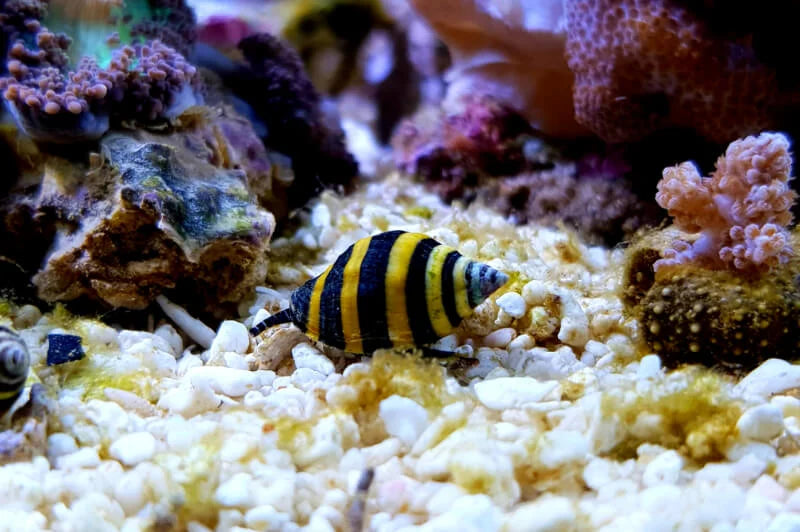
Bumble Bee Snail (Engina mendicaria)
