

- Sku: SQ-APISTOGRAMMACA
- Vendor: Squeaky's Aquatics
Cockatoo Dwarf Cichlid (Apistogramma cacatuoides)
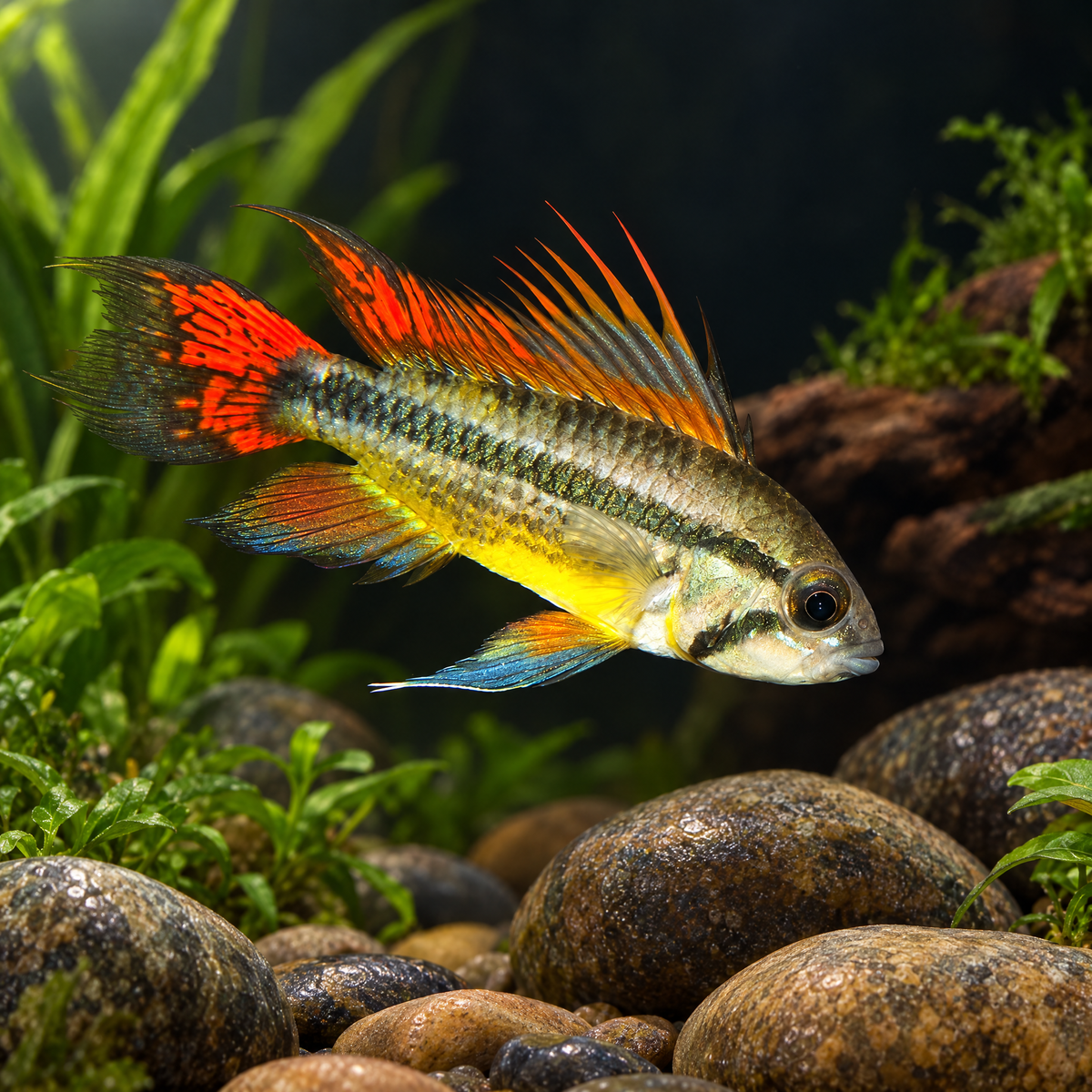
The Cockatoo Dwarf Cichlid (Apistogramma cacatuoides) is the friendliest doorway into the world of South American dwarf cichlids. Males flare a tall, spiky dorsal crest that gives the fish its name, then back it up with a lyre-shaped tail edged in orange and red, while females stay smaller and plainer until they have eggs to guard and turn a startling buttercup yellow. Tank-bred stock is forgiving about water chemistry, tops out around three inches, and settles happily into a planted 20 gallon, which makes this the rare cichlid you can keep with a school of tetras and still call beginner friendly. Browse the rest of our freshwater livestock and supplies to build the tank around it.
Care Guide
- Tank size: 20 gallons for a single fish or a pair, 29 gallons or more if you want a male with two or three females. Floor space matters more than height, so a 20 long is the ideal shape.
- Caves are not optional: this is a cave spawner and a naturally shy bottom dweller. Give it at least one cave per female plus a few spares. An Apisto Cave is purpose-built for the job, and cholla wood works just as well.
- Aquascape: break the bottom into territories with plants, wood, and leaf litter so fish can get out of each other's line of sight. Cryptocoryne wendtii, Anubias nana, and Java Fern all thrive in the same low-light, soft-water conditions the fish likes.
- Substrate: fine sand. Cockatoos sift mouthfuls of it looking for food, and sand lets them do that without scraping their gills.
- Water parameters: 75 to 82°F, pH 6.0 to 7.5, hardness 2 to 15 dGH. Tank-bred fish handle average tap water fine. A handful of catappa leaves softens and tints the water toward their blackwater home streams and brings out deeper color.
- Feeding: micropredator. Frozen foods get the best response, so rotate frozen brine shrimp and bloodworms with a quality sinking pellet like Cichlid PeeWee 1.5mm or Hikari Vibra Bites. Feed small portions twice a day and make sure food actually reaches the bottom.
- Maintenance: weekly water changes of 25 percent. They are hardy but dislike nitrate creep, and clean water is what turns a drab store fish into a showpiece over the first month at home.
Specifications
| Scientific name | Apistogramma cacatuoides |
| Common names | Cockatoo Dwarf Cichlid, Cockatoo Apisto, Big Mouth Apistogramma |
| Care level | Beginner, the most forgiving Apistogramma |
| Temperament | Peaceful, territorial around the cave when spawning |
| Max size | Males 3 to 3.5 inches, females about 2 inches |
| Minimum tank | 20 gallons, 29 gallons for a harem |
| Temperature | 75 to 82°F |
| pH | 6.0 to 7.5 |
| Hardness | 2 to 15 dGH |
| Diet | Carnivore, micropredator |
| Swimming level | Bottom and lower middle |
| Lifespan | 3 to 5 years |
| Origin | Amazon basin, Peru and Colombia. Our stock is tank bred. |
| Pickup | In-store pickup at Squeaky's Aquatics |
Compatibility
Cockatoos own the bottom of the tank and ignore everything swimming above them, which makes them excellent community cichlids. Pair them with mid and upper water schoolers like the Cardinal Tetra, Ember Tetra, Rummy Nose Tetra, or Kubotai Rasbora. Algae crew like the Otocinclus Catfish and Clown Pleco stay out of the way on wood and glass. Corydoras work in a 29 gallon or larger where there is enough floor to share, with the Sterbai Cory a good match for the warmer end of the range and the Panda Cory for the cooler end.
Give them room from other substrate-claiming cichlids unless the tank is 40 gallons or more, and skip fin nippers such as tiger barbs, which will shred a male's crest and trailing fin extensions. Dwarf shrimp are food, not tank mates, though ramshorn and nerite snails are safe. If a pair spawns, expect the female to defend a few inches around her cave for a couple of weeks. That is normal behavior and not a sign of an aggressive fish.
Recommended Foods & Supplies
- Aquarium Co-Op Apisto Cave purpose-built spawning and hiding cave
- Hikari Bio-Pure Frozen Brine Shrimp for color and conditioning
- Xtreme Cichlid PeeWee 1.5mm slow-sinking staple pellet
- Hikari Vibra Bites bloodworm-shaped sinking sticks
- Repashy Community Plus gel food for variety
- Fritz Catappa Leaves for blackwater tint and natural cover
FAQ
How do I tell males from females?
Males are noticeably larger, carry the tall spiky dorsal crest, and grow a lyre-shaped tail marked with orange and red. Females stay around two inches, wear a plain sandy yellow, and turn vivid golden yellow with black blotches when they are holding eggs or herding fry. Ask us which we have in the tank and we will show you.
Do I need soft, acidic blackwater to keep one?
No. Tank-bred cockatoos live comfortably from pH 6.0 all the way to 7.5 and in average tap hardness. Soft acidic water with leaf litter deepens their color and is required if you want viable fry, but it is not needed for a healthy, long-lived fish.
Will it eat my cherry shrimp?
Adults will hunt shrimp, including full-grown cherries, and they are very good at it. Keep the shrimp colony in a separate tank. Snails are safe.
Will it tear up my planted tank?
Not the way a larger cichlid would. Cockatoos sift sand and nose around the base of plants but do not uproot or eat them. Rooted crypts, swords, and anything attached to wood or rock stay exactly where you put them.
Have a question?
Cockatoo Dwarf Cichlid (Apistogramma cacatuoides)
