


- Sku: 210172
- Vendor: Squeaky's Aquatics
Electric Yellow Cichlid (Labidochromis caeruleus)
The Electric Yellow Cichlid (Labidochromis caeruleus), also called the Electric Yellow Lab or Yellow Lab, is a Lake Malawi mbuna with a lemon-yellow body and crisp black trim on the dorsal and pelvic fins. It is one of the calmest mbuna in the hobby, which makes it the classic first fish for an African cichlid tank. Care level is beginner-friendly and temperament is semi-aggressive, so it fits right into a rocky, hard-water rift lake setup alongside other mbuna.
Browse the rest of our freshwater fish, and pick up water care to keep your rift lake chemistry steady.
Care Guide
- Tank: 30 gallons minimum for a small group, 55 gallons or more for a mixed mbuna community. A 4 ft footprint gives males room to claim territory.
- Aquascape: Stack rockwork into caves and crevices, like the Hikari Texas Holey Rock, over aragonite sand such as CaribSea African Cichlid Mix. Broken sight lines keep aggression low.
- Water: Hard, alkaline water, pH 7.6 to 8.6. If your tap water is soft, raise KH and pH with Fritz Rift Lake Cichlid Buffer and add minerals with Fritz Rift Lake Cichlid Salt.
- Feeding: Omnivore. In the wild Yellow Labs pick insect larvae and small invertebrates off the rocks, so they handle a bit more protein than most mbuna. Feed a quality cichlid pellet such as Hikari Cichlid Staple, with a vegetable-based pellet or flake a few times a week. Skip beef heart and other heavy, fatty foods, which can trigger bloat in mbuna.
- Stocking: Keep one male with three or more females, or a group of six or more. A slightly crowded tank spreads out chasing.
- Maintenance: 25 to 30 percent water changes weekly. Mbuna are heavy eaters and need strong filtration.
Specifications
| Common Name | Electric Yellow Cichlid, Electric Yellow Lab, Yellow Lab |
| Scientific Name | Labidochromis caeruleus |
| Origin | Lake Malawi, East Africa (captive bred) |
| Adult Size | Up to 4 inches |
| Minimum Tank | 30 gallons (55+ for mixed mbuna) |
| Temperature | 76 to 82°F |
| pH | 7.6 to 8.6 |
| Hardness | 10 to 20 dGH |
| Diet | Omnivore |
| Temperament | Semi-aggressive (mild for an mbuna) |
| Care Level | Beginner-friendly |
| Breeding | Maternal mouthbrooder |
| Pickup | In-store pickup only |
Compatibility
Good tank mates: other similar-sized mbuna such as the Electric Blue Johanni, rusty and acei cichlids, and robust synodontis catfish or bristlenose plecos. The yellow body contrasts beautifully with blue mbuna.
Avoid: soft-water community fish (tetras, rasboras, gouramis), slow or long-finned fish, and small shrimp, which will be eaten. Do not house with other Labidochromis or very similar yellow mbuna, since they can hybridize.
Recommended Foods & Supplies
- Hikari Cichlid Staple, a daily pellet
- Vitalis Cichlid Herbivore Pellets, a vegetable-rich rotation food
- Seachem NutriDiet Cichlid Flakes
- Fritz Rift Lake Cichlid Buffer and Rift Lake Cichlid Salt
- CaribSea African Cichlid Mix substrate
FAQ
Are Electric Yellow Cichlids good for beginners?
Yes. They are hardy, tolerant of a range of hard-water conditions, and one of the least aggressive mbuna, so they are a great starting point for an African cichlid tank.
Can I keep just one?
You can, but they show more natural behavior in a group. Mbuna do best in a well-stocked tank where no single fish gets singled out.
How can I tell males from females?
It is tricky, since both sexes are yellow. Males usually grow larger and show darker, bolder black on the dorsal and pelvic fins, while females tend to have paler fin edges.
Will they eat my plants?
Less than most mbuna, but they dig and rearrange. Tough plants like anubias and java fern attached to rock hold up best.
Have a question?
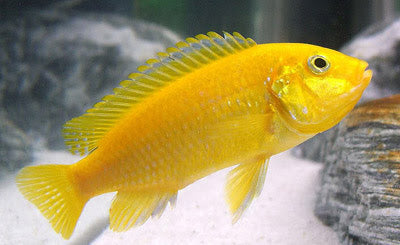
Electric Yellow Cichlid (Labidochromis caeruleus)
