


- Sku: FW1-F6851
- Vendor: Squeaky's Aquatics
Leucistic Axolotl (Ambystoma mexicanum)
The Leucistic Axolotl (Ambystoma mexicanum) is one of the most charming and beginner-friendly amphibians in the hobby, instantly recognized by its pale pink-to-white body, feathery red external gills, and permanent smile. Leucistic ("lucy") axolotls keep their dark eyes, which sets them apart from the pink-eyed albino morph. These fully aquatic salamanders are hardy, long-lived, and full of personality, as long as you give them cool, clean water and a calm tank.
Explore the rest of our freshwater livestock and aquatic oddities, and consider a similarly sized Wild Type Axolotl if you would like a tank companion.
Care Guide
Axolotls are easy to keep once their two non-negotiables are met: cool water and pristine water quality.
- Cool water, no heater. Keep the tank at 60 to 68°F. Cool water is the single most important factor for axolotl health. Sustained temperatures above 74°F cause stress, loss of appetite, and illness. In warm rooms, a clip-on fan or an aquarium chiller may be needed in summer.
- Tank size. A single adult needs at least a 20 gallon tank, adding roughly 10 gallons per additional axolotl. Choose a long footprint over a tall one, since axolotls walk along the bottom rather than swim in open water.
- Substrate. Use a bare bottom or fine aquarium sand only. Never use gravel or small stones, which axolotls swallow while feeding and which cause life-threatening impaction.
- Gentle filtration. Axolotls dislike strong current. A sponge filter or a baffled hang-on-back filter keeps the water clean without blasting them around the tank.
- Water quality. Aim for pH 7.4 to 7.8 and moderately hard water. Always dechlorinate fresh water before it goes in. Axolotls have permeable skin and are very sensitive to ammonia, chlorine, and nitrite, so a fully cycled tank and regular water changes are essential.
- Hides and low light. Provide a cave or shaded area. Axolotls have no eyelids and prefer dim, calm tanks where they can retreat.
Specifications
| Scientific Name | Ambystoma mexicanum |
| Common Names | Leucistic Axolotl, Lucy, Mexican Walking Fish |
| Care Level | Beginner to Intermediate |
| Adult Size | 9 to 12 inches |
| Lifespan | 10 to 15 years |
| Temperature | 60 to 68°F |
| pH | 7.4 to 7.8 |
| Minimum Tank Size | 20 gallons (single adult) |
| Diet | Carnivore |
| Temperament | Peaceful, predatory toward small tankmates |
| Origin | Endemic to Lake Xochimilco, Mexico (captive-bred) |
| Availability | In-store pickup only |
Compatibility
- Best kept alone or with other axolotls of a similar size.
- Do not house with fish. Fish nip the delicate external gills, and axolotls will try to eat anything that fits in their mouth.
- Keep tank mates the same size. Larger axolotls may nip the limbs of smaller ones (limbs regenerate, but the stress is best avoided).
- Snails and shrimp will be treated as food, so skip cleanup crews in an axolotl tank.
Recommended Foods & Supplies
- Sera Axolotl Wafers, a soft sinking staple food
- ZooMed Axolotl & Aquatic Newt Food, high-protein sinking pellets
- Earthworms and frozen bloodworms make excellent supplemental feedings
- DrTim's One & Only Axolotl to cycle the tank quickly and safely
- Seachem Prime Complete to dechlorinate every water change
- Hikari Bacto-Surge Sponge Filter for gentle, axolotl-safe flow
Frequently Asked Questions
Do axolotls need a heater?
No. Axolotls are cool-water animals. Keep them between 60 and 68°F and never let the tank sit above about 72°F for long. In most homes no heater is needed, and a chiller or fan helps during hot months.
What do axolotls eat?
They are carnivores. Earthworms, axolotl pellets and wafers, and occasional frozen bloodworms are all great. Feed adults every two to three days and juveniles daily.
Can I keep my axolotl with fish?
It is not recommended. Fish nip the gills and axolotls may eat smaller fish. Keep them solo or with same-size axolotls only.
What substrate is safe?
A bare bottom or fine sand only. Gravel and small stones are swallowed during feeding and can cause fatal impaction.
Have a question?

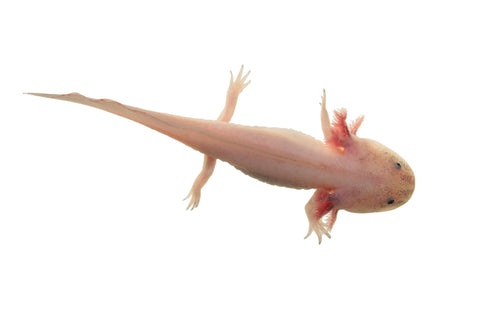
Leucistic Axolotl (Ambystoma mexicanum)
