

- Sku: 160082
- Vendor: Squeaky's Aquatics
Peacock Gudgeon (Tateurndina ocellicauda)
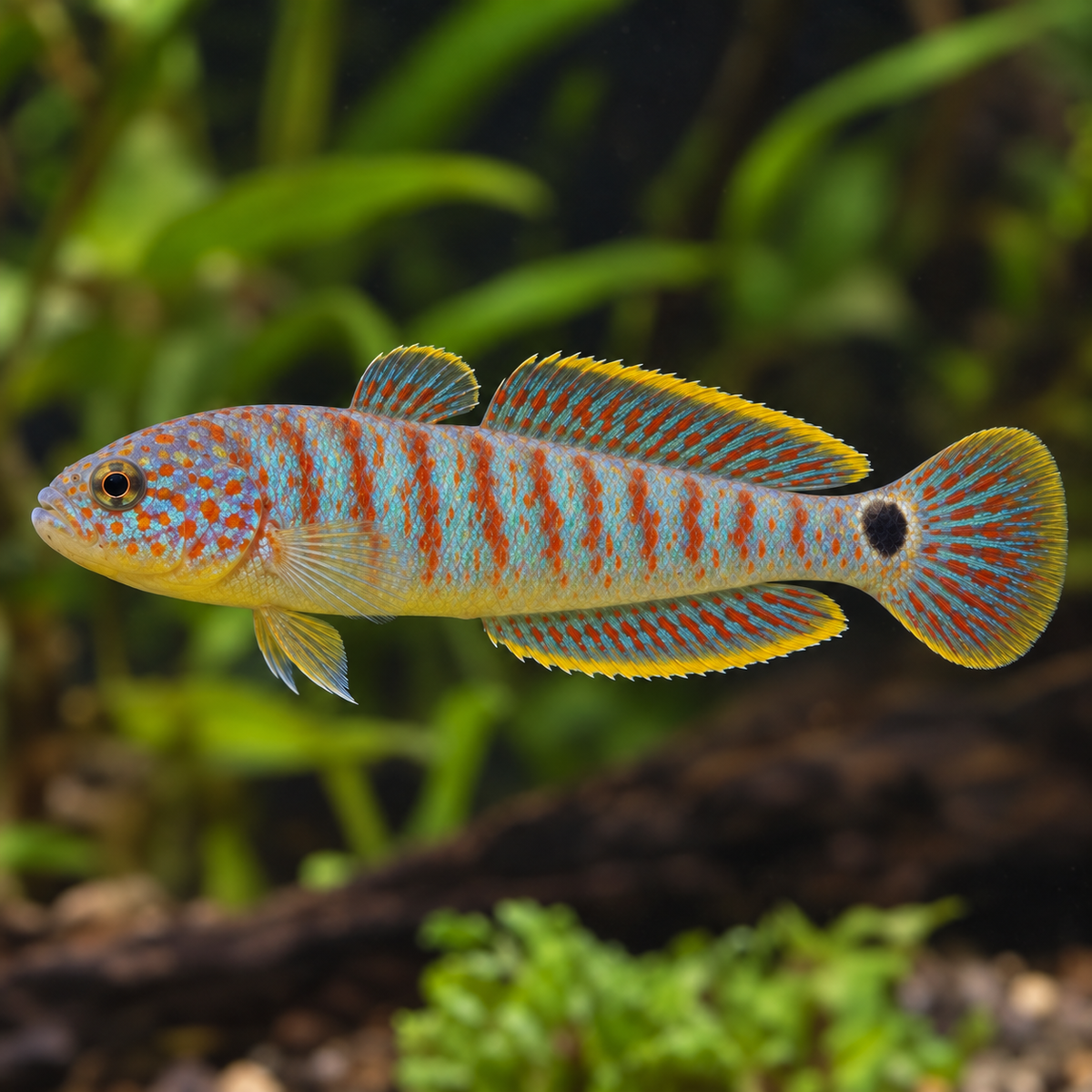
The Peacock Gudgeon (Tateurndina ocellicauda) is one of the best looking small fish you can put in a planted community tank, and one of the most underrated. A silvery blue body is broken up by ragged red bars, the fins are edged in yellow and shot through with red rays, and there is a dark eyespot at the base of the tail that gives the species its name. Males develop a pronounced forehead hump as they mature. They stay under three inches, they are peaceful, and they will breed in your display tank without any special effort. Care level is beginner. Browse the rest of our live fish and freshwater supplies to build the tank around them.
Care Guide
- Tank size: 15 to 20 gallons is a comfortable home for a small group. Footprint matters more than height, since they work the lower half of the tank.
- Diet: micropredator. They much prefer small live and frozen foods, so build the diet around mini bloodworms, daphnia, and brine shrimp. Many will take micro pellets, but colour and spawning both improve noticeably on frozen and live food.
- Water parameters: 72 to 79°F, pH 6.5 to 7.5, hardness 5 to 10 dGH. Soft and slightly acidic is ideal, but they are adaptable and forgiving.
- Aquascape: dense planting, driftwood, and a darker substrate. Peacock Gudgeons are shy in a bare tank and show their best colour when they feel covered. Leave open swimming lanes between the planted areas.
- Caves: give them small caves, pipe sections, or tight rock crevices. They use them constantly, and they are where spawning happens.
- Lid: recommended. They are not notorious jumpers, but a startled fish can still make it over the rim.
- Breeding: genuinely easy. The female lays eggs on the roof of a cave and the male takes over completely, guarding and fanning the clutch for five to seven days until they hatch. Fry are free swimming a day or two later and need very small food such as infusoria and baby brine shrimp. Move fry to their own tank if you want to raise a decent number.
Specifications
| Scientific name | Tateurndina ocellicauda |
| Common names | Peacock Gudgeon, Peacock Goby |
| Family | Eleotridae, the sleepers and gudgeons. Not a true goby. |
| Origin | Lowland streams and ponds of eastern Papua New Guinea |
| Max size | Up to 3 inches (7.5 cm), often smaller |
| Care level | Beginner |
| Temperament | Peaceful, mildly territorial with its own kind |
| Minimum tank | 15 gallons |
| Temperature | 72 to 79°F |
| pH | 6.5 to 7.5 |
| Hardness | 5 to 10 dGH |
| Diet | Carnivore, small live and frozen foods |
| Breeding | Cave spawner, paternal care, easy |
| Pickup | In-store only |
Compatibility
An excellent community fish for small, peaceful tankmates. They do well with Ember Tetras, Neon Tetras, Galaxy Rasboras, corydoras, and Otocinclus. Keep them away from anything large or boisterous, since they are slow deliberate feeders that lose out to pushy fish.
Among themselves they squabble, but it is almost entirely bluff. Males flare and display at each other over cave territory and rarely do any damage. A group of six or more with several caves spreads the attention around and gives you constant colour, since a displaying male is a male at his brightest. One caution worth knowing: they will eat their own fry and any other very small fry in the tank, so dwarf shrimp adults are fine but shrimplets will not survive.
Recommended Foods & Supplies
- SFBB Mini Bloodworms and Baby Brine Shrimp, the foods that bring out their colour
- Freeze-Dried Daphnia for easy everyday feeding
- Hikari Micro Pellets as a dry staple
- AquaVitro Ceramic Hide, the cave they will spawn in
- Cryptocoryne wendtii and Java Moss for the dense planting they prefer
FAQ
Is this actually a goby?
No, despite the common name Peacock Goby. It belongs to the Eleotridae, the sleepers and gudgeons. True gobies have their pelvic fins fused into a suction disc, and this fish does not. In practice it also means it swims freely instead of perching on the bottom the way a true goby does.
How do I tell males from females?
Males are larger, more colourful, and develop a distinct hump on the forehead as they mature. Females stay slimmer with a yellow wash on the belly and dark barring in the anal and dorsal fins. The hump is the easiest tell on an adult.
Will they breed in my community tank?
Very likely, yes. They spawn readily in caves and the male guards the eggs himself. Getting fry to survive is the harder part, since other fish and the parents will eat them. Move the cave to a separate tank if you want to raise a batch.
Do I need a group or is one fine?
A group of six or more is much better. They are not a strict schooling fish, but in a group they display to each other constantly, which is when the colour really comes out. A single fish tends to sit quietly and stay drab.
Have a question?
Peacock Gudgeon (Tateurndina ocellicauda)
