


- Sku: FW1-F1069
- Vendor: Squeaky's Aquatics
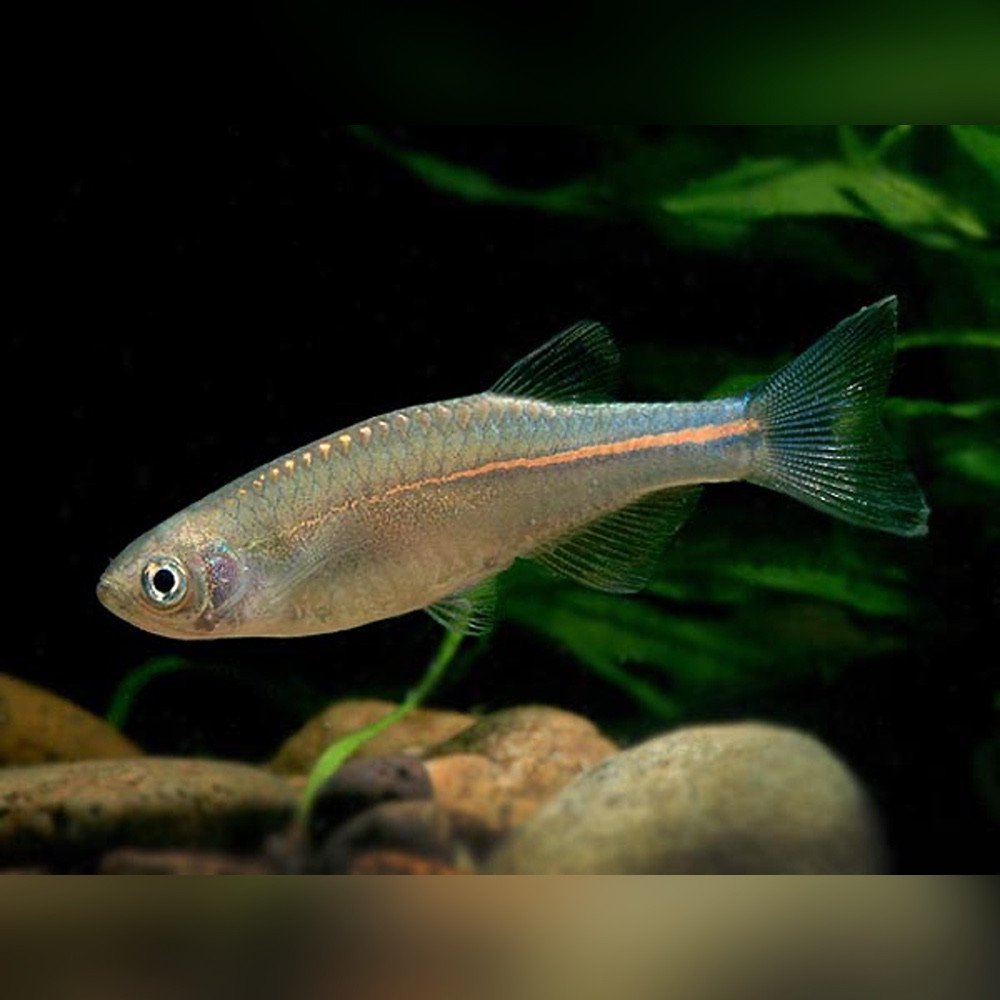
Pearl Danio (Danio albolineatus)
The Pearl Danio (Danio albolineatus) is the quiet overachiever of the danio family. Instead of the bold stripes of its zebra cousin it wears a soft mother-of-pearl sheen, lavender over silver, lit up by a single orange-pink racing stripe that runs from mid-body into the tail. Put six or more together under decent lighting and the whole group flickers as they turn. They are fast, endlessly active, genuinely peaceful, and about as hardy as a tropical fish gets, which makes them one of the better first schooling fish we stock. Browse the rest of our freshwater livestock and supplies to build out the tank.
Care Guide
- Keep six at an absolute minimum, eight to ten is better. This is the single biggest factor in how they behave. A proper group is confident and constantly on the move; a lone pair or trio turns skittish, hides, and can start pestering tank mates out of stress.
- Tank size: 20 gallons is the practical minimum for a real school, and a long footprint beats a tall one every time. These are sprinters, so open swimming length matters far more than gallons on paper.
- Flow and oxygen: in the wild they live in brisk, well-oxygenated hill streams. They love current. Angle a powerhead or your filter return down the length of the tank and they will spend all day surfing it.
- Water parameters: 68 to 77°F, pH 6.5 to 7.5, GH 4 to 18. Note the temperature range, since Pearl Danios do beautifully at room temperature and are one of the few tropicals that suit an unheated or subtropical tank.
- Feeding: omnivore and completely unfussy. A quality flake such as Ocean Nutrition Freshwater Community Formula or Hikari Micro Pellets makes a fine staple. Rotate in freeze-dried daphnia or frozen bloodworms a couple of times a week for color and condition. They feed at the surface and mid-water and eat fast, so drop food in a couple of spots.
- Aquascape: open water down the middle with planting along the back and sides. They are not shy fish and do not need heavy cover, but a few plants give slower tank mates somewhere to step out of the traffic.
- Lid required, no exceptions. Danios are among the most reliable jumpers in the hobby, and a startled school will find any gap in a cover. A full lid or a tight mesh top is essential, including around cord and hose cutouts.
Specifications
| Scientific name | Danio albolineatus |
| Common names | Pearl Danio, Turquoise Danio, Gold Danio |
| Care level | Beginner |
| Temperament | Peaceful, very active |
| Max size | 2 to 2.5 inches |
| Minimum group | 6, ideally 8 to 10 |
| Minimum tank | 20 gallons, long footprint preferred |
| Temperature | 68 to 77°F, no heater required in most rooms |
| pH | 6.5 to 7.5 |
| Hardness | 4 to 18 dGH |
| Diet | Omnivore |
| Swimming level | Top and middle |
| Origin | Streams of Myanmar, Thailand, Laos and Sumatra |
| Pickup | In-store pickup at Squeaky's Aquatics |
Compatibility
An easy community fish that shares the tank well as long as its tank mates can handle a bit of energy. Since Pearl Danios own the top and middle of the water column, the best pairings sit somewhere else: bottom dwellers like the Panda Cory, Sterbai Cory, and Otocinclus Catfish are ideal. Other mid-water schoolers such as the Neon Tetra, Cardinal Tetra, and Brilliant Rasbora work nicely, and they mix perfectly with their own relatives like the Zebra Danio. Nerite snails are completely safe, and adult Neocaridina shrimp generally hold their own, though any shrimplets born in the open will be treated as food.
What to avoid: slow, long-finned fish such as bettas, fancy guppies, and angelfish. Pearl Danios are not aggressive, but they are quick and constantly moving, which stresses out fish that swim deliberately and can lead to nipped fins and stolen food. Give them roommates that keep up or stay out of the way.
Recommended Foods & Supplies
- Ocean Nutrition Freshwater Community Formula Flake as a daily staple
- Hikari Micro Pellets sized right for small mouths
- Hikari Bio-Pure Freeze-Dried Daphnia for variety and conditioning
- SFBB Frozen Bloodworms as a twice-weekly treat
- Water conditioner and test kits to keep the tank stable
FAQ
Is this the same as a Celestial Pearl Danio?
No, and it is a common mix-up. The Celestial Pearl Danio (Danio margaritatus) is a tiny, shy, spotted nano fish for calm planted tanks. The Pearl Danio here is a larger, faster, far bolder open-water schooler. Different fish, different tank.
Do they really not need a heater?
In a typical heated home, usually not. They are comfortable from the upper 60s through the upper 70s, which makes them a great choice for an unheated room-temperature tank. What they will not tolerate is a temperature that swings, so if your room gets cold at night a heater set low is still the safer call.
Why do mine look washed out?
Almost always stress, a group that is too small, or a bright bare tank. Colors deepen with a larger school, a darker substrate, some plant cover, and a varied diet. Give them a couple of weeks to settle and the pearl sheen fills in considerably.
Are they fin nippers?
Not habitually, unlike tiger barbs. Nipping shows up when they are kept in groups that are too small or housed with slow, trailing-finned fish that are simply easy targets. Keep eight of them and pick active tank mates and the problem does not appear.
Will they eat my shrimp?
Adult Neocaridina are usually fine, since a full-grown cherry shrimp is too big to swallow. Shrimplets are another story. If you want a shrimp colony to actually multiply, give it dense moss and plant cover, or keep the two in separate tanks.
Have a question?
Pearl Danio (Danio albolineatus)
