


- Sku: SQ-CLOWNPREMIUMPI
- Vendor: Squeaky's Aquatics
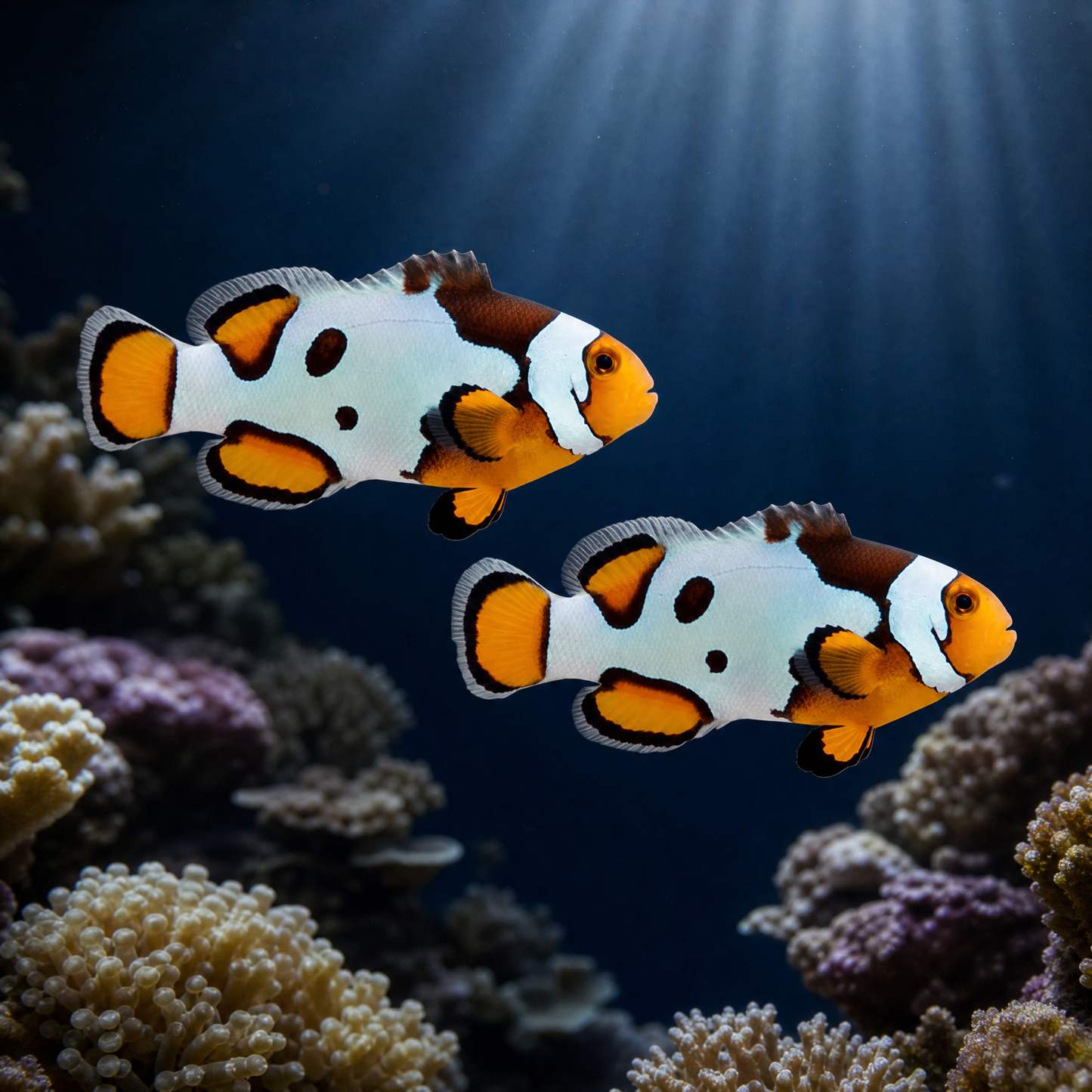
Premium Picasso Clownfish (Amphiprion percula)
The Premium Picasso Clownfish is a high grade designer Amphiprion percula, and it is the fish that made people start collecting clownfish the way they collect corals. Selective breeding pushed the normal three white bars into wandering, irregular shapes that spill across the body, merge into each other, and stop in the middle of nowhere. Heavy black outlining frames every white patch against deep orange, and no two fish carry the same pattern. Underneath the paint job it is still a True Percula: captive bred, eating prepared food from day one, and about as forgiving as a marine fish gets. Browse the rest of our saltwater livestock and supplies to build the tank around it.
Why buy the bonded pair
Clownfish are protandrous, which means every fish hatches male and the dominant one of a pair turns female. A bonded pair has already been through that process together: the larger female and the smaller male have settled the hierarchy, they share a territory, and they go straight into your tank as a working unit. Buying two singles and hoping they pair up is the slower, riskier route, and introducing a second clown to an established adult later is riskier still. If you want two Picassos in your display, the pair is the way to do it.
Care Guide
- Tank size: 20 gallons or larger for a pair. Clownfish stake out a small territory and stay in it, so rockwork and a hosting spot matter more than open swimming room.
- Water parameters: 74 to 80°F, pH 8.1 to 8.4, salinity 1.020 to 1.026. Captive bred Percula are among the hardiest marine fish available.
- Feeding: omnivore, and never shy about it. A marine pellet such as PE Saltwater Pellets daily, plus frozen PE Mysis two or three times a week, keeps the orange saturated.
- Anemone: optional and not required at all. If you want the classic scene, a bubble tip (Entacmaea quadricolor) like our Snowflake Bulb Anemone or Green Bulb Anemone is the host they adopt most readily, and only in a mature tank with strong light.
- Spawning: a settled pair in a well fed tank will often start laying eggs on a flat rock near their host. You do not have to do anything about it, and watching them tend a nest is one of the better shows in the hobby.
- Lid: recommended. Clowns are not famous jumpers, but an open rim and a spooked fish is a bad combination.
Specifications
| Scientific name | Amphiprion percula, Premium Picasso grade |
| Common names | Premium Picasso Clownfish, Picasso Percula, Designer Percula |
| Base species | True Percula, the thicker black bordered cousin of the Ocellaris |
| Origin | Captive bred, never wild collected |
| Care level | Beginner |
| Temperament | Peaceful, territorial only toward other clownfish |
| Reef safe | Yes, fully |
| Max size | About 3 inches |
| Minimum tank | 20 gallons for a pair |
| Temperature | 74 to 80°F |
| pH | 8.1 to 8.4 |
| Salinity | 1.020 to 1.026 |
| Diet | Omnivore |
| Host anemone | Not required. Bubble tip (Entacmaea quadricolor) if you want one |
| Pickup | In-store pickup at Squeaky's Aquatics |
Compatibility
Peaceful with everything except other clownfish, and fully reef safe with corals, clams, and inverts including the Scarlet Skunk Cleaner Shrimp. Solid tank mates include the Royal Gramma, Banggai Cardinal, Blue Green Chromis, Bicolor Blenny, Tailspot Blenny, Flame Hawkfish, and the Engineer Goby.
One pair, and that is it. A bonded pair is the complete clownfish population for a normal display tank. Do not add a third clown, and do not mix clownfish species, because the established female will treat a newcomer as a rival rather than company. If you want to compare other looks first, we also stock the Black Ice Longfin, the Longfin Ocellaris, the standard Ocellaris, the Wyoming White, and the larger Spotcinctus.
Recommended Foods & Supplies
- PE Saltwater Pellets 2mm daily staple
- Piscine Energetics PE Mysis
- SFBB Mysis Shrimp Cube
- Xtreme Marine Krill Flakes
- Hikari Marine-S
FAQ
What makes it a Premium Picasso rather than a standard Picasso?
Grading comes down to how much irregular white the fish carries and how dramatic the pattern is. Premium grade fish show heavier, more broken, more connected bar work than an entry level Picasso. Grading is done by eye and standards vary between breeders, so come look at the actual fish rather than shopping the label.
Will the pattern change as it grows?
Yes, and that is part of the appeal. Picasso patterning continues developing as the fish matures, usually toward more white. The photo shows the strain rather than a portrait of the exact fish in our tank, since every one is marked differently.
How do I tell the male from the female?
Size. In a bonded pair the female is clearly the larger of the two and the male stays noticeably smaller. If the female is ever lost, the male will change sex and take over the role.
Do I need an anemone for them?
No. Captive bred clowns have never seen an anemone and will host a rock, a coral, a powerhead, or nothing at all. Anemones need a mature tank and strong lighting, so treat one as a later project rather than a starter purchase.
Percula or Ocellaris, what is the difference?
True Percula, this fish, carries thicker black borders around the white bars, a slightly deeper orange, and stays a touch smaller. Ocellaris has thinner black edging and is the more common of the two. Care is effectively identical.
Have a question?
Premium Picasso Clownfish (Amphiprion percula)
