


- Sku: FW1-F3772
- Vendor: Squeaky's Aquatics
Sparkling Gourami (Trichopsis pumila)
The Sparkling Gourami (Trichopsis pumila), also sold as the Pygmy Gourami, is one of the best true nano fish in the hobby. At about an inch and a half fully grown it is a whole gourami shrunk down for small planted tanks: a warm golden tan body dusted with iridescent blue and green speckles, fins edged in red, and striking electric blue eyes that catch the light as it drifts through the plants. It is peaceful, curious, and has one party trick most fish do not, it croaks. Browse the rest of our freshwater livestock and supplies to build a nano community around it.
Care Guide
- Tank size: 10 gallons for a group of four to six. A single pair can live in a well planted 5 gallon, but a small group in a 10 shows far more natural behavior.
- Plant it densely: this fish comes from weedy ditches, ponds, and rice paddies in Southeast Asia and it only sparkles when it feels hidden. Java Moss, stem plants, and a floating cover such as Salvinia or Frogbit make the difference between a fish that hides and a fish that shows off.
- Low flow only: they are built for still water. A strong filter outflow wears them out, so baffle the output or use a gentle sponge filter.
- Surface access: like all gouramis and bettas, they breathe air from the surface with a labyrinth organ. Keep a small air gap under the lid and do not let floating plants cover every inch of the surface.
- Water parameters: 76 to 82°F, pH 6.0 to 7.5, hardness 5 to 15 dGH. Soft, slightly acidic water with a few catappa leaves brings out the best color, but stable parameters matter more than exact numbers.
- Feeding: a micropredator with a tiny mouth. Offer small foods such as Hikari Micro Pellets or Xtreme Nano Pellets, plus frozen baby brine shrimp a few times a week. Some newly imported fish ignore dry food at first, and frozen foods win them over.
- Slow eaters: they pick at food carefully. In a tank with fast, greedy fish, make sure some food actually reaches them.
Specifications
| Scientific name | Trichopsis pumila |
| Common names | Sparkling Gourami, Pygmy Gourami, Dwarf Croaking Gourami |
| Family | Osphronemidae, the gouramis |
| Care level | Beginner, in a calm planted tank |
| Temperament | Peaceful and somewhat shy |
| Adult size | About 1.5 inches |
| Group size | 4 to 6 recommended |
| Minimum tank | 10 gallons for a group |
| Temperature | 76 to 82°F |
| pH | 6.0 to 7.5 |
| Hardness | 5 to 15 dGH |
| Flow | Low. A labyrinth fish from still water |
| Diet | Micropredator, small pellets and frozen foods |
| Lifespan | 4 to 5 years |
| Origin | Mekong and Chao Phraya basins: Thailand, Cambodia, Laos, and Vietnam |
| Water type | Freshwater |
| Pickup | In-store pickup at Squeaky's Aquatics |
Compatibility
Think small and calm. Sparkling Gouramis do best with other nano fish that will not outcompete them at feeding time, such as Ember Tetras, Micro Tiger Rasboras, Kubotai Rasboras, or Clown Killifish. Otocinclus and Kuhli Loaches keep to the glass and floor without bothering them. In a 20 gallon, a group can share the tank with a Honey Gourami, the other famously gentle gourami.
Shrimp and snails. Adult Amano Shrimp, adult Neocaridina, and nerite snails are safe. Newborn shrimplets are bite sized, so a shrimp colony will still grow in a heavily mossed tank but expect some losses.
What to avoid. Male bettas and larger gouramis, which can bully a fish this small. Fin nippers such as tiger barbs. Fast, boisterous eaters like big danios and most livebearers in a small tank, since the gourami will go hungry. Anything with a mouth large enough to swallow a 1.5 inch fish.
Recommended Foods & Supplies
- Hikari Micro Pellets, sized for a tiny mouth
- Xtreme Nano Slow-Sinking Pellets for a daily staple
- Hikari Bio-Pure Frozen Baby Brine Shrimp to tempt picky eaters and bring out color
- Java Moss and Salvinia for cover and dimmed light
- Fritz Catappa Leaves for gentle tannins and a natural look
- Seachem Prime for every water change
FAQ
Do they really croak?
Yes. Trichopsis gouramis make a soft clicking or croaking sound using specialized tendons in their pectoral fins, mostly when males display at each other or during courtship. In a quiet room you can sometimes hear it right through the glass.
Can I keep just one?
You can, and it will be peaceful, but a single fish tends to stay hidden. A group of four to six is far more confident and lets you watch the little flaring displays and chasing that make this species fun.
How do I tell males from females?
It takes a close look. Males usually have longer, more pointed dorsal and anal fins and somewhat stronger color. Mature females often show pale developing eggs through the belly when lit from behind. Most are sold unsexed, and a group of several almost always includes both.
Mine look dull in the store tank. Will they color up?
Usually, yes. The blue speckles and red fin edges show best in a dim, planted tank on a dark background. Bright light over bare gravel washes them out, and color typically improves within a couple of weeks once they settle in at home.
Sparkling Gourami or Honey Gourami?
Both are gentle. The Honey Gourami is larger at about 2 inches, bolder, and easier to see across a community tank. The Sparkling Gourami is the better pick for a true nano tank of 10 gallons or less, and for anyone who wants the croaking and the jewel-like speckles up close.
Have a question?
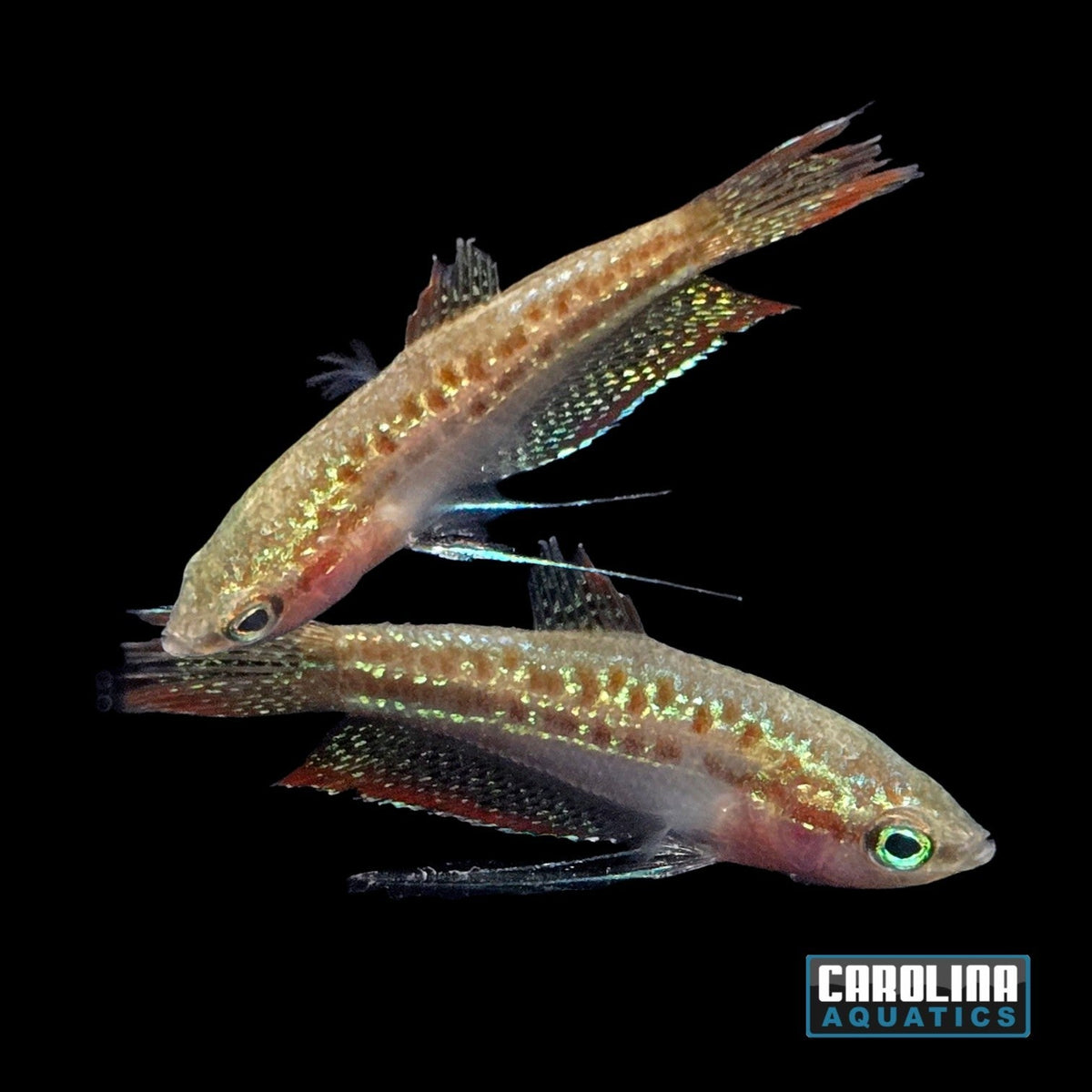
Sparkling Gourami (Trichopsis pumila)
