


- Sku: 8758900
- Vendor: Squeaky's Aquatics
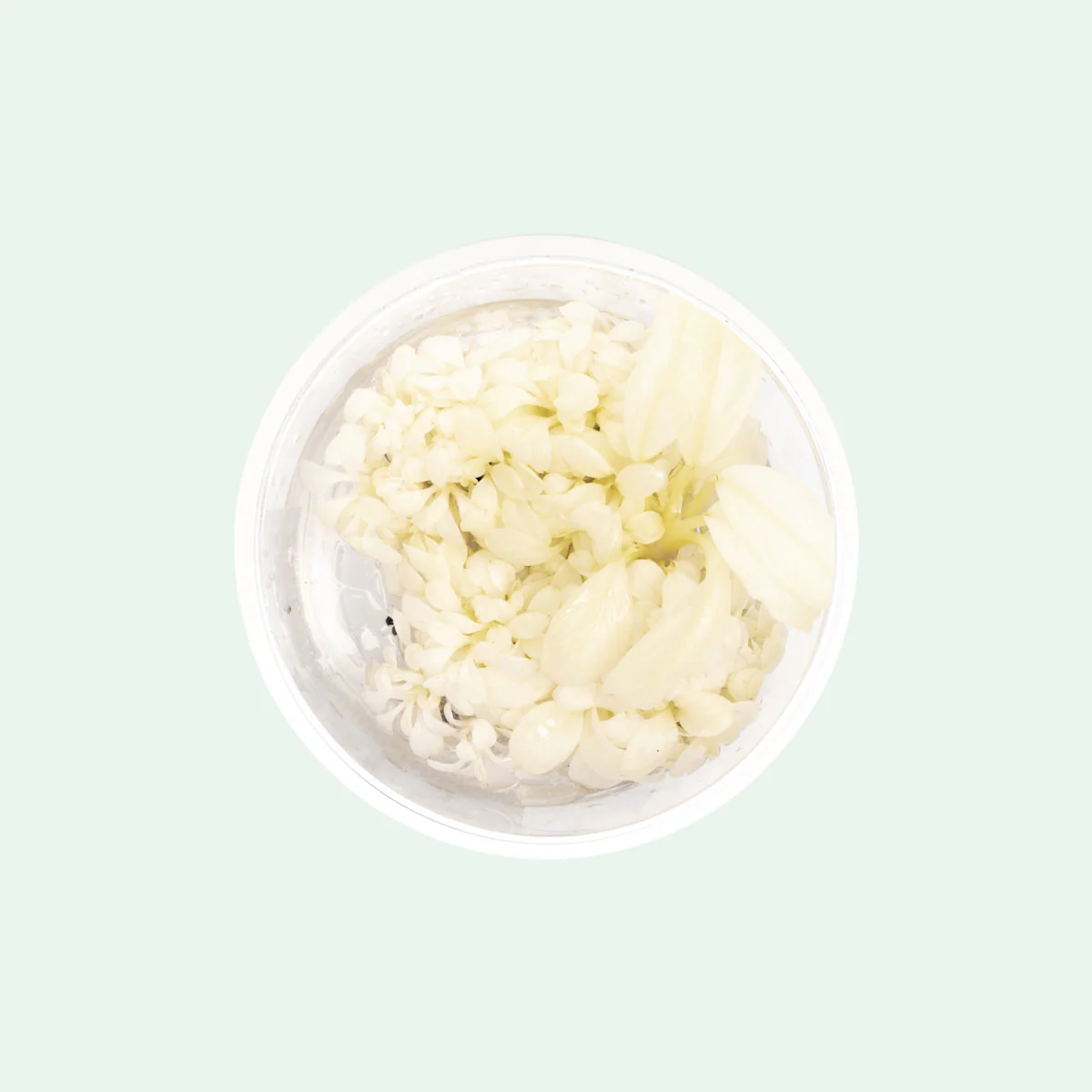
Anubias barteri 'White Rose' - Tissue Culture Cup
Anubias barteri 'White Rose' is a variegated anubias whose leaves are splashed and marbled with creamy white over deep green, and new leaves often unfurl almost entirely white, sometimes with a soft pink blush. Grouped on a piece of driftwood it looks like a cluster of pale blossoms, a bright accent that stands out in any green scape. Like all anubias it grows from a rhizome, needs no CO2, and is attached to wood or rock rather than planted in the substrate. It comes as a clean tissue culture cup, grown in a sterile lab so it is free of snails, algae, and pesticides, and safe for shrimp tanks straight out of the cup. Browse the rest of our freshwater aquarium plants.
Care Guide
- Lighting: Low to moderate. White leaf tissue has little chlorophyll and can scorch or grow algae under intense light, so place it in partial shade or away from the brightest spot.
- CO2: Not required. It grows well in low tech tanks.
- Attach, do not bury: Tie or glue the rhizome, the thick horizontal stem, to driftwood or rock. Roots can reach into the substrate, but a buried rhizome rots.
- Growth: Very slow, even for an anubias. Because the white areas produce little energy, expect a new leaf every few weeks at most. Patience is part of owning this plant.
- Keep some green: Leaves that come in pure white cannot feed the plant and may eventually yellow and melt. That is normal. Leave the green and marbled leaves in place so the plant has enough energy to keep growing.
- Fertilizer: A light dose of an all in one liquid fertilizer such as Seachem Flourish helps, since anubias feed mostly through their leaves and roots in the water column.
- Preparing the cup: Rinse the gel off gently under dechlorinated water. Tissue culture plants are small at first, so mount the clump whole or divide it into a few pieces with healthy leaves.
Specifications
| Common Name | Anubias White Rose |
| Scientific Name | Anubias barteri 'White Rose' |
| Plant Type | Rhizome epiphyte, variegated |
| Care Level | Easy, but very slow |
| Lighting | Low to moderate |
| CO2 | Not required |
| Growth Rate | Very slow |
| Placement | Foreground to midground, attached to wood or rock |
| Mature Height | About 3 to 6 inches |
| Temperature | 72 to 82°F |
| pH | 6.0 to 7.5 |
| Propagation | Rhizome division |
| Origin | Cultivated variety. The species is native to West Africa |
| Sold As | Tissue culture cup |
Placement and Companions
White Rose looks best where its pale leaves contrast with something dark: tucked into the roots of a piece of Malaysian Driftwood, against dark stone, or at the base of green stem plants. Because it grows so slowly, it is ideal for nano tanks and for the shaded spots under taller plants where it keeps its shape for a long time with no trimming.
- Anubias Pinto and Anubias Nana Gold for a collection of unusual anubias on one piece of wood
- Bucephalandra Green, another slow rhizome plant that shares the same care
- Java Moss to soften the wood around the rhizome
- Cherry Shrimp and Otocinclus to keep the slow growing leaves free of film
Anubias leaves are tough and bitter, so even plant nibblers like goldfish and many cichlids usually leave them alone.
Recommended Supplies
- Seachem Flourish Glue or Aqua Adhere Aquarium Glue to mount the rhizome
- Malaysian Driftwood or CaribSea Scapers Select Driftwood as a mounting base
- Seachem Flourish for gentle, complete fertilizing
- Tom Aquatic Gardener Multi-Tool for trimming old leaves in tight spaces
FAQ
Why is it growing so slowly?
That is the nature of this plant. Anubias are slow to begin with, and White Rose has less green tissue to make energy. A new leaf every few weeks is normal. Steady conditions and a little fertilizer help more than extra light.
Some of the white leaves turned yellow and died. Is it dying?
Probably not. Fully white leaves cannot support themselves for long and often fade over time. As long as the rhizome is firm and green or marbled leaves keep coming, the plant is healthy. Trim off melted leaves at the base.
Will new leaves always be white?
Not always. Variegation varies from leaf to leaf. Some come in mostly white, others marbled, and some mostly green. The mix of all three is what gives the plant its look.
Can I plant it in the gravel?
Only the roots. Keep the rhizome above the substrate, attached to wood or rock or lightly wedged between stones, or it will rot.
Is it safe for shrimp?
Yes. Tissue culture plants are grown without pesticides and come free of snails and algae, so it is safe for shrimp and fry.
Have a question?
Anubias barteri 'White Rose' - Tissue Culture Cup
