


- Sku: F1509
- Vendor: Squeaky's Aquatics
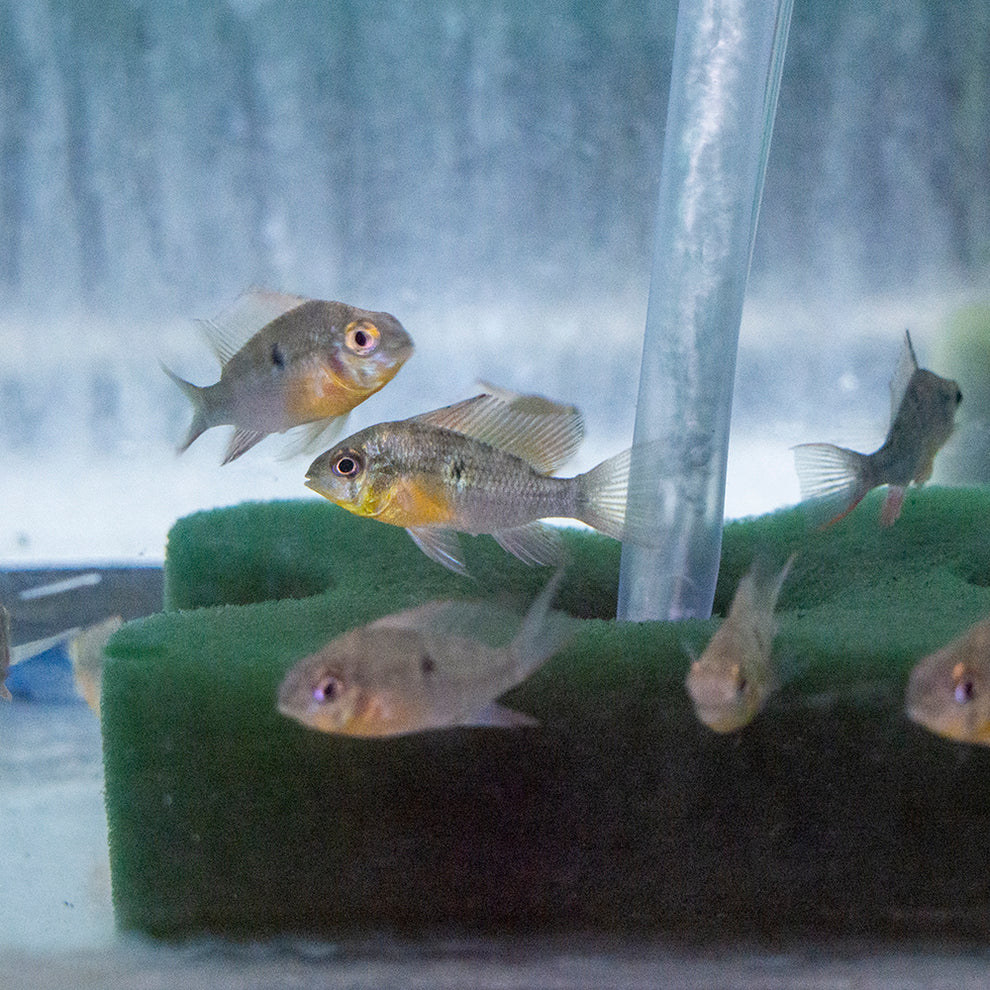
Bolivian Ram (Mikrogeophagus altispinosus)
The Bolivian Ram (Mikrogeophagus altispinosus) is the dwarf cichlid we point most beginners toward. It has all the charm of a cichlid, the watchful eyes, the sand sifting, the pairs that guard their spot, without the bad attitude or the fragility. Look for a warm golden body, a dark bar through the middle, soft blue sheen on the fins, red edging on the tail, and in adults long trailing tips on the tail and dorsal fin. It is peaceful, adaptable, and far hardier than its famous cousin the German Blue Ram. Browse the rest of our live fish and freshwater supplies to build its community.
Bolivian Ram or German Blue Ram?
The two share a genus and a nickname, but they are very different fish to keep. The German Blue Ram (Mikrogeophagus ramirezi) is smaller, more colorful, and famously delicate, needing warm, soft, very clean water around 82 to 86°F. The Bolivian Ram is a little larger and more subdued in color, and it is comfortable at ordinary community temperatures, in a wider pH range, and in tanks that are not run perfectly. If you have lost German Blue Rams before, this is the ram to try next.
The fish in our tanks are young, about 2 inches, so the long fin extensions and full color of an adult are still developing. Give them a few months of good food and stable water and they fill out beautifully.
Care Guide
- Tank size: 20 gallon long for one fish, 30 gallons or more for a pair or when keeping them with other bottom dwellers. Floor space matters more than height.
- Substrate and decor: soft sand such as Estes Natural Aquatic Sand, with driftwood, rocks, and plants breaking the tank into territories. A flat stone or a cave like the Aquarium Co-Op Apisto Cave gives a pair a place to call home.
- Water parameters: 74 to 80°F, pH 6.0 to 7.8, soft to moderately hard. They are adaptable, but stability matters more than hitting an exact number.
- Water quality: change 25 to 30% weekly. Cichlids show poor water quickly with clamped fins and faded color.
- Feeding: omnivore. Offer a small sinking pellet like Xtreme Community Peewee or Hikari Micro Pellets daily, with frozen bloodworms or brine shrimp a few times a week. They feed near the bottom, so make sure food gets past the tetras.
- Singles, pairs, or groups: a single Bolivian Ram is perfectly content. A bonded pair is wonderful to watch but will guard a territory when spawning. Groups work only in larger tanks with plenty of broken sightlines.
- Medication sensitivity: go easy on salt and copper, and ask us before treating a tank with rams in it.
Specifications
| Scientific name | Mikrogeophagus altispinosus |
| Common names | Bolivian Ram, Bolivian Butterfly Cichlid, Ruby Crown Cichlid |
| Care level | Beginner |
| Temperament | Peaceful, mildly territorial when spawning |
| Size when purchased | About 2 inches |
| Adult size | About 3 to 3.5 inches |
| Minimum tank | 20 gallons long for one, 30 gallons for a pair |
| Temperature | 74 to 80°F |
| pH | 6.0 to 7.8 |
| Substrate | Soft sand preferred |
| Diet | Omnivore, small sinking pellets and frozen foods |
| Lifespan | 4 to 6 years |
| Origin | Mamoré and Guaporé river basins of Bolivia and Brazil. Aquarium stock is mostly farm raised |
| Water type | Freshwater |
| Pickup | In-store pickup at Squeaky's Aquatics |
Compatibility
Bolivian Rams make an excellent centerpiece for a calm South American or general community. Pair them with midwater schoolers like Cardinal Tetras, Rummy Nose Tetras, or Black Emperor Tetras, peaceful bottom dwellers like the Sterbai Cory and Bushynose Pleco, and gentle gouramis such as the Pearl Gourami. In a roomy tank they also get along with adult angelfish.
What goes wrong: aggressive or larger cichlids such as oscars and African mbuna will bully them, and fast fin nippers like tiger barbs stress them out. Two males in a small tank will squabble over the floor, so give extra rams extra space. Adult shrimp are usually left alone, but shrimplets and tiny fry will be eaten.
Recommended Foods & Supplies
- Xtreme Community Peewee or Hikari Micro Pellets as the daily staple
- Hikari Bio-Pure Frozen Bloodworms for conditioning and color
- Repashy Community Plus as a nutritious gel food
- Estes Natural Aquatic Sand for natural sifting
- Aquarium Co-Op Apisto Cave as a territory anchor
- Fritz Catappa Leaves for tannins and a natural look
FAQ
Is a Bolivian Ram good for a beginner?
Yes. It is one of the easiest cichlids you can keep. It handles normal community temperatures and a wide pH range, and it is much more forgiving than the German Blue Ram. Just add it to a tank that is already cycled and stable.
Should I get one, a pair, or a group?
One is perfectly happy alone. A pair is the most rewarding if you have 30 gallons or more, and they may spawn and guard eggs. Groups need a large tank with plenty of cover so no single fish gets picked on.
Can I tell males from females?
It is hard in young fish. Adult males usually grow a bit larger with longer fin extensions, and females often show a pinkish belly when ready to spawn. At about 2 inches, most of ours are too young to sex reliably.
Can I keep it with German Blue Rams?
In a larger tank, yes, but their needs pull in different directions. German Blue Rams want it warmer than Bolivian Rams prefer, so a compromise around 80°F is the best you can do. Most keepers pick one or the other.
Will it eat my plants?
No. Bolivian Rams sift sand for food but leave plants alone. They may uproot a freshly planted stem while digging, so anchor new plants well.
Have a question?
Bolivian Ram (Mikrogeophagus altispinosus)
