


- Sku: 430052
- Vendor: Squeaky's Aquatics
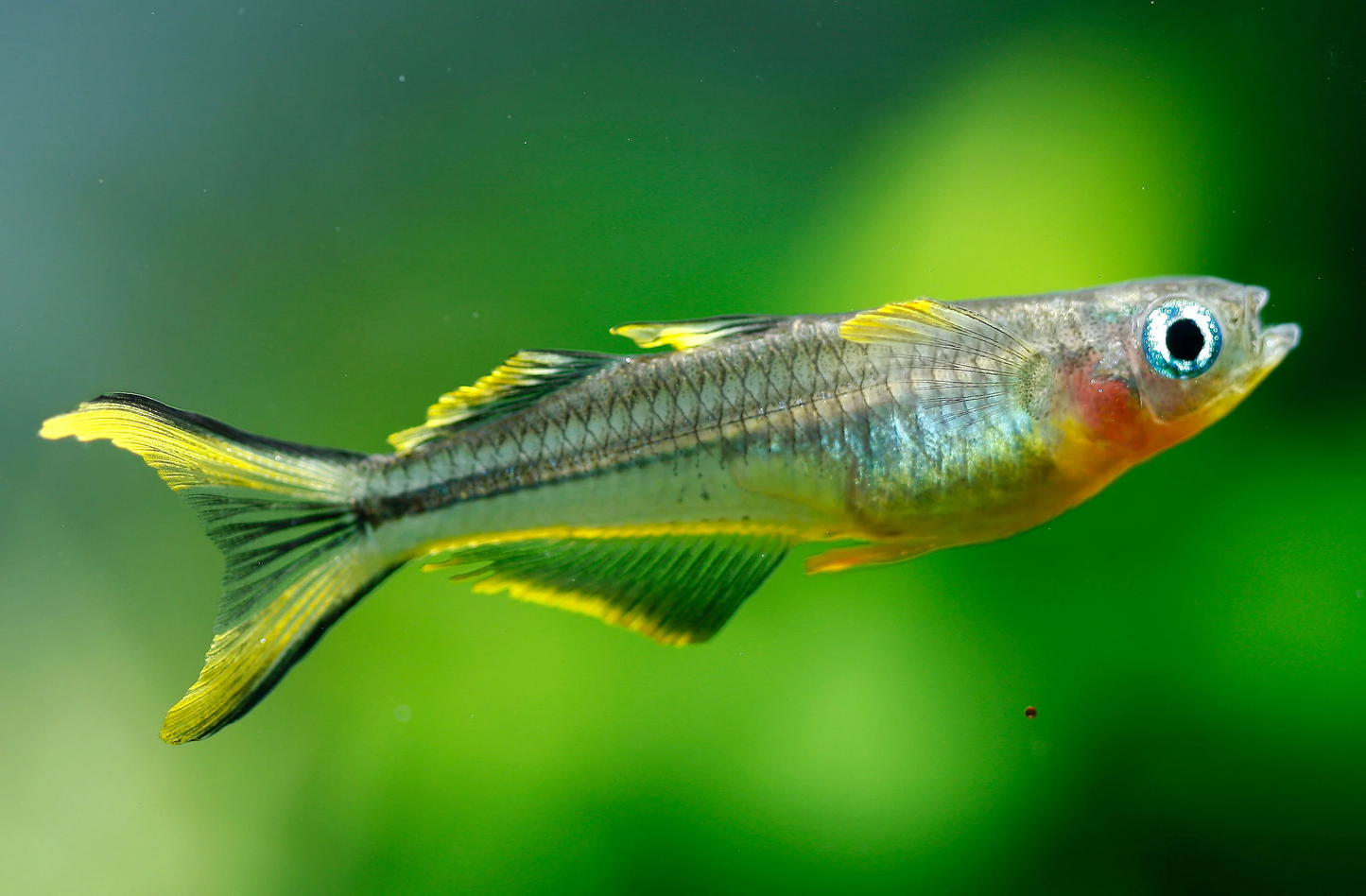
Forktail Rainbowfish (Pseudomugil furcatus)
The Forktail Rainbowfish (Pseudomugil furcatus) is a blue-eye, one of the small cousins of the true rainbowfishes, and it is the flashiest of the group. Males carry bright lemon-yellow fins outlined in black, a deeply forked yellow tail that gives the fish its name, and the brilliant white-blue iris the family is named for. They spend the day out in the open flaring at each other rather than hiding, which makes a group of them one of the most active displays you can put in a small planted tank. Care level is intermediate, temperament is peaceful. Browse the rest of our live fish and freshwater supplies to set them up properly.
Care Guide
- Tank size: a 24 by 12 inch footprint, roughly 20 gallons, is the sensible minimum for a proper group.
- Group size: eight to ten minimum. Below that they turn nervous and washed out, and you lose the constant male-to-male display that is the point of the species. Include several males.
- Water parameters: pH 7.0 to 8.0 and hard water, roughly 15 to 30 dGH. Most Georgia tap water is already right. If yours is soft, raise it with Seachem Equilibrium and confirm with a GH test kit. Do not treat these as blackwater fish.
- Temperature matters more than usual: 75 to 82°F. This species comes from warm lowland streams and does poorly kept cool. A room-temperature tank is not enough.
- Oxygen and flow: they come from clear streams with moderate current, so give them decent circulation and good surface agitation. Stagnant, warm, low-oxygen water is a bad combination for them.
- Diet: micropredator with a small mouth. Feed micro pellets, crushed flake, baby brine shrimp, and daphnia. Small frequent feedings suit them better than one large one.
- Aquascape: planted edges with open water in the middle for displaying. Java moss is worth adding, since it doubles as their spawning site.
- Lid: recommended. Like most surface-oriented stream fish they will jump.
- Breeding: females scatter a few large eggs at a time into moss or spawning mops over a period of days. Be aware that infertile eggs are common in this species even from healthy adults, so expect a low hatch rate rather than a failure on your part.
Specifications
| Scientific name | Pseudomugil furcatus |
| Common names | Forktail Rainbowfish, Forktail Blue-eye, Yellow Finned Blue-eye |
| Family | Pseudomugilidae, the blue-eyes |
| Origin | Musa and Kwagila river basins, eastern Papua New Guinea |
| Max size | About 2 inches (5 to 6 cm) |
| Care level | Intermediate |
| Temperament | Peaceful |
| Minimum group | 8 to 10 |
| Minimum tank | 20 gallons |
| Temperature | 75 to 82°F |
| pH | 7.0 to 8.0 |
| Hardness | Hard, around 15 to 30 dGH |
| Diet | Micropredator, small foods |
| Lifespan | 12 to 18 months, naturally short-lived |
| Pickup | In-store only |
Compatibility
Peaceful and easy to house, as long as the tankmates are small and not food thieves. The classic pairing is with a Peacock Gudgeon, which wants nearly identical conditions and occupies the lower part of the tank while the blue-eyes work the top. Other good company includes Paskai Rainbowfish and other blue-eyes, Threadfin Rainbowfish, small danios, Pygmy Cories, and dwarf shrimp.
Avoid anything large or predatory, and skip fast greedy feeders that will strip the food before these get their share. They will also eat their own eggs and any very small fry, so shrimplets are unlikely to survive in the same tank.
Recommended Foods & Supplies
- Hikari Micro Pellets, correctly sized for a small mouth
- SFBB Baby Brine Shrimp and Freeze-Dried Daphnia for colour and conditioning
- Seachem Equilibrium if your water is too soft for them
- Fritz GH Test Kit to check where your hardness actually sits
- Java Moss for cover and as a spawning site
FAQ
Is this a real rainbowfish?
Close, but not quite. Blue-eyes sit in their own family, Pseudomugilidae, alongside the true rainbowfishes rather than inside them. In practice they are kept the same way, just at a much smaller size.
How do I tell males from females?
Males are far more colourful, with bright yellow black-edged fins and extended fin rays. Females are plainer and shorter finned. The fish in the photo is a male.
Mine only lived about a year. What did I do wrong?
Probably nothing. This species is naturally short-lived and twelve to eighteen months is a normal span even in excellent conditions. Keeping a group and letting them breed is the usual way keepers maintain them long term.
Can I keep them with my soft water tetras?
Not ideally. These want hard alkaline water and warmth, so they suit a hard-water community far better. Pair them with other blue-eyes, rainbows, and a Peacock Gudgeon instead.
Have a question?
Forktail Rainbowfish (Pseudomugil furcatus)
