


- Sku: 8030230
- Vendor: Squeaky's Aquatics
Panda Angelfish (Pterophyllum scalare)
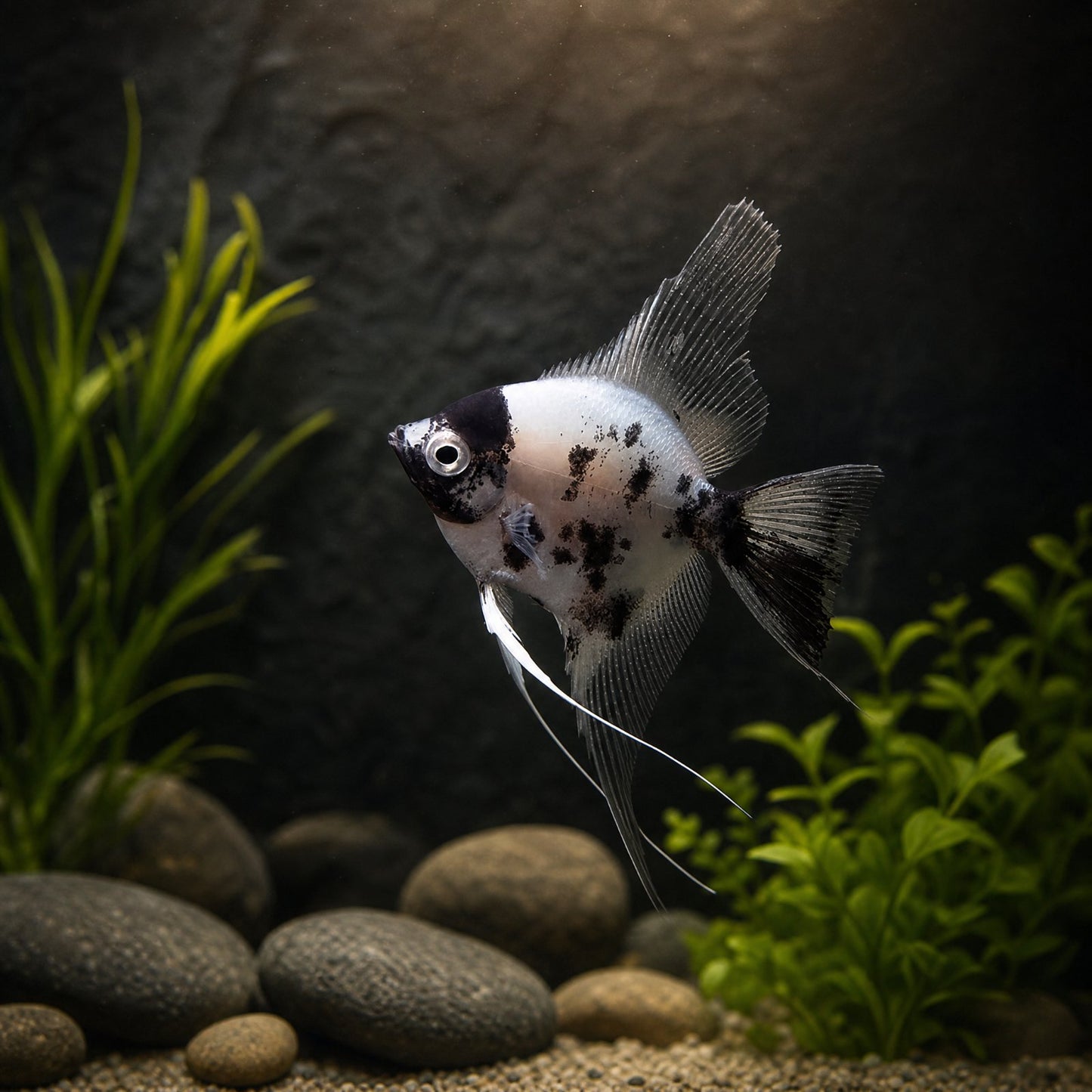
The Panda Angelfish (Pterophyllum scalare) is a captive bred color form built around one striking idea: a clean pearl white body scattered with inky black blotches, finished with a dark mask across the face and eye. Add the trailing filament fins and the slow, deliberate glide angelfish are loved for and you have a centerpiece fish that holds a tall tank on its own. It is an intermediate, semi-aggressive cichlid with real personality, which is most of the appeal and all of the homework. Browse the rest of our freshwater livestock and supplies while you plan the tank.
Every Panda Is Different
Panda is a pattern, not a fixed blueprint. Every fish carries its own arrangement of black patches over the white base, so no two in the tank look alike and we cannot promise a specific pattern from the photo. Pick the one you like in person and we will bag that fish.
Their markings also move. Angelfish shift their black pigment with mood, lighting, and age: a stressed or newly moved fish often goes pale and washed out, a confident settled fish darkens up. Many pandas gain or lose spotting as they mature, and juveniles frequently look plainer than they will at full size. Give a new fish two weeks in your tank before you judge its color.
Care Guide
- Tank size and shape: height matters more than footprint here. 29 gallons is the working minimum for one or a pair, 55 gallons and up for a group, and you want at least 18 inches of water depth so the fins are never folded against the glass.
- Water parameters: 78 to 84°F, pH 6.0 to 7.5. Angels are warm water fish, which is exactly why they pair so well with Discus and Sterbai Corys and so poorly with cool water species.
- How many: keep one, keep a bonded pair, or keep five or more so aggression spreads out. Groups of three or four are the trap: two fish pair off and gang up on whoever is left.
- Aquascape: tall plants, driftwood, and broad leaves such as Anubias to break sight lines, with open water in the middle for cruising. Gentle flow, since long fins fight a strong current all day.
- Feeding: omnivore with a healthy appetite. A quality flake such as Xtreme Beef Heart Flake as the staple, rotated with frozen bloodworms or SFBB Cichlid Delight a few times a week. Feed small portions twice daily rather than one large meal.
- Expect pairing behavior: as they mature two fish will choose each other, claim a leaf or a flat surface, and defend it. Perfectly normal cichlid behavior, and the reason a small tank with several adults eventually goes wrong.
- Water quality: tall bodies and long fins make them quick to show trouble. Stay on top of water changes; ragged or clamped fins are usually a nitrate problem before they are a disease problem.
Specifications
| Scientific name | Pterophyllum scalare |
| Common names | Panda Angelfish, Panda Marble Angel, Freshwater Angelfish |
| Care level | Intermediate |
| Temperament | Semi-aggressive, territorial when paired |
| Adult size | About 6 inches long, up to 8 inches tall with fins |
| Minimum tank | 29 gallons tall for one or a pair, 55 gallons for a group |
| Group size | Single, a bonded pair, or 5 or more. Avoid 3 to 4 |
| Temperature | 78 to 84°F |
| pH | 6.0 to 7.5 |
| Diet | Omnivore, quality flake plus frozen foods |
| Lifespan | 8 to 10 years |
| Origin | Amazon basin, South America. Panda is a captive bred color form |
| Water type | Freshwater |
| Pickup | In-store pickup at Squeaky's Aquatics |
Compatibility
Build the community around the angel rather than dropping the angel into an existing nano tank. Good company means fish that are calm, warm water tolerant, and too large to be swallowed: Black Skirt Tetras, Boesemani Rainbowfish, and Pearl Gourami up top, with Sterbai Corys and a Bristlenose Pleco working the bottom. Sterbai in particular are one of the few corys that genuinely enjoy angelfish temperatures. Other angels and Discus also work in a large enough tank.
What goes wrong: anything small enough to fit the mouth eventually disappears, so skip Neon and Ember Tetras, Chili Rasbora, Celestial Pearl Danio, and shrimp colonies. Long trailing fins are a target for nippers, which rules out Tiger Barbs and Serpae Tetras. Avoid cool water fish such as White Cloud Minnows and most goldfish tankmates, since nobody wins at a compromise temperature. Finally, a breeding pair will clear a corner of the tank and mean it, so give a bonded pair enough room or expect casualties.
Recommended Foods & Supplies
- Xtreme Beef Heart Flake staple built for angels and discus
- SFBB Cichlid Delight frozen conditioning food
- SFBB Frozen Bloodworms the treat that brings them to the glass
- Ocean Nutrition Community Flake for the rest of the tank
- Malaysian Driftwood vertical structure and sight breaks
- Anubias Nana tough broad leaves they will not shred
FAQ
Will it really eat my Neon Tetras?
Yes, once it is big enough, and it will take its time getting there so the loss feels sudden. This is the most common angelfish regret we hear. If neons are staying, the angel should not.
Can I keep one in a 20 gallon?
A juvenile will be fine for a while, but a standard 20 is too short for an adult and the fish ends up with folded or damaged finnage. If a 20 is the tank you have, a 20 tall works better than a 20 long, and a 29 works better than both.
Will my two angels breed?
Very possibly. Angelfish pair off readily and will lay eggs on a leaf, filter intake, or the glass. First few batches usually get eaten, which is normal. Expect the pair to become noticeably more territorial once they start.
Why does mine look faded compared to the store tank?
Stress and new surroundings. Angelfish drop their black pigment when unsettled and darken again once they feel at home. Give it a couple of weeks, keep the lights moderate, and make sure it has cover.
How many should I get?
One is genuinely fine, and a single angel in a community tank is a great look. If you want more, jump to five or six rather than stopping at three or four, since a small group is where bullying concentrates.
Is the panda pattern stable as it grows?
Mostly, but not guaranteed. Black markings can spread, shrink, or shift as the fish matures. You are buying a pattern range rather than a fixed design, which is part of what makes each one interesting.
Have a question?
Panda Angelfish (Pterophyllum scalare)
