


- Sku: FW1-F7690
- Vendor: Squeaky's Aquatics
Freshwater Pom Pom Crab (Ptychognathus barbatus)
The Freshwater Pom Pom Crab (Ptychognathus barbatus) is the rare freshwater crab that never asks for a beach. Vampire crabs, red claw crabs, and fiddlers all need a dry ledge to climb out onto, but this little Southeast Asian stream dweller is fully aquatic and spends its entire life underwater in an ordinary planted tank. The name comes from the dense tufts of bristles on its claws, which it fans open like a pair of tiny brushes to comb food particles out of the current. Peaceful, hardy, and safe with plants and adult shrimp, it is one of the most entertaining beginner invertebrates we stock. Browse the rest of our freshwater invertebrates and freshwater livestock to build out the tank.
Care Guide
- Tank size: 10 gallons is plenty for one crab or a small group. They use the floor and the hardscape rather than open water, so footprint matters more than height.
- No land area required. This is the headline feature. Ptychognathus barbatus is fully aquatic and does not need a beach, a ramp, or a paludarium build. A standard freshwater setup is all it wants.
- A tight lid is not optional. Fully aquatic does not mean it will not try. These crabs are determined climbers and will walk up airline tubing, filter intakes, and silicone seams. Cover the tank and seal the cord gaps.
- Flow and oxygen: they come from fast, cool, well oxygenated streams. Moderate to strong current keeps them happy and gives them something to filter feed from. A sponge filter or a small powerhead aimed across the hardscape works well.
- Water parameters: 68 to 78°F, pH 6.8 to 7.8, GH 6 to 15. They tolerate a wide range, but they do want minerals in the water for healthy molts. Seachem Equilibrium is an easy fix for soft tap water.
- Feeding: omnivore and opportunist. It filter feeds with the claw bristles, grazes biofilm, and scavenges anything that reaches the bottom. Offer sinking pellets, algae wafers, blanched vegetables, and frozen foods a few times a week.
- Molting: give it caves, cholla wood, and leaf litter to hide in while the new shell hardens. Leave the shed exoskeleton in the tank, the crab will eat it back for the calcium.
- No copper. Like all invertebrates, it will not survive copper based medications. Treat the display tank with invertebrate safe products only.
Specifications
| Scientific name | Ptychognathus barbatus |
| Common names | Freshwater Pom Pom Crab, Hairy Handed Crab, Bearded Crab |
| Care level | Beginner |
| Temperament | Peaceful and shy |
| Fully aquatic | Yes, no land area needed |
| Plant safe | Yes |
| Max size | About 1.5 inches across the shell, roughly 2.5 inches leg span |
| Minimum tank | 10 gallons |
| Temperature | 68 to 78°F |
| pH | 6.8 to 7.8 |
| Hardness | 6 to 15 dGH |
| Diet | Omnivore, filter feeder and scavenger |
| Lifespan | 2 to 3 years |
| Origin | Coastal freshwater streams of Southeast Asia and southern Japan |
| Pickup | In-store pickup at Squeaky's Aquatics |
Compatibility
Shy and non-confrontational. It spends most of its time picking through the substrate and hardscape, and it has no interest in chasing healthy fish. Good tank mates include small peaceful schoolers like the Neon Tetra, Kubotai Rasbora, and Celestial Pearl Danio, plus bottom dwellers such as the Pygmy Cory and Bumblebee Otocinclus. Adult Amano Shrimp, Cherry Shrimp, and nerite snails are fine company as well.
Two honest cautions. First, this is still a crab, so a freshly molted shrimp, a baby shrimp, or a dying fish that lands within reach may get eaten. That is scavenging, not hunting, and it will not put a dent in an established shrimp colony. Second, keep it away from anything large enough to treat it as a snack, so no large cichlids, big loaches, or pufferfish. Plants are completely safe, including delicate carpets, and it will happily perch on Anubias Nana or a moss covered branch to feed in the current.
Recommended Foods & Supplies
- Xtreme Shrimpee Sinking Sticks invertebrate staple
- Hikari Algae Wafers and Fluval Bug Bites Bottom Feeder Formula
- Repashy Bottom Scratcher gel food for variety
- Seachem Equilibrium to keep GH in the molting range
- Galapagos Cholla Wood and Fritz Catappa Leaves for biofilm and molting cover
FAQ
Does it need a land area like other freshwater crabs?
No, and that is exactly why people want this one. It is fully aquatic and lives underwater permanently, so it drops straight into a normal community or planted tank with no paludarium build required.
Mine does not have big pom poms. Did I get the wrong crab?
Almost certainly not. The showy bristle tufts are mostly a male trait. Females have the same claws with much shorter, sparser hair. Both sexes behave identically, the males are just flashier about it.
Is it safe with my shrimp?
With healthy adult shrimp, yes, and the two are commonly kept together. It is an opportunist though, so newly molted or baby shrimp that wander into a claw can be taken. In a planted tank with good cover, a shrimp colony and a pom pom crab coexist without trouble.
Will they breed in my aquarium?
No. The species is amphidromous, meaning the larvae must drift down to brackish or salt water to develop. A female may carry eggs in freshwater, but the larvae cannot complete their life cycle in a home tank. Every one of these is wild collected.
Do I really need a lid?
Yes. This is the single most common way people lose them. They are strong climbers and will follow any cord, hose, or corner seam up and out. Cover the tank and block the gaps around equipment before you add the crab.
Have a question?
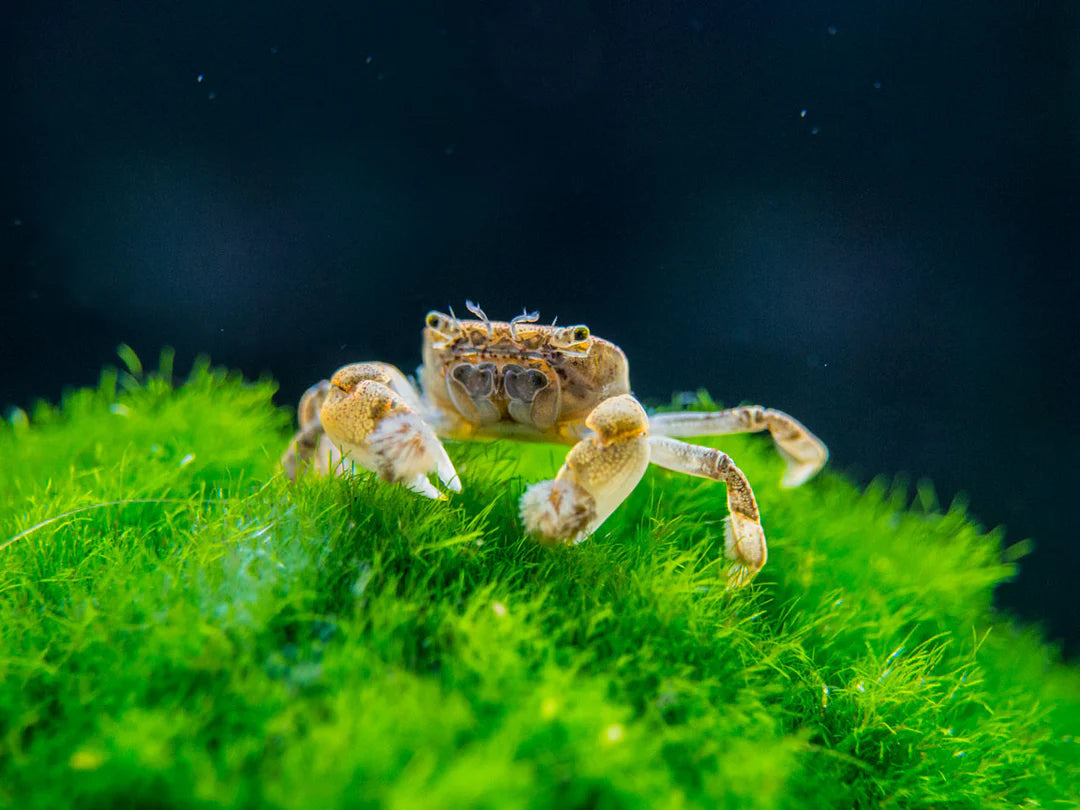
Freshwater Pom Pom Crab (Ptychognathus barbatus)
