


- Sku: 1315337
- Vendor: Squeaky's Aquatics
Powder Brown Tang (Acanthurus japonicus)
The Powder Brown Tang (Acanthurus japonicus) is the best looking of the brown surgeonfish and the easiest of the group to keep. A warm tan body carries a clean white mask across the cheek, a bright orange streak runs the length of the rear dorsal fin, and the whole outline is traced in yellow and white, finishing in a crisp white-edged tail. It is an active, constantly grazing reef fish that earns its keep on algae. Reef safe with corals and inverts, but it needs real swimming room and a serious commitment to greens. Browse the rest of our saltwater livestock and supplies to round out the tank.
Choose Your Size
| Size | Roughly | Notes |
|---|---|---|
| Small | 1.5 to 2 in | Adapts fastest, but the least margin for error. Needs food available constantly. |
| Medium | 2.5 to 3.5 in | The sweet spot. Sturdy enough to handle the move, young enough to settle easily. |
| Medium-Large | 3.5 to 4.5 in | Full color and confidence. Good choice for a tank that already has fish. |
| Large | 4.5 to 5.5 in | Substantial fish. Wants a large system and will hold its own territory. |
| X-Large | 5.5 in and up | Near adult. Takes longer to settle into a new tank and needs the most space. |
Sizes are approximate and stock rotates. If a size shows as unavailable, ask us when the next one is expected.
Care Guide
- Tank size: 125 gallons or larger. This is not a fish that can be talked into a smaller box. Adults reach eight inches and swim continuously, so length matters more than volume on paper.
- Water parameters: 72 to 78°F, pH 8.1 to 8.4, salinity 1.020 to 1.026. Tangs are sensitive to swings, so steady beats perfect.
- Feeding: herbivore first. Offer dried seaweed on a clip every day or close to it, backed by marine grazing pellets and spirulina flake. Meaty food a couple of times a week is fine as a supplement, never as the base.
- Underfeeding shows. A tang kept on a thin, meat-heavy diet gets hollow behind the eyes and can develop head and lateral line erosion. Plenty of greens plus good water quality is the prevention, and it is much easier than the cure.
- Flow and oxygen: they come from surge zones. Strong flow and good surface agitation suit them well.
- Aquascape: open water down the middle with rockwork it can graze and a crevice to wedge into at night.
- Handle with care: the scalpel at the base of the tail is sharp and will slice a net. Use a container rather than a net when you move it, for your sake and its.
Specifications
| Scientific name | Acanthurus japonicus |
| Common names | Powder Brown Tang, Japan Surgeonfish, White-faced Surgeonfish |
| Care level | Intermediate |
| Temperament | Semi-aggressive, territorial toward other tangs |
| Reef safe | Yes |
| Max size | About 8 inches |
| Minimum tank | 125 gallons |
| Temperature | 72 to 78°F |
| Salinity | 1.020 to 1.026 |
| Diet | Herbivore |
| Origin | Western Pacific: Philippines, Indonesia, southern Japan |
| Pickup | In-store pickup at Squeaky's Aquatics |
Compatibility
Fine with most non-tang fish and completely safe with corals and inverts. Good company includes the Ocellaris Clownfish, Banggai Cardinalfish, Blue Green Chromis, Royal Gramma, and cleanup crew inverts like the Scarlet Skunk Cleaner Shrimp.
The trouble is other tangs, especially anything with a similar body shape or another Acanthurus. One tang per tank is the safe rule unless the system is very large and everyone goes in at once. Adding a second tang later, to an established one, is how fights start.
Comparing the surgeonfish? The Powder Blue Tang is the close relative and the showier fish, though a good deal more demanding. For a smaller, gentler option try the Flame Fin Tomini Tang or Mimic Eibli Tang, and for the hardiest starting point of the group, the Scopas Tang.
Recommended Foods & Supplies
- Rod's Food Leafy Purple Seaweed daily grazing sheet
- Rod's Food Three Weed Blend for variety
- Vitalis Marine Grazing Pellets
- Two Little Fishies VeggieMag magnetic seaweed clip
- Vitalis Universal Grazing Station for continuous feeding
- Saltwater Refractometer for accurate salinity
FAQ
Is this the same as a Gold Rim or Whitecheek Tang?
No, and the difference matters. The Gold Rim or Whitecheek Tang is Acanthurus nigricans, a related fish with a much worse survival record in aquariums. Ours is A. japonicus, the hardier of the pair. Tell them apart by the face: on japonicus the white cheek patch runs from under the eye all the way down to the mouth, and the rear dorsal fin carries a bold orange streak. On nigricans the white patch is a smaller oval that stops short of the mouth. Shops mix the two names up constantly, so check the fish, not the label.
Do I really need 125 gallons?
For an adult, yes. They grow to eight inches and cruise all day, and a cramped tang gets stressed, then aggressive, then sick. A small one can start in something smaller, but only if the bigger tank is genuinely coming.
Can I keep it with my other tang?
Only in a large system, and ideally by adding both at the same time. Two tangs of similar shape in a modest tank will fight, and this species is territorial with its own kind in particular.
Why is everyone so worried about ich with these?
Powder tangs carry very little natural resistance and are frequently stressed by collection and shipping, which is exactly when ich takes hold. That is why quarantine before the display tank is not optional advice with this fish. Once it is settled, eating well, and living in stable water, it is a durable long-term reef fish.
Will it eat my corals?
No. It grazes algae off rock and glass and leaves corals and inverts alone.
Have a question?
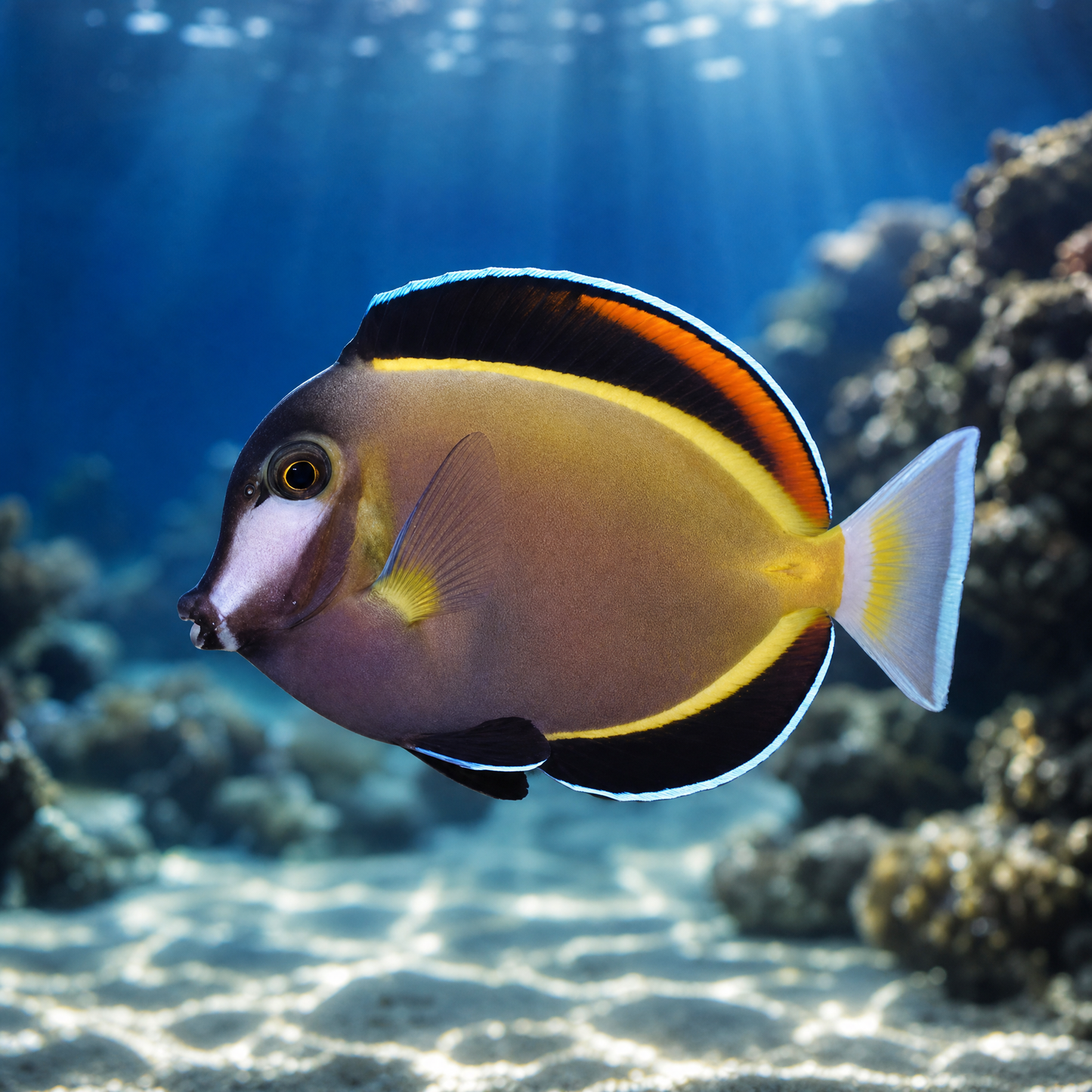
Powder Brown Tang (Acanthurus japonicus)
