


- Sku: SQ-TRUEJULIICORY
- Vendor: Squeaky's Aquatics
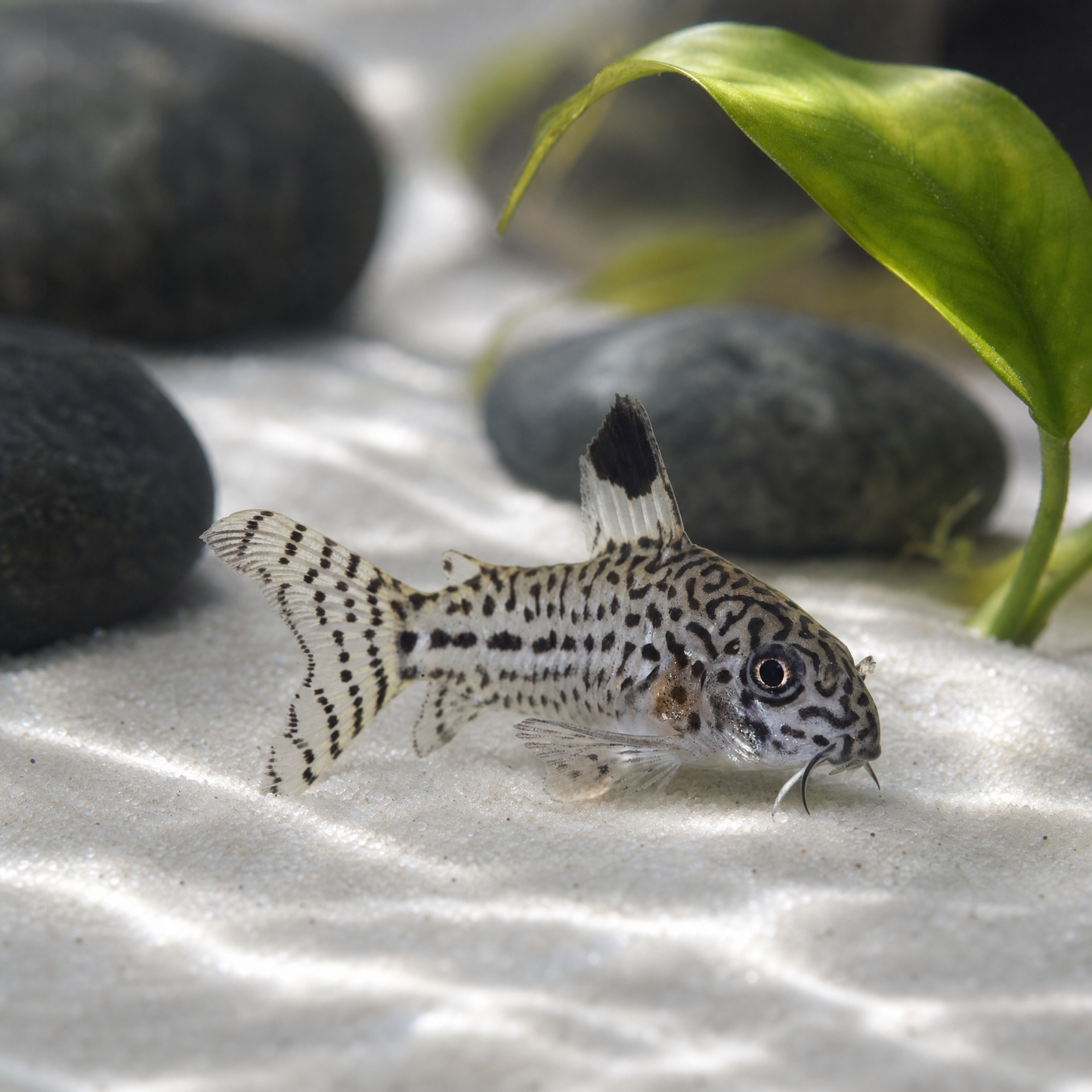
True Julii Cory (Corydoras julii)
The True Julii Cory (Corydoras julii) is the genuine article behind a name the hobby hands out far too freely: a small, tidy, armored bottom dweller in pale silver, marked with fine separate black dots rather than the connected maze pattern of its common stand in. It is peaceful, endlessly busy, and an excellent community fish, provided you give it two things most tanks get wrong: a real group and a soft floor. Browse the rest of our freshwater livestock and supplies to build out the bottom crew.
How To Spot A True Julii
This is the real Corydoras julii, a coastal eastern Brazilian species that is genuinely uncommon in the aquarium trade. The fish sold under the Julii name in almost every United States store is actually Corydoras trilineatus, the False Julii or Three Line Cory, which we stock and label as exactly that on its own listing.
The difference lives in the head pattern. A true C. julii wears small, round, clearly separated dots, each one distinct, with no lines joining them up. The False Julii wears connected squiggles that run together into a maze or fingerprint, plus a heavier unbroken stripe down the midline. True julii also tends to run a little smaller and cleaner looking overall. Care requirements are identical, so this is a collector's distinction rather than a husbandry one, and it is worth knowing which one you actually own.
Care Guide
- Tank size: 20 gallon long or larger. These fish work the floor, so length and footprint matter far more than height. A 20 long beats a 29 tall for the same group.
- Substrate is the whole ballgame: soft sand such as Estes Natural Aquatic Sand or Estes Crystal Lake Sand lets them do what they are built to do. Sharp or coarse gravel wears the barbels away, and barbel damage is the single most common reason a cory fails in a home tank.
- Group size: six is the floor, eight to ten is the honest recommendation. In a real group they forage in the open, pile up together to rest, and occasionally sprint across the tank in formation for no reason at all. In a pair they hide.
- Water parameters: 73 to 79°F, pH 6.0 to 7.5. A cooler running cory than a Sterbai, so it is a poor match for a tank held in the low 80s for discus or German rams.
- Feeding: omnivore, and emphatically not a cleanup crew. They will not live on what other fish drop. Feed them directly with sinking food after the lights dim: Hikari Sinking Wafers, Repashy Bottom Scratcher gel, or frozen bloodworms.
- Handling: the locking pectoral and dorsal spines tangle in mesh nets instantly, which stresses the fish and can prick you. Guide them into a cup or bag underwater instead.
- Medication sensitivity: scaleless and thin skinned. Go easy on copper based treatments and full dose aquarium salt, and ask us before you dose a tank that contains corys.
Specifications
| Scientific name | Corydoras julii |
| Common names | True Julii Cory, Julii Cory, Leopard Cory, Spotted Cory |
| Care level | Beginner |
| Temperament | Peaceful |
| Adult size | About 2 inches |
| Minimum group | 6, with 8 to 10 preferred |
| Minimum tank | 20 gallons (long footprint) |
| Temperature | 73 to 79°F |
| pH | 6.0 to 7.5 |
| Substrate | Soft sand or smooth rounded gravel, never sharp |
| Diet | Omnivore, sinking wafers, gel, and frozen foods |
| Lifespan | 5 to 10 years |
| Origin | Coastal river drainages of eastern Brazil, including the Parnaiba and Poti |
| Water type | Freshwater |
| Pickup | In-store pickup at Squeaky's Aquatics |
Compatibility
This is one of the easiest community fish there is. It ignores everything above it and asks only for floor space and calm neighbors. Pair it with small schooling fish like Neon Tetras, Cardinal Tetras, Ember Tetras, or Rummy Nose Tetras, with Otocinclus working the glass. Other corys such as the Panda, Skunk, or Sterbai make good company, though corys shoal most tightly with their own species, so a full group of one kind beats one each of six kinds.
What goes wrong: anything big enough to swallow a two inch fish, including adult angelfish and most medium to large cichlids. Persistent fin nippers such as tiger barbs and serpae tetras will harass them at rest. Aggressive bottom feeders like larger loaches and territorial plecos will outcompete them at dinner. They are safe with adult shrimp but will happily eat shrimplets, so do not count on a cory tank to grow a shrimp colony. Finally, avoid tanks run hot for discus, and avoid sharp gravel no matter how good it looks.
Recommended Foods & Supplies
- Estes Natural Aquatic Sand the barbel safe floor they need
- Hikari Sinking Wafers everyday staple that reaches the bottom
- Repashy Bottom Scratcher invertivore gel they go silly for
- SFBB Frozen Bloodworms twice weekly conditioning treat
- Anubias Nana and Dwarf Sagittaria shade and cover over open sand
- Fritz Catappa Leaves tannins and a grazing surface
FAQ
How is this different from the Julii Cory on your other listing?
That one is Corydoras trilineatus, the False Julii, which is what nearly every store sells under the Julii name. This one is the actual Corydoras julii. Look at the head: separate dots here, connected maze lines there. Husbandry is identical.
Is it worth paying more for the true species?
Only if the correct ID matters to you. They behave the same, live the same length of time, and want the same tank. Plenty of keepers are perfectly happy with the False Julii, and we would rather you buy the one you actually want.
How many should I actually buy?
Six minimum, and eight to ten if the tank allows. This is not upselling, it is the difference between a fish that forages in the open all day and a fish that lives under the driftwood. Groups of three or fewer are visibly stressed and far less interesting to watch.
Can I keep them on my existing gravel?
If it is smooth and rounded, yes. If it is the sharp crushed stuff, please plan on switching. Eroded barbels do not always grow back, and a cory that cannot feel its food stops feeding well.
Mine keeps dashing to the surface. Is something wrong?
Usually no. Corys gulp air and absorb oxygen through their gut, so an occasional sprint up and back is completely normal behavior. Constant surface gulping by the whole group is different and points to poor water quality or low oxygen, so test the tank in that case.
Will they clean my tank?
No, and this myth kills a lot of corys. They eat leftovers only incidentally and starve slowly if that is all they get. Feed them a sinking food of their own every day.
Have a question?
True Julii Cory (Corydoras julii)
