


- Sku: SW4-SW0112
- Vendor: Squeaky's Aquatics
Blue Leg Hermit Crab (Clibanarius tricolor)
The Blue Leg Hermit Crab (Clibanarius tricolor) is the classic small reef hermit: bright blue legs, orange antennae, and a borrowed snail shell it carries everywhere. It spends all day picking over rock and sand for film algae, hair algae, detritus, and leftover food, which makes it a busy and genuinely useful member of a cleanup crew. It is also one of the most entertaining animals in the tank to watch. Browse the rest of our saltwater livestock and supplies and our invertebrates.
One honest note before you buy. Hermit crabs trade up to bigger shells as they grow, and a crab that cannot find an empty shell may kill a snail to take its home. Keep a few spare empty shells in the tank and the problem mostly goes away. Sold individually.
Care Guide
- Tank size: 10 gallons and up, with live rock to climb and graze.
- Spare shells: offer two or three empty shells per crab, slightly larger than the one it is wearing, with round openings. This is the single most important thing you can do to protect your snails.
- Diet: omnivorous scavenger. Film algae, hair algae, detritus, and uneaten food. In a very clean tank, offer a small piece of dried nori on a clip or a pinch of thawed mysis a couple of times a week so it is not tempted to go hunting.
- Reef safe: yes. It ignores corals, but it is a climber and can knock over frags that are not glued down.
- Water: 72 to 78°F, salinity 1.023 to 1.025, pH 8.1 to 8.4. Like all invertebrates it needs stable salinity and zero copper, so drip acclimate slowly.
- Molting: it sheds its exoskeleton as it grows, and the cast skin can look like a dead crab. Leave it in the tank; the crew will clean it up.
- How many: roughly one per 5 gallons as part of a mixed crew. More crabs means more competition for shells and food, so go lighter if you keep a lot of snails.
Specifications
| Common names | Blue Leg Hermit Crab, Blue Legged Hermit, Dwarf Blue Leg Hermit |
| Scientific name | Clibanarius tricolor |
| Family | Diogenidae (left-handed hermit crabs) |
| Origin | Caribbean and Western Atlantic |
| Care level | Beginner |
| Temperament | Peaceful, but competes for shells |
| Adult size | About 1 inch |
| Minimum tank | 10 gallons |
| Reef safe | Yes, provide spare shells to protect snails |
| Diet | Omnivorous scavenger |
| Eats | Film algae, hair algae, detritus, leftover food |
| Temperature | 72 to 78°F |
| Salinity | 1.023 to 1.025 |
| Sold as | Individual crabs |
| Water type | Saltwater |
Compatibility
Safe with corals and with peaceful reef fish such as clownfish, gobies, and cardinalfish. It rounds out a cleanup crew nicely alongside Cerith Snails for the sand bed, Zebra Turbo Snails for film algae, and an Emerald Crab for bubble algae.
Two cautions. First, the shell issue: with snails in the tank, always keep empty shells available, and expect the occasional snail loss anyway if shells run short. Mixing hermit species, such as adding Mexican Red Leg Hermits, works but increases competition for shells. Second, predators: hawkfish, triggers, puffers, large wrasses, and many shrimp-eating fish will eat small hermits.
Recommended Foods & Supplies
- BRS Nori Seaweed Sheets for supplemental grazing in a clean tank
- Ocean Nutrition Grid Feeding Clip to hold the nori in place
- SFBB Frozen Mysis Shrimp as an occasional protein treat
- Nassarius Snail to work the sand bed alongside it
- Saltwater Refractometer to keep salinity stable, the biggest factor in invert health
FAQ
Will it kill my snails?
It can. Hermit crabs need progressively bigger shells, and one that cannot find a vacant shell may attack a snail for its shell. Keeping two or three empty shells per crab in the tank prevents most of this. It is the honest tradeoff of keeping hermits and snails together.
Where do I get empty shells?
Any clean, empty marine snail shell slightly larger than the crab's current one works. Rinse well and boil before adding. Round openings are preferred over narrow slits.
Does it actually eat algae?
Yes, it grazes film and hair algae and cleans up detritus and leftover food. It will not clear a heavy hair algae outbreak on its own, so fix the nutrient source too.
My hermit is out of its shell. Is it dead?
Not necessarily. Check whether it is a molt, which looks like a whole crab but is hollow and light. A crab caught outside its shell is vulnerable, so make sure empty shells are available.
How many should I buy?
About one per 5 gallons as part of a mixed crew. It is easy to add more later, and fewer crabs means fewer shell fights.
Have a question?
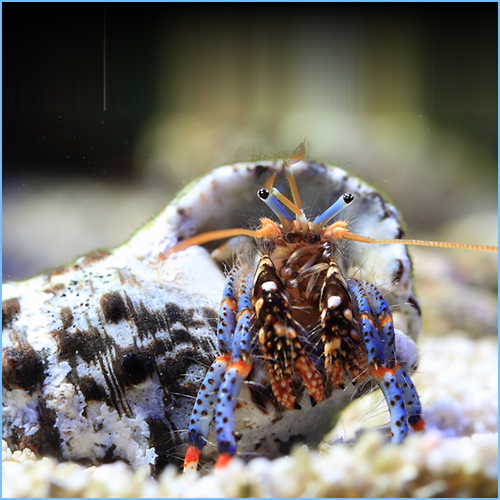
Blue Leg Hermit Crab (Clibanarius tricolor)
