


- Sku: FW1-F6934
- Vendor: Squeaky's Aquatics
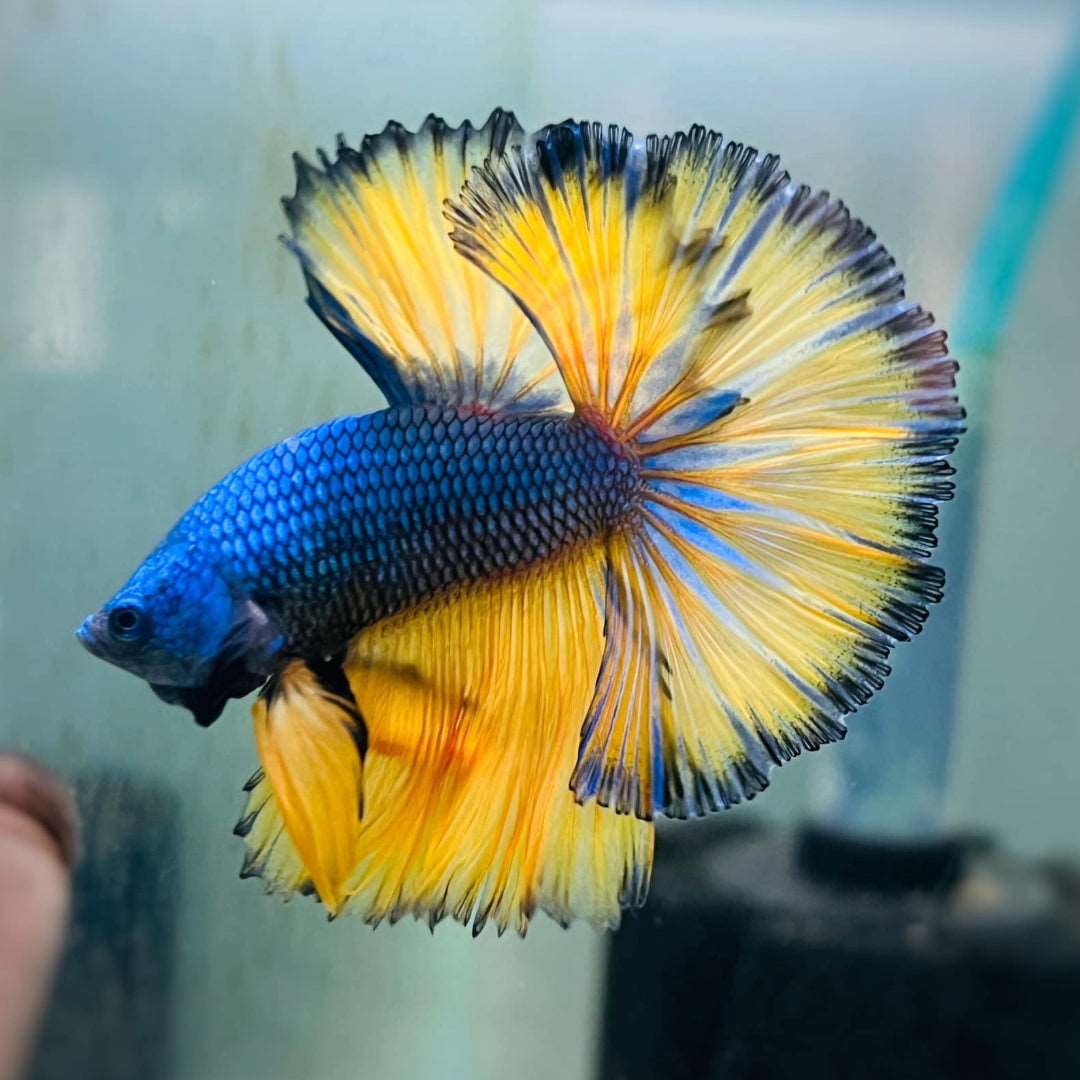
Mustard Gas Halfmoon Male Betta (Betta splendens)
The Mustard Gas Halfmoon Male Betta (Betta splendens) is one of the great color combinations in the hobby: a deep royal blue body, scaled like chainmail, against fins that burn golden yellow with a dark outer edge. That hard split between body color and fin color is what makes a fish a Mustard Gas, and the sharper the line, the better the fish. Add the halfmoon tail, which opens to a full 180 degree half circle when he flares, and you get a centerpiece that does not need a single tank mate to hold your attention. Browse the rest of our freshwater livestock and supplies to set him up properly.
Care Guide
- Tank size: 5 gallons is the honest minimum and 10 gallons is better. More water means a more stable tank, and stability is what keeps long finned bettas healthy.
- Heat is not optional. These are tropical fish from Southeast Asia and they need 78 to 82°F year round. A room temperature tank leaves a betta sluggish, off its food, and prone to illness. A small submersible heater handles it.
- Keep the flow low. That gorgeous tail is a sail. Halfmoons tire out fighting current and can end up resting on the bottom in a tank with too strong a filter. Baffle the outflow or run a gentle sponge filter.
- Nothing sharp. Heavy finnage snags and tears on plastic plants and rough ornaments. Use silk plants like the ZooMed Betta Plant, live plants, or smooth wood such as Betta Mopani Wood. Torn fins on a halfmoon take weeks to grow back.
- Feeding: carnivore, not a flake eater. A quality betta pellet like Hikari Betta Bio-Gold or Xtreme Betta Floating Pellets is the staple, with freeze dried bloodworms as a treat a couple of times a week. Two or three pellets twice a day is plenty, and overfeeding is the most common husbandry mistake.
- Surface access: bettas breathe air through a labyrinth organ and must be able to reach the surface. Never fill a tank to the brim under a sealed lid, and give him a leaf hammock near the top to rest on.
- Tannins help. A catappa leaf softens the water slightly, releases mild antibacterial tannins, and is genuinely good for fin condition.
- Lid required. Bettas jump, and a startled one will clear an open rim.
Specifications
| Scientific name | Betta splendens |
| Variety | Mustard Gas, halfmoon tail type, male |
| Family | Osphronemidae, the gouramis |
| Care level | Beginner |
| Temperament | Semi-aggressive. One male per tank, always |
| Max size | About 2.5 to 3 inches including finnage |
| Minimum tank | 5 gallons, heated and filtered |
| Temperature | 78 to 82°F |
| pH | 6.5 to 7.5 |
| Hardness | 3 to 15 dGH |
| Flow | Low. Long fins do not handle current well |
| Diet | Carnivore, betta pellets and frozen or freeze dried foods |
| Lifespan | 3 to 5 years in a proper setup |
| Origin | Selectively bred. Wild B. splendens comes from Thailand and neighboring Southeast Asia |
| Pickup | In-store pickup at Squeaky's Aquatics |
Tank Mates & Compatibility
Never two males. This is the one absolute rule. Two male bettas in the same tank will fight until one is dead, and there is no tank size or amount of decor that reliably prevents it. Males and females also should not be housed together outside of a supervised, temporary breeding setup, because the male will harass the female relentlessly once spawning is over.
Community options. In a 10 gallon or larger, a calm betta often does fine with bottom dwellers and inverts that stay out of his way: Skunk Corys, Black Kuhli Loaches, Otocinclus, nerite snails, and Amano Shrimp. Temperament varies by individual though, so have a backup plan before you add anything.
What to avoid. Fin nippers are the obvious problem, since a halfmoon tail is the most tempting target in the tank. Skip tiger barbs and similar. Also avoid anything long finned and colorful, like fancy guppies, which a betta may read as a rival male.
Other bettas we carry. If you want a different look, have a look at the Tricolor Halfmoon, Twintail Halfmoon, Halfmoon Butterfly, and Radium Rosetail. They all go in separate tanks.
Recommended Foods & Supplies
- Hikari Betta Bio-Gold or Xtreme Betta Floating Pellets, the daily staple
- SFBB Freeze-Dried Bloodworms as a treat
- Marina Submersible Heater
- Fritz Catappa Leaves for tannins and fin condition
- ZooMed Betta Bed Leaf Hammock and Betta Mopani Wood
- Seachem Betta Basics water conditioner
FAQ
What exactly makes it a Mustard Gas?
It is a bi-color pattern: a dark body, usually blue, steel, or green, paired with contrasting yellow or orange fins. The name comes from the sharp separation between the two. A good Mustard Gas has a clean line where the body color stops and the fin color starts, which is exactly what you see on this one.
Will his fins really open into a half circle?
When he flares, yes. Halfmoon refers to a caudal fin that spreads to a full 180 degrees, forming a clean D shape. He will not hold it constantly, so expect the full display when he sees his reflection, another fish, or you at feeding time.
Can he live in a bowl or a vase?
No, and this is worth being blunt about. Bettas survive in bowls because they breathe air, but they do not thrive. Unheated, unfiltered, and unstable water is what gives the species its short lifespan reputation. Five gallons with a heater is not a luxury setup, it is the baseline.
Why is he tearing at his own tail?
Tail biting turns up in heavily finned bettas and is usually linked to boredom, stress, or water quality. More enrichment, cleaner water, and a tannin source generally sort it out. It is not contagious and the fins do grow back.
Do I get the exact fish in the photo?
The photo is of one of our actual fish rather than a stock image, but every betta is individually patterned and we may have more than one of this variety in. Stop in and pick the one you like, and we will hold him for you.
Have a question?
Mustard Gas Halfmoon Male Betta (Betta splendens)
