


- Sku: FW1-F6934-2
- Vendor: Squeaky's Aquatics
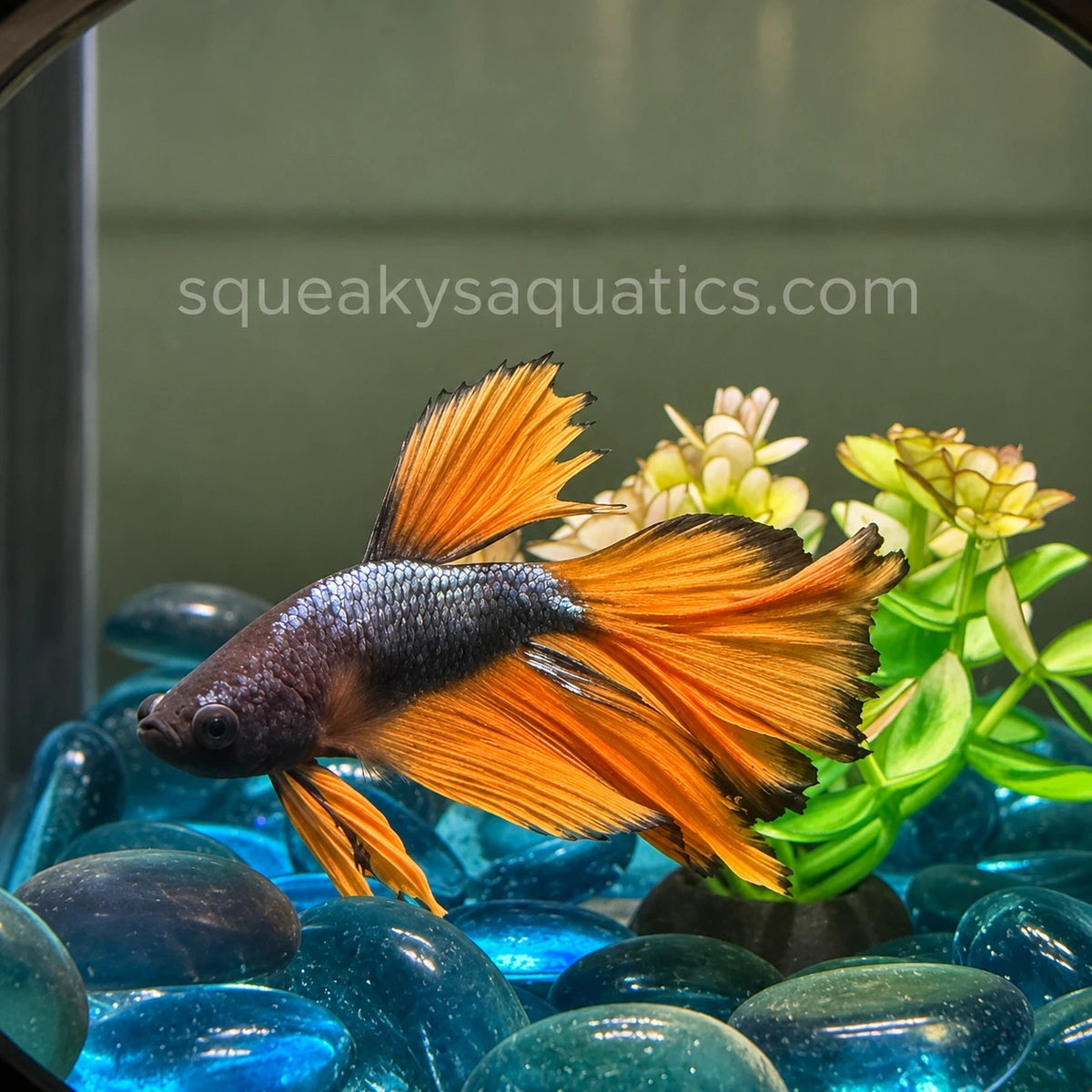
WYSIWYG Mustard Gas Halfmoon Male Betta (Betta splendens)
This Mustard Gas Halfmoon Male Betta (Betta splendens) has the classic Mustard Gas split: a dark charcoal head and a body covered in metallic steel-blue scales, then a clean change to warm mustard orange fins edged in black. "Mustard Gas" is the name breeders use for exactly that combination, a dark blue or black body with yellow to orange finnage. "Halfmoon" means his tail is bred to open into a wide fan when he flares, close to a half circle. Like most domestic bettas he is hardy, eats well, and is a good first fish for a keeper who gives him a heated, filtered tank. Browse the rest of our live freshwater fish and freshwater supplies to set his tank up right.
Why WYSIWYG Matters on a Mustard Gas Halfmoon
Two Mustard Gas bettas from the same spawn can look very different. How far the blue reaches into the fins, how much black edging there is, how bright the mustard reads, and how full the tail spreads all vary fish to fish, so a stock photo tells you very little. The photo on this listing is him in our store, as he looks right now. Color on a metallic betta shifts with lighting and viewing angle, usually deepens once he settles into a warm, stable tank, and can fade for a while after stress such as a move. Treat the photo as a true starting point, not a frozen guarantee.
Care Guide
- Tank size: 5 gallons minimum, 10 gallons is better. Cups and bowls are survival, not living; a heated, filtered, cycled tank is where a betta's color and personality really show.
- Temperature: 78 to 82°F, and a heater is not optional. Cold water makes a betta sluggish and open to disease, and a steady temperature matters more than hitting a perfect number.
- Gentle flow. Those big halfmoon fins act like a sail, so strong current wears him out. Baffle the filter outlet or use a sponge filter.
- Leave an air gap and use a lid. Bettas breathe air at the surface with their labyrinth organ, and they can jump.
- Water parameters: pH 6.5 to 7.5, soft to moderately hard. Do a partial water change every week with a betta-safe conditioner such as Seachem Betta Basics.
- Feeding: carnivore. Use a quality betta pellet like Hikari Betta Bio-Gold as the staple, with frozen or freeze-dried bloodworms two or three times a week. Feed small portions; overfeeding is the most common way bettas get bloated.
- Decor: give him resting spots near the surface, like a ZooMed Betta Floating Lounge, and skip anything with sharp edges. Halfmoon fins tear easily on rough plastic plants and decor.
- One male per tank. Non-negotiable. Two male bettas in the same water will fight until one of them is dead.
Specifications
| Scientific name | Betta splendens |
| This listing | WYSIWYG, one specific male, quantity of one |
| Variety | Mustard Gas, dark blue body with mustard orange fins |
| Fin type | Halfmoon, long finned |
| Sex | Male |
| Care level | Beginner |
| Temperament | Semi-aggressive, one male per tank |
| Max size | About 2.5 to 3 inches |
| Minimum tank | 5 gallons, 10 preferred |
| Temperature | 78 to 82°F |
| pH | 6.5 to 7.5 |
| Diet | Carnivore |
| Lifespan | 3 to 5 years with good care |
| Origin | Captive bred, domestic Betta splendens |
| Pickup | In-store pickup at Squeaky's Aquatics |
Compatibility
He can live in a community tank of 10 gallons or more if you pick the right neighbors: nothing that nips, nothing flashy enough to look like a rival, and nothing small enough to swallow. Small, calm fish that stay out of his way work best, such as a school of Ember Tetras or Kubotai Rasboras, Pygmy Corys on the bottom, or Otocinclus for algae. In a 5 gallon he is happiest alone, with a Racetrack Nerite Snail at most.
Avoid fin nippers like tiger barbs and serpae tetras, long-finned or brightly colored fish like fancy guppies, and gouramis, which are close relatives and often fight with bettas. Never add a second betta. Temperament varies a lot by individual, so watch the tank closely for the first week and have a backup plan if he turns out to be a bully.
Recommended Foods & Supplies
- Fluval Bug Bites Betta Formula or Hikari Betta Bio-Gold as the daily staple
- Frozen bloodworms or Fluval freeze-dried bloodworms as a treat
- Seachem Betta Basics or Fritz Betta Water for water changes
- Sicce Jolly 10W Pre-Set Heater for a 5 gallon, or the 20W for a 10 gallon
- ZooMed Betta Floating Lounge and a Hikari Dark Rock Cave for resting spots
- Fritz Catappa Leaves and ZooMed Mopani Wood for tannins and cover
FAQ
Is the photo really this fish?
Yes. That is him in our store, photographed as he is now. That is what WYSIWYG means. There is one of him, so when he sells the page comes down instead of being restocked with a different betta.
Will his color change?
Some, yes. Metallic bettas look different under different lights and from different angles, and most deepen in color once they settle into a warm, clean tank. Stress, cold water, or a move can dull him for a few days. A lasting fade usually points to water quality or temperature, so check those first.
Does he really need a heater and a filter?
Yes. Bettas are tropical fish and do best at 78 to 82°F, which most homes do not hold on their own. A gentle filter keeps waste from building up between water changes, which also protects those long fins from fin rot.
Why is he flaring at his reflection?
He sees another male and puts on a display. A little flaring is normal and even healthy exercise, but constant flaring is stressful. If he does it all day, lower the glare by adding a background, moving a lamp, or adding plants near the glass.
Can he live with another betta?
No. Two males will fight, often to the death, and even a female in the same tank outside a supervised breeding setup usually ends with torn fins. Keep him as the only betta in his tank.
Have a question?
WYSIWYG Mustard Gas Halfmoon Male Betta (Betta splendens)
