

- Sku: 1590097
- Vendor: Squeaky's Aquatics
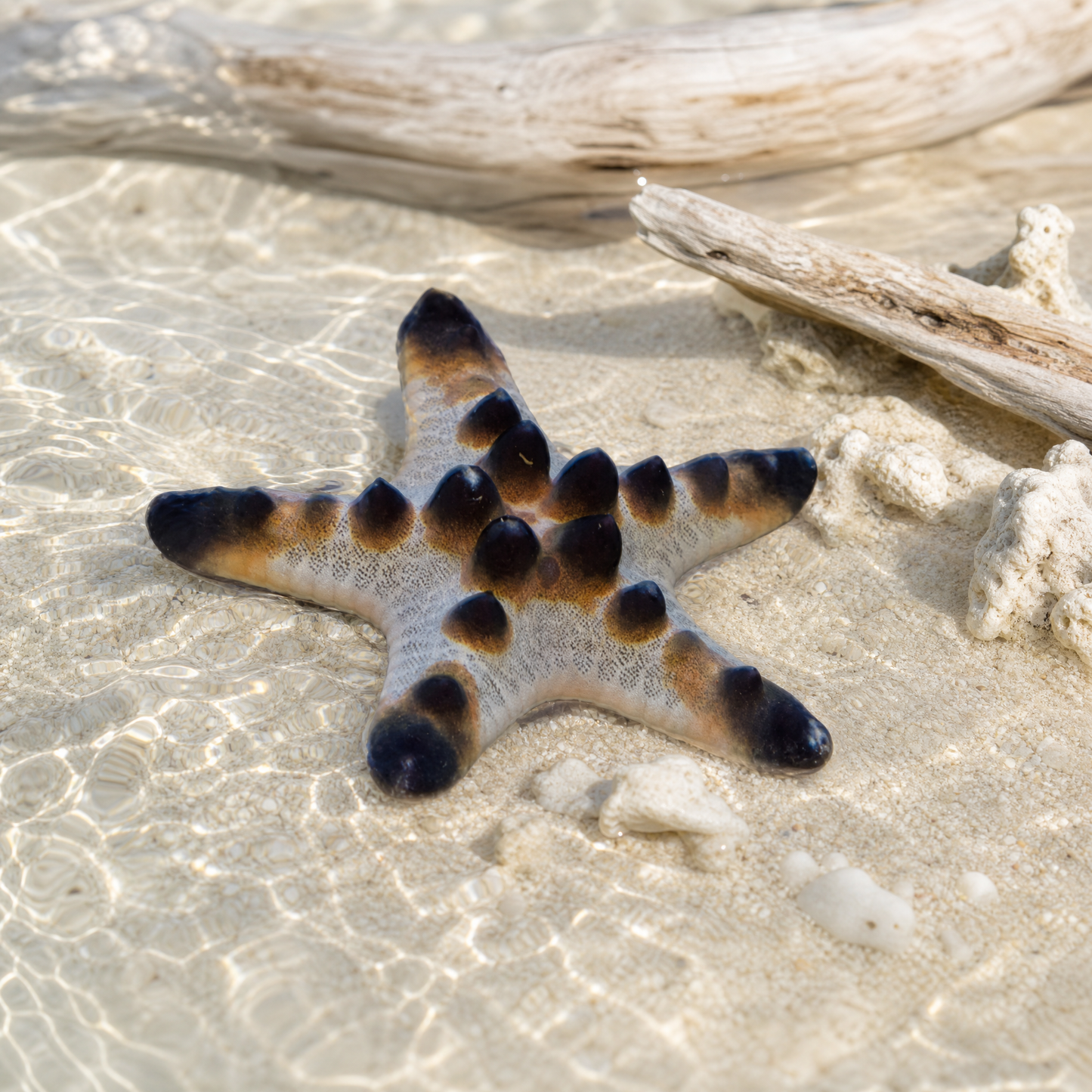
Chocolate Chip Starfish (Protoreaster nodosus)
The Chocolate Chip Starfish (Protoreaster nodosus) is one of the most recognizable animals in the hobby, a broad tan five-armed sea star studded with blunt dark brown spines that really do look like chocolate chips pressed into dough. It is hardy, active, always visibly doing something, and it makes a genuine centerpiece for a fish-only saltwater tank. It is also a predator, which is the part most people find out too late. Read the reef warning below before you buy. Browse the rest of our saltwater livestock and supplies to build around it.
Care Guide
- Drip acclimate slowly. This is not optional. Echinoderms have no way to buffer a sudden salinity change, and a fast acclimation is the single most common reason a healthy sea star dies in its first week. Drip over 60 to 90 minutes minimum, longer if you can. Ask us and we will walk you through it at pickup.
- Never expose it to air. Air pulled into the water vascular system can be fatal and does not always show for days. Move it submerged, in a bag or a cup of water, never lifted out with a net.
- No copper. Ever. Copper based medications and most anti-parasitic treatments kill invertebrates, and echinoderms are among the most sensitive of all. Never dose copper in a tank housing this animal, and be aware that copper lingers in rock and sand long after a treatment ends. Check with us before dosing anything.
- Tank size: 30 gallons is a workable starting point for the small specimens we stock, but plan honestly for the adult. These reach 10 to 15 inches across, and a full grown animal wants a mature 75 gallon or larger with real surface area to graze.
- Give it sand. A soft aragonite bed of a couple inches or more suits its natural lagoon habitat and lets it settle and forage properly. CaribSea Seaflor Special Grade is a good fit. Sharp crushed coral is not.
- Mature tank only. Sea stars need stable, established water and will not tolerate a cycling or newly set up system. Nitrates should be low and steady.
- Water parameters: 72 to 78°F, pH 8.1 to 8.4, salinity 1.023 to 1.025 specific gravity, dKH 8 to 12. Stability matters more than hitting an exact number, so a reliable salinity refractometer is worth owning.
- Feeding: a scavenging carnivore. It will find leftovers on its own, but do not rely on that. Target feed two or three times a week by placing a piece of meaty food directly under the animal, which everts its stomach over the food to digest it. Frozen clams on the half shell are the easiest option, along with chopped shrimp, mussel, mysis, or Formula One.
- It will climb the glass and the rockwork. That is normal behavior, not distress. Make sure rock is stacked stably, because a big sea star pushing through a loose aquascape can bring it down.
Specifications
| Scientific name | Protoreaster nodosus |
| Common names | Chocolate Chip Starfish, Chocolate Chip Sea Star, Horned Sea Star, Knobbed Sea Star |
| Family | Oreasteridae |
| Care level | Intermediate. Easy once settled, unforgiving during acclimation |
| Reef safe | No. Eats corals, clams, sponges, and tube worms |
| Temperament | Peaceful toward fish, predatory toward sessile invertebrates |
| Max size | 10 to 15 inches across |
| Minimum tank | 30 gallons to start, 75 gallons or more for an adult |
| Temperature | 72 to 78°F |
| pH | 8.1 to 8.4 |
| Salinity | 1.023 to 1.025 SG. Keep it stable |
| Alkalinity | 8 to 12 dKH |
| Diet | Carnivore and scavenger. Target feed meaty foods |
| Substrate | Soft sand, 2 inches or deeper |
| Copper | Lethal. Never dose copper in this tank |
| Lifespan | 5 to 7 years in a well kept tank |
| Origin | Indo-Pacific, in shallow sandy lagoons and seagrass beds |
| Pickup | In-store pickup at Squeaky's Aquatics |
Compatibility
Good with most fish. In a fish-only or FOWLR system it ignores tankmates entirely and they generally ignore it. It also coexists fine with other motile cleanup crew members such as Nassarius Snails, Mexican Turbo Snails, Mexican Red Leg Hermit Crabs, and a Pincushion Urchin, though very small snails may occasionally be caught.
What to avoid. Corals, clams, sponges, tube worms, and anemones are all food, so a reef tank is out. Harlequin shrimp are the reverse problem: they eat sea stars exclusively and will kill this animal arm by arm, so never house the two together. Large angelfish, triggers, and puffers will nip at its arms, and some pufferfish treat a sea star as a chew toy. Other sea stars are also on the menu.
Better cleanup crew choices for a reef tank. If what you actually want is a working cleanup crew, look at Emerald Crabs, Scarlet Skunk Cleaner Shrimp, Peppermint Shrimp, and snails. All of those are reef safe and none of them will eat your corals.
Recommended Foods & Supplies
- Frozen Clams on the Half Shell, the simplest way to target feed
- SFBB Mysis Shrimp or PE Mysis
- Ocean Nutrition Frozen Formula One
- Milwaukee MA887 Digital Refractometer for the salinity stability this animal needs
- Instant Ocean Reef Crystals and the rest of our salt mixes
- CaribSea Seaflor Special Grade Sand for a proper soft bed
- Test kits from our water testing shelf to keep nitrates in check
FAQ
Can I put one in my reef tank?
No. This is the question we get most and the answer does not have exceptions. It will eat soft corals, LPS, clams, sponges, and tube worms. Some people report getting away with it for a while, which usually just means the star was well fed and had not gotten hungry yet. Keep it in a fish-only or FOWLR system.
Why do the chocolate chips vary so much?
The spines differ from animal to animal in number, size, and how dark they are, and some individuals have chips running down the arms while others cluster them near the center. Body color ranges from cream to tan to grey. Every one is a little different, so what arrives will not be identical to the photo.
Mine is not moving. Is it dead?
Not necessarily. Sea stars park themselves for long stretches, especially after a meal or a move. Signs of real trouble are different: deflated or shrivelled arms, white patches, tissue that looks like it is dissolving, or a body that has gone limp and floppy. A healthy one is firm, and its tube feet still grip when you look closely.
One of its arms is damaged. Will it grow back?
Usually yes, given clean stable water and good feeding. Regeneration is slow, on the order of months, and the new arm often stays shorter and paler than the others. The bigger question is what damaged it, since a nipping tankmate will simply do it again.
How long is acclimation really?
Plan an hour and a half. Float to match temperature, then drip slowly until the volume in your container has at least doubled, and never dump store water into your tank. Rushing this is the most common way these animals are lost, and it is entirely preventable.
Have a question?
Chocolate Chip Starfish (Protoreaster nodosus)
